Weather Maps and Forecasting
Interactive passage with audio narration, comprehension questions, and printable PDF.
By completing this purchase you agree to our Terms of Use and Privacy Policy. Your subscription renews automatically until you cancel. You can cancel anytime from your account settings. All sales are final and non-refundable. Digital content is available for download in your account immediately upon purchase.
What's included
Weather Maps and Forecasting preview and details
About this printable Weather Maps and Forecasting science reading passage, NGSS-aligned (Grades 5-8)
Sample passage and quiz from Weather Maps and Forecasting
Reading passage and comprehension quiz preview
Weather Maps and Forecasting
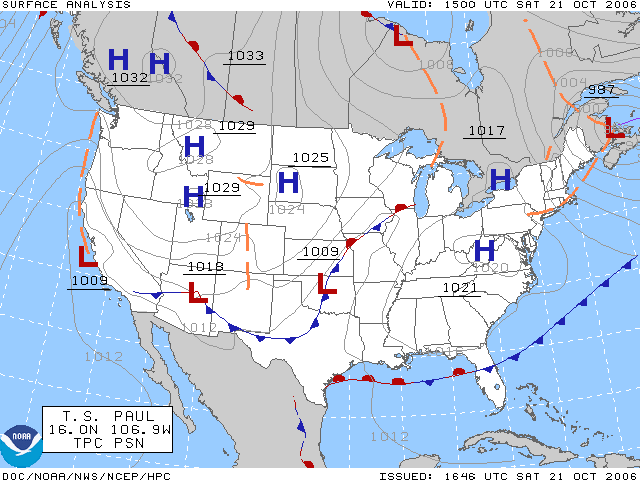
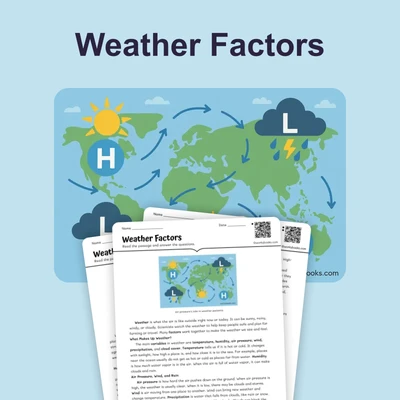
Areas marked with a large “H” indicate a high-pressure system, which usually brings clear skies and calm weather, while an “L” shows a low-pressure system. Wikimedia Commons
Weather maps are essential scientific tools that display current atmospheric conditions and help predict future weather. Meteorologists use these maps to interpret complex data and communicate information about temperature, precipitation, and wind. The ability to read and understand weather maps is crucial for making decisions about agriculture, transportation, and safety. These maps show patterns in the atmosphere that explain why certain weather events, like storms or clear skies, happen in specific places at specific times.
Understanding Weather Map Symbols and Station Models
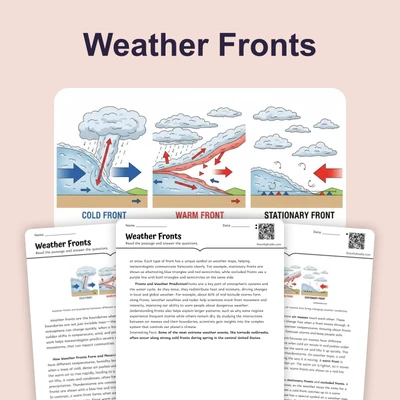
Weather maps use standardized symbols to represent atmospheric features. Areas marked with a large “H” indicate a high-pressure system, which usually brings clear skies and calm weather, while an “L” shows a low-pressure system, often linked to clouds and storms. Fronts are boundaries between air masses with different temperatures and humidity. A blue line with triangles shows a cold front, and a red line with semicircles represents a warm front. Isobars are lines connecting points of equal air pressure. When isobars are close together, it means strong winds. Station models use small diagrams to show information at a specific location, including temperature, pressure, wind direction and speed, cloud cover, and precipitation. By reading these elements, meteorologists can identify weather patterns and predict changes.
Interpreting Weather Data and Forecasting Methods
Meteorologists collect weather data using surface observations, upper-air balloons, satellites, and radar systems. This data feeds into numerical weather prediction models—computer simulations that use atmospheric equations to forecast weather. Forecasts are most accurate for the next 1-3 days and become less reliable as time increases, especially beyond seven days. Probability forecasts, like a 40% chance of rain, show the likelihood of precipitation based on historical and current data. Severe weather warnings are issued using real-time data and models. A watch means conditions are right for severe weather, while a warning means severe weather is happening or about to happen.
Real-World Applications and Scientific Principles
Weather forecasting is essential for public safety, agriculture, and transportation. For example, accurate hurricane predictions can save lives by providing early evacuation alerts. Farmers use forecasts to plan planting and harvesting, reducing crop losses from unexpected frosts or storms. These systems demonstrate how the atmosphere behaves as a complex, interacting system. Weather maps and forecasts reveal cause-and-effect relationships: a moving cold front can trigger thunderstorms, while a high-pressure system can bring extended dry weather. The science of weather forecasting connects to broader concepts in Earth science, such as energy transfer and the water cycle.
Understanding weather maps and forecasting methods empowers people to make informed decisions, from everyday choices like bringing an umbrella to preparing for dangerous storms. As technology improves, forecasting becomes more accurate, helping communities adapt to changing weather patterns and climate.
Interesting Fact: The world’s first televised weather forecast was broadcast in 1949, using hand-drawn maps and symbols—technology has advanced a lot since then!
Comprehension quiz (10 questions)
1. What does a high-pressure system usually bring?
2. Which symbol on a weather map represents a cold front?
3. What is the main purpose of isobars on a weather map?
4. What does a probability forecast of 40% chance of rain mean?
5. What happens to forecast accuracy as you predict farther into the future?
6. What should people do when a weather warning is issued?
7. What is the main function of station models on a weather map?
8. Which of the following is NOT a method used to collect weather data?
9. True or False: Low-pressure systems are usually linked to calm, clear weather.
10. True or False: Numerical weather prediction uses computers to simulate the atmosphere.
Perfect for the way you teach
- Build comprehension skills
- Auto-graded quiz
- Differentiated reading
- Read together at home
- Improve fluency
- Quiet reading time
- Reading curriculum support
- Independent practice
- Track Lexile growth