This learning resource is available in interactive and printable formats. The interactive worksheet can be played online and assigned to students. The Printable PDF version can be downloaded and printed for completion by hand.
This audio-integrated reading passage delves into the foundational concept of air pressure, aligning with the NGSS Disciplinary Core Idea of Physical Science (PS3.A: Definitions of Energy). The text explains how air pressure, the force exerted by the weight of air molecules, is a critical component of our physical world. It explores real-world applications of this principle, from how a straw works to the changes in pressure experienced at different altitudes. By defining key terms like "air molecules" and explaining the relationship between pressure and altitude, the passage provides a clear and accessible introduction to this scientific concept. It also touches on the connection between air pressure and weather systems, making the topic relevant and relatable. The passage incorporates keywords such as air pressure, atmospheric pressure, force of air, and molecules to enhance its SEO value and support students in grasping this fundamental physical concept. This resource is designed to support the understanding of how energy is stored in matter, specifically within the context of atmospheric dynamics.
CONTENT PREVIEW
Expand content preview
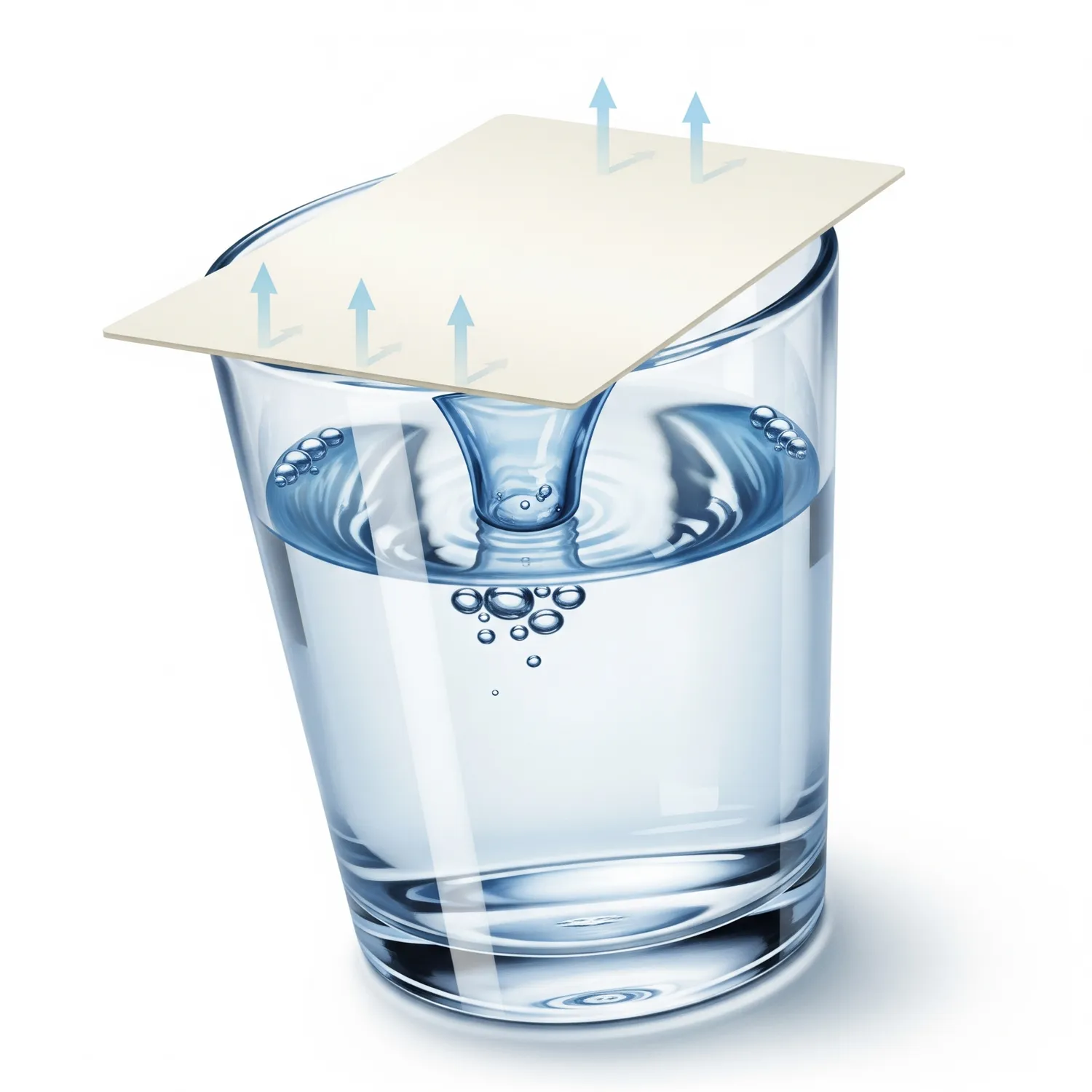
Air pressure can be demonstrated by a simple cup of water and a card.
What Is Air Pressure?
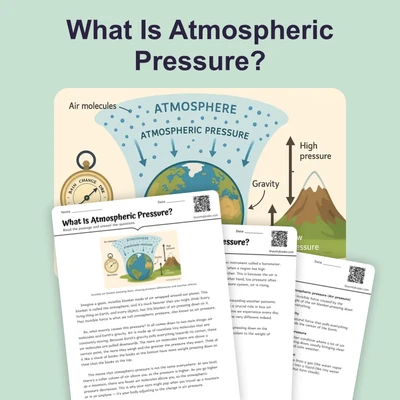
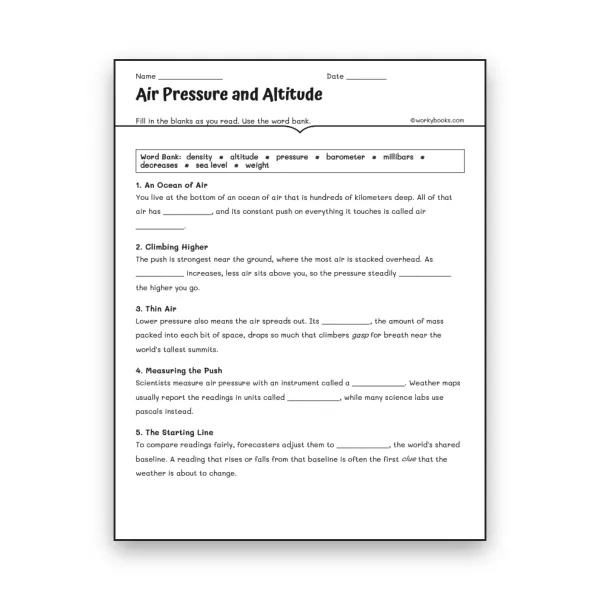
Air is all around us—even though we can’t see it. The air that fills our atmosphere is made of billions of tiny molecules. Each molecule is so small, we can’t see it with our eyes. But together, these air molecules have weight. The weight of all this air creates something called air pressure. Air pressure is the force of air pushing down and around us from every direction.
Even though air feels like nothing, it’s actually pressing on everything all the time. Imagine living at the bottom of an invisible ocean of air. That’s what it’s like! The air above you pushes down because of gravity, and all the air around you pushes in from the sides too. But we don’t feel crushed. This is because the air inside our bodies pushes back, so the pressure is balanced.
You might have noticed air pressure in your daily life. For example, when you ride in an airplane or drive up a mountain, your ears might pop. That’s because the air pressure gets lower as you go up higher—there is less air above you pressing down. When you drink through a straw, you suck air out of the straw, lowering the pressure inside. The higher outside air pressure then pushes your drink up into your mouth. Balloons stay inflated because the air inside pushes outward against the balloon, while air outside pushes in.
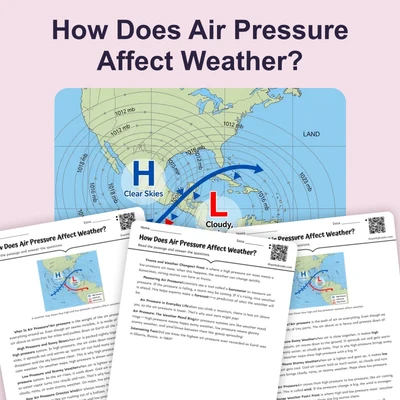
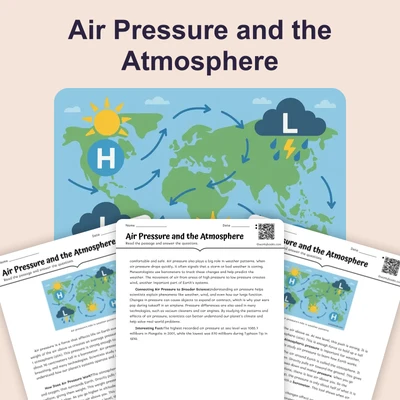
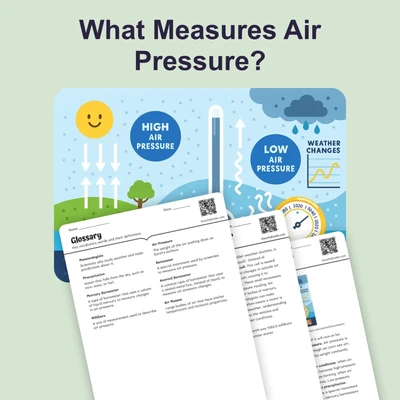
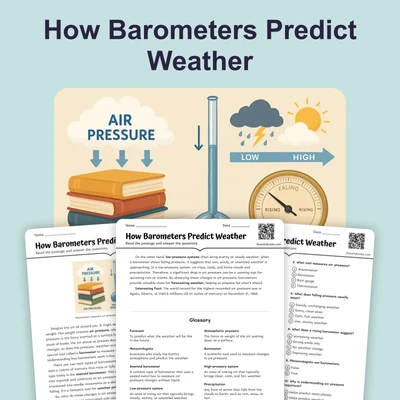
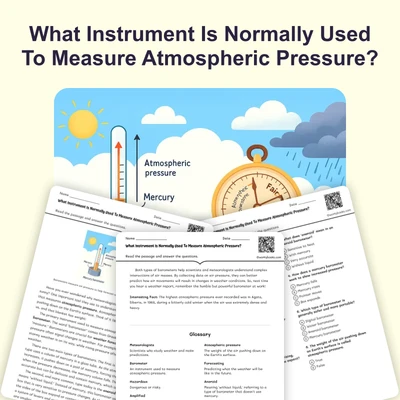
Air pressure is important for weather, too. A barometer is a tool that measures air pressure. If the air pressure is high, it usually means sunny and clear weather. If the air pressure is low, clouds and storms may be coming. That’s why weather scientists pay close attention to air pressure every day.
You can see air pressure in action with fun experiments. Try crushing a can by heating it with a little water inside, then quickly cooling it in ice water. The sudden drop in air pressure inside the can lets the stronger outside air pressure crush it! Suction cups also work because air pressure outside the cup holds it tight to the wall.
Interesting Fact: Mount Everest is so high that the air pressure at the top is only about a third as strong as at sea level!
What creates air pressure?
The weight of air moleculesSunshine and rainOnly strong windsGravity pulling water
What tool measures air pressure?
BarometerThermometerRulerCompass
Why do ears pop on mountains?
Air pressure changesRunning too fastIt's too coldSun is brighter
What happens when you suck on a straw?
Pressure inside straw lowersDrink freezesStraw fills with airCup gets smaller
What does high air pressure usually bring?
Sunny weatherHeavy rainSnowfallWind storms
Why don’t we feel crushed by air pressure?
Pressure is balancedAir is not realWe are very strongThere is no pressure
Air pressure pushes from all directions. True or false?
TrueFalse
What is the atmosphere?
Layer of air around EarthLayer of waterLayer of soilLayer of plants
Perfect For:
👩🏫 Teachers
• Reading comprehension practice
• Auto-graded assessments
• Literacy skill development
👨👩👧👦 Parents
• Reading practice at home
• Comprehension improvement
• Educational reading time
🏠 Homeschoolers
• Reading curriculum support
• Independent reading practice
• Progress monitoring
Reading Features:
📖
Reading Passage
Engaging fiction or nonfiction text
❓
Comprehension Quiz
Auto-graded questions
📊
Instant Feedback
Immediate results and scoring
📄
Printable Version
Download for offline reading
🔊
Read Aloud
Voice-over with word highlighting
Reviews & Ratings
No reviews yet. Be the first to share your experience!
Related Content
Tools and Technology in Earth Science
This middle school science reading passage explores the wide range of tools and technologies used in Earth science, from...
MS-ESS2-2MS-ESS3-2MS-ETS1-1MS-PS4-3
Scientific Inquiry in Earth Science
This passage explores scientific inquiry in Earth science for grades 6-8, aligned with NGSS standards MS-ESS1-4, MS-ESS2...
MS-ESS1-4MS-ESS2-1MS-ESS3-5SEP
What Is Earth Science?
This engaging middle school science passage introduces students to the field of Earth science, aligning with NGSS standa...
MS-ESS1MS-ESS2MS-ESS3SEP
Earth: Our Home in Space
This engaging Grade 4-5 science passage, aligned to NGSS, introduces students to Earth's special place in the solar syst...
Earth's Spheres
This middle school science passage introduces students to Earth's four major spheres: the geosphere, hydrosphere, atmosp...
MS-ESS2-4MS-ESS2-6
What Is Space Weather and How Does It Affect the Earth?
This NGSS-aligned science passage for middle school explains what space weather is and how it affects Earth. Students le...
MS-ESS2-2
Earth's Energy Balance
This engaging, NGSS-aligned science passage for grades 6–8 explores Earth's energy balance, a key process that keeps our...
MS-ESS2-6
Earth's Rotation
This middle school science passage, aligned with NGSS standard MS-ESS1-1, focuses on Earth's rotation—how Earth spins on...
MS-ESS1-1
Earth's Interior
This comprehensive passage for grades 6-8 explores Earth's layered interior, including the crust, mantle, outer core, an...
MS-ESS2-1MS-ESS2-2
Facts About Earth
This engaging science reading passage introduces Grade 4 and 5 students to Earth, our home planet. Aligned with NGSS sta...
Meteorite Impacts on Earth
This engaging science reading passage for Grades 4-5 explores meteorite impacts on Earth, aligning with NGSS standards. ...
Venus: Earth's Twin?
This comprehensive science passage for grades 6-8 examines Venus—often called Earth's twin—by exploring its similarities...
MS-ESS1-2MS-ESS1-3
Earth Changes Over Millions of Years
This engaging, audio-integrated science passage for Grade 4-5 students explores how Earth has changed over millions of y...
Earth's Moon Facts
This engaging science passage, 'The Moon: Earth's Companion,' is designed for Grade 4-5 students and aligns with NGSS ge...
Earth's Quick and Slow Changes
In 'Earth's Quick and Slow Changes,' students categorize 12 Earth events by their speed of occurrence, enhancing underst...
Earth: Our Home Planet
This comprehensive science passage for grades 6-8 explores Earth’s unique characteristics and the interconnected systems...
MS-ESS1-2
Earth's Revolution
This middle school science passage explores the science behind Earth's revolution around the Sun, closely aligned with N...
MS-ESS1-1
Earth's Seasons
This comprehensive reading passage for grades 6-8 explains why Earth has seasons, revealing the scientific mechanisms be...
MS-ESS1-1
Earth's Place in the Universe
This reading passage explains Earth's place in the universe, supporting NGSS 1-ESS1-1. It describes how Earth is one of ...
1-ESS1-1
Aphelion and Perihelion
This engaging reading passage, 'Aphelion and Perihelion,' delves into the fascinating aspects of Earth's elliptical orbi...
MS-ESS1-1: DEVELOP AND USE A MODEL OF THE EARTH-SUN-MOON SYSTEM TO DESCRIBE THE CYCLIC PATTERNS OF LUNAR PHASESECLIPSES OF THE SUN AND MOONAND SEASONS.