Why Are Anthropogenic Greenhouse Gases Important? — Reading Comprehension
Rate this
Premium Resource
Present
Present in classroom. No work saved
Assign
Classroom with student accounts, Track progress
Quick Play
No student accounts, assign with a link
Grades
3
4
5
6
7
8
PRINT+DIGITAL RESOURCE
This learning resource is available in interactive and printable formats. The interactive worksheet can be played online and assigned to students. The Printable PDF version can be downloaded and printed for completion by hand.
This NGSS-aligned reading passage explains the importance of anthropogenic greenhouse gases and their role in climate change. Students learn how human activities like burning fossil fuels and deforestation release gases such as carbon dioxide, methane, and nitrous oxide. These gases trap heat in the atmosphere, leading to global warming, melting ice, rising sea levels, and more extreme weather. The text connects science concepts to real-world problems and solutions like using renewable energy and reducing emissions. This middle school resource supports Earth and Human Activity standards and builds climate science understanding.
CONTENT PREVIEW
Expand content preview
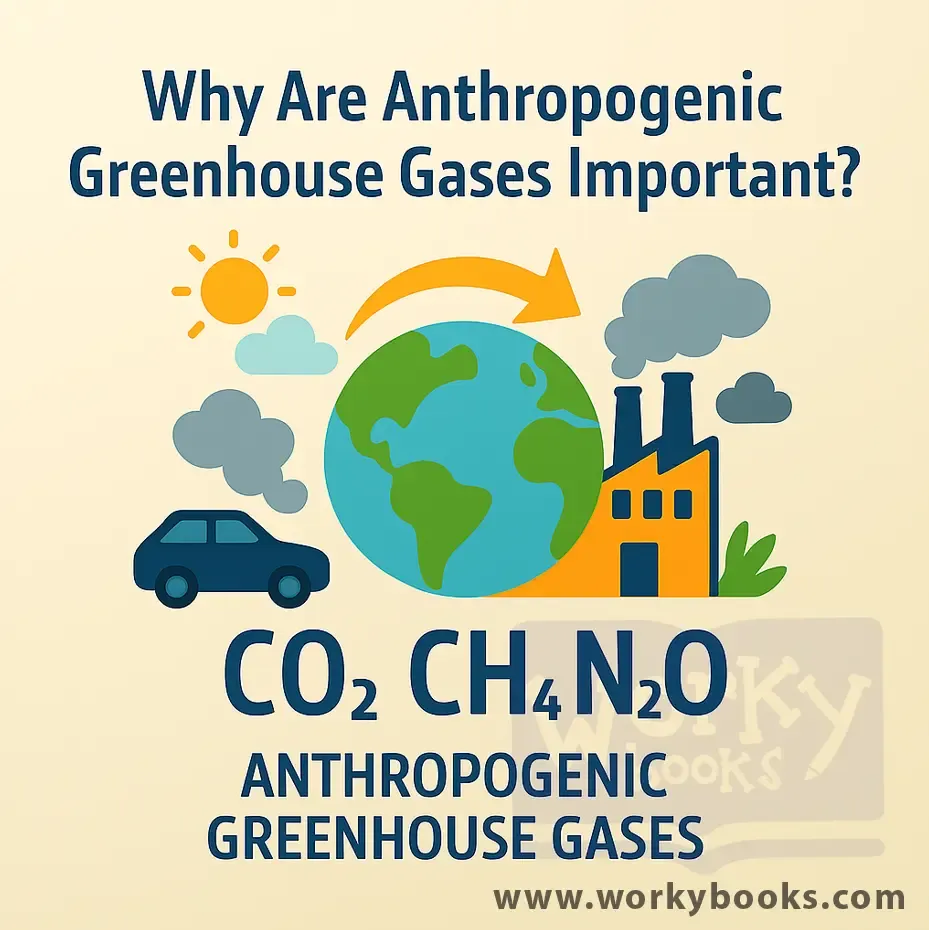
Greenhouse gases are gases in Earth’s atmosphere that trap heat and keep the planet warm enough for life. Some greenhouse gases, like water vapor and carbon dioxide (CO₂), occur naturally. But when humans add extra gases to the atmosphere, they are called anthropogenic greenhouse gases—meaning they come from human activities.
These gases are important because they play a major role in climate change. When we burn fossil fuels like coal, oil, and gas for energy, or cut down forests, we release large amounts of greenhouse gases into the air. The most common anthropogenic greenhouse gases are carbon dioxide (CO₂), methane (CH₄),
nitrous oxide (N₂O). These gases trap more heat in the atmosphere, making Earth’s average temperature rise—a process known as global warming.
Even small increases in these gases can have big effects. Higher temperatures can lead to melting glaciers, rising sea levels, and stronger storms. These changes affect people, animals, and ecosystems all over the world. For example, warmer oceans can cause more powerful hurricanes, while drier land may lead to longer droughts.
Understanding anthropogenic greenhouse gases helps scientists track and predict climate change. It also helps governments and communities make better decisions, like switching to renewable energy or protecting forests. By reducing the release of these gases, we can slow down global warming and protect life on Earth.
These gases are important not because they are good—but because they have a big impact on the planet’s climate. Managing them wisely is one of the most important challenges we face today.
Fun Fact: Methane traps over 25 times more heat than carbon dioxide over a 100-year period—making it a powerful greenhouse gas even though it is less common!
What does "anthropogenic" mean?
Caused by plantsCaused by the sunCaused by humansCaused by animals
Which of the following is an anthropogenic greenhouse gas?
OxygenMethaneWater vaporNitrogen
What is the main effect of greenhouse gases?
They cool the EarthThey trap heat in the atmosphereThey block sunlightThey remove pollution
How are anthropogenic greenhouse gases produced?
By rain and snowFrom growing treesThrough human activities like burning fossil fuelsBy oceans evaporating
What is one major result of increased greenhouse gases?
More forest growthStronger storms and sea level riseLess sunlight reaching EarthColder winters globally
Why is methane especially important to climate change?
It is very commonIt cools the airIt traps more heat than carbon dioxideIt helps plants grow
What is the main idea of this passage?
All gases are dangerousGreenhouse gases clean the airHuman-caused greenhouse gases are warming EarthThe ocean absorbs all gases
What might happen if we reduce greenhouse gas emissions?
Global warming slows downMore fossil fuels are burnedTemperatures rise fasterEarth becomes colder than ever
Perfect For:
👩🏫 Teachers
• Reading comprehension practice
• Auto-graded assessments
• Literacy skill development
👨👩👧👦 Parents
• Reading practice at home
• Comprehension improvement
• Educational reading time
🏠 Homeschoolers
• Reading curriculum support
• Independent reading practice
• Progress monitoring
Reading Features:
📖
Reading Passage
Engaging fiction or nonfiction text
❓
Comprehension Quiz
Auto-graded questions
📊
Instant Feedback
Immediate results and scoring
📄
Printable Version
Download for offline reading
🔊
Read Aloud
Voice-over with word highlighting
Reviews & Ratings
No reviews yet. Be the first to share your experience!
Related Content
What's The Main Idea?
These short science texts are a great way to practice main idea. Students will read the paragraphs and then choose the m...
RI.2.6
Comparing Weather and Climate Texts
This reading comprehension worksheet has 5th graders read two informational texts about Weather and Climate. Students th...
RI.5.9
Reading for Main Details—Birds
This informational text on birds is a great way to practice main idea. Students will read the passage, then give the mai...
RI.2.6RI.2.8
Koi Fish—What’s the Main Idea?
This informational text on koi fish is a great introduction to teaching main idea. Students will be asked, in multiple c...
RI.3.2RF.3.4RI.3.1
What Is Earth Science?
This engaging middle school science passage introduces students to the field of Earth science, aligning with NGSS standa...
MS-ESS1MS-ESS2MS-ESS3SEP
Spider—Main Idea
This informational text on spiders is a great introduction to teaching main idea. Students will be asked, in multiple ch...
RI.3.2RF.3.4RI.3.1RI.2.6
Reading for Main Details—Beavers Teeth
This informational text on beavers is a great way to practice main idea. Students will read the passage, then give the m...
RI.2.6RI.2.10
Reading for Main Details—Veternarians
Practie summarizing paragraphs with this fun informational text on veternarians! Students will give the main idea of eac...
RI.2.2RI.2.10
Understanding Anthropogenic Climate Change
This NGSS-aligned science passage explains anthropogenic climate change in a way that’s accessible for middle school stu...
Main Idea and Supporting Details in Informational Text
RI.3.1RI.3.2RI.3.8
Tools and Technology in Earth Science
This middle school science reading passage explores the wide range of tools and technologies used in Earth science, from...
MS-ESS2-2MS-ESS3-2MS-ETS1-1MS-PS4-3
Interpreting visual information on Layers of the Earth
This informational text on the layers of the earth is a great way to practice using images during reading. Students will...
RI.1.7RI.10RF.1.4.ARF.1.4
Informational Text — Astronauts
Practice this second grade context clues worksheet with this informational text on astronauts. Students will read the te...
RI.2.4RI.2.10RI.3.4RI.3.10
Penguins— Main Purpose
This informational text on penguins with comprehension questions is a great way to practice reading fluency and main ide...
RI.1.2RI.1.10RF.1.4.ARF.1.4.B
Transportation and Climate Change
This engaging science passage for grades 6-8 explores the vital role that transportation plays in climate change. Studen...
Informational Text —Learn About Dinosaurs
This informational text on dinosaurs with comprehension questions to follow is perfect for teaching main idea. Students ...
RF.3.4RF.3.4.ARF.3.4.CRI.3.2
Informational Text — Habitats
This short informational text on habitats will teach your students what a habitat is, as well as provide some examples o...
RF.3.4.A
Climate Change: Causes
This comprehensive middle school science passage explores the causes of climate change by examining both natural and hum...
MS-ESS3-5MS-LS2-4
Climate Change: Solutions and Mitigation
This passage explores scientific solutions and mitigation strategies for climate change, designed for middle school scie...
MS-ESS3-4MS-ESS3-5
Informational Text —Elephants Facts
This informational text on elephants with comprehension questions to follow is perfect for teaching main idea. Students ...