This learning resource is available in interactive and printable formats. The interactive worksheet can be played online and assigned to students. The Printable PDF version can be downloaded and printed for completion by hand.
This comprehensive middle school science passage explores the causes of climate change by examining both natural and human-driven factors. Aligned with NGSS standards MS-ESS3-5 and MS-LS2-4, the text details the mechanisms of the greenhouse effect, the role of greenhouse gases like CO₂ and methane, and how activities such as burning fossil fuels, deforestation, and agriculture contribute to atmospheric changes. Students will learn about the scientific evidence that links increased greenhouse gas concentrations and global temperature rise to human actions, as well as the difference between natural and anthropogenic factors. The passage is accompanied by glossary terms, multiple-choice questions, writing prompts, Spanish translations, and graphic organizers. Audio integration is available for accessibility. This resource is designed to build scientific literacy, analytical thinking, and understanding of core earth science concepts for grades 6–8.
CONTENT PREVIEW
Expand content preview
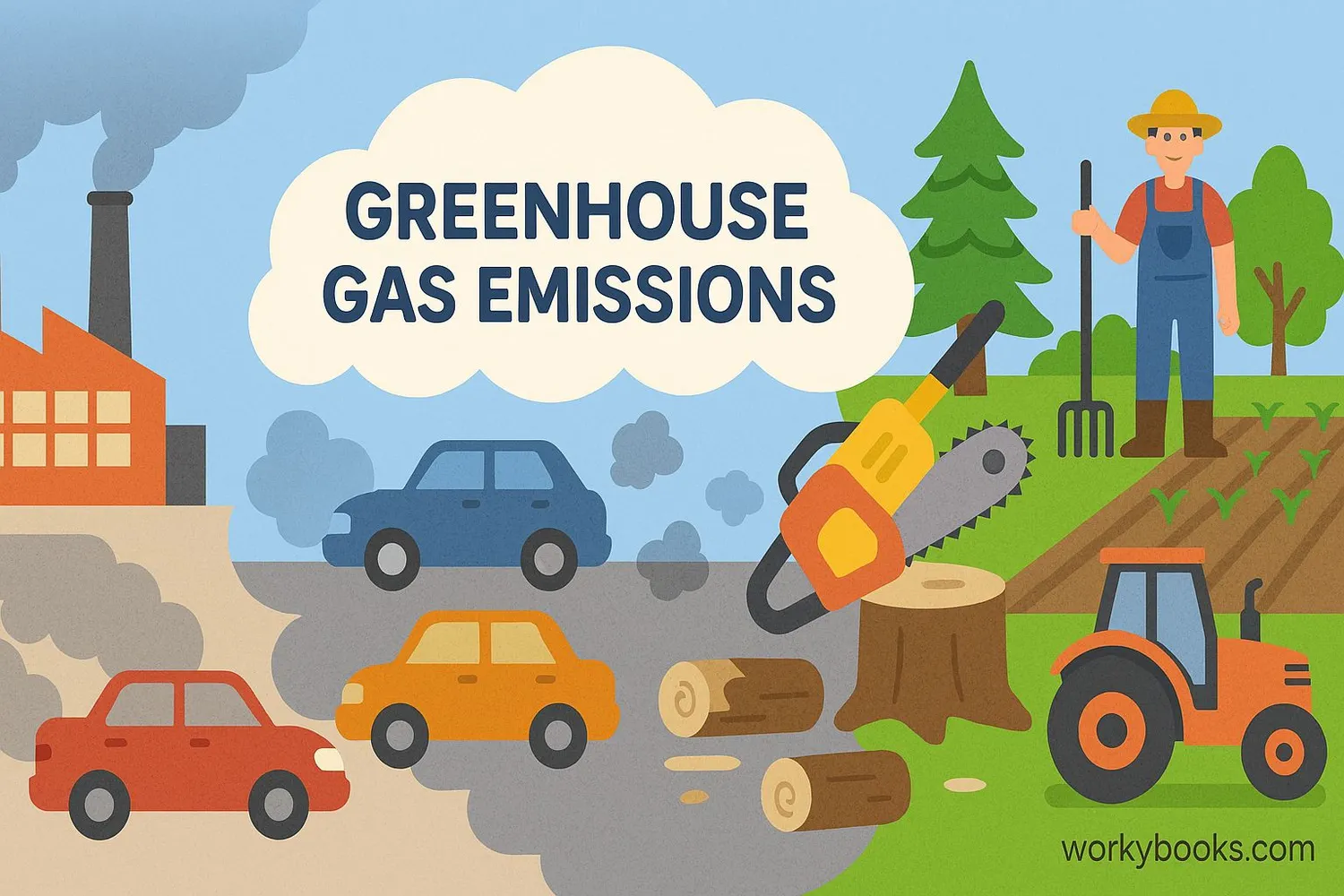
Examples of human activities that contribute to greenhouse gas emissions
Climate change is one of the most urgent scientific and environmental challenges facing our planet today. Over the past century, average global temperatures have risen significantly, leading to melting ice caps, rising sea levels, and shifting weather patterns. Scientists are working to understand why Earth's climate is changing so rapidly and what is causing these changes. To answer this question, we need to examine both natural processes and human activities that influence our atmosphere.
How the Greenhouse Effect Works The greenhouse effect is a natural process that keeps Earth's surface warm enough to support life. When energy from the Sun reaches Earth, some of it is absorbed by the surface and some is reflected back toward space. Greenhouse gases in the atmosphere, such as carbon dioxide (CO₂), methane (CH₄), nitrous oxide (N₂O), and water vapor, trap some of this heat, preventing it from escaping into space. Without the greenhouse effect, Earth's average temperature would be about -18°C (0°F), making it too cold for most life forms. However, when the concentration of greenhouse gases increases, more heat is trapped, leading to higher global temperatures.
Human Activities and Greenhouse Gas Emissions While the greenhouse effect is natural, human activities are dramatically increasing the amount of greenhouse gases in our atmosphere. Burning fossil fuels like coal, oil, and natural gas for energy releases large quantities of CO₂. Deforestation, or cutting down forests, also contributes by releasing stored carbon and reducing the number of trees that absorb CO₂ from the air. Agriculture adds methane from livestock and nitrous oxide from fertilizers. Industrial processes, such as cement production, release additional greenhouse gases. Since the start of the Industrial Revolution around 1750, the level of atmospheric CO₂ has increased by more than 45%.
Scientific Evidence and Natural vs. Human Causes Scientists use many kinds of evidence to determine the causes of climate change. For example, ice core samples show that current CO₂ levels are higher than at any time in the past 800,000 years. Global temperature records reveal a strong correlation between rising temperatures and increased greenhouse gas emissions since the late 1800s. The chemical makeup, or isotopic signature, of atmospheric carbon also matches that of fossil fuels, proving that much of the CO₂ comes from human sources. Although natural factors like solar cycles and volcanic eruptions can affect climate, they cannot explain the speed and scale of recent warming. Over 97% of climate scientists agree that human activities are the main cause of current climate change.
Understanding the science behind climate change is essential for making informed decisions about energy, transportation, and the future of our planet. By reducing greenhouse gas emissions, protecting forests, and using cleaner energy sources, society can help slow the rate of warming and reduce the impacts on ecosystems and people worldwide.
Interesting Fact: Earth’s atmosphere now contains over 420 parts per million (ppm) of carbon dioxide, the highest level measured in more than 800,000 years!
What is the greenhouse effect?
A natural process that traps heat in Earth’s atmosphere.A way plants make food using sunlight.A type of pollution caused by cars.A process that cools the planet.
Which of the following is NOT a greenhouse gas mentioned in the passage?
What human activity is responsible for releasing large amounts of carbon dioxide into the atmosphere?
Burning fossil fuelsPlanting treesUsing solar panelsFishing in the ocean
Why does deforestation increase the amount of carbon dioxide in the air?
It releases stored carbon and removes trees that absorb CO₂.It adds more oxygen to the air.It creates new habitats for animals.It stops methane from entering the atmosphere.
What does the term 'isotopic signature' mean in the context of the passage?
A unique chemical fingerprint that shows the source of carbon.A type of gas in the atmosphere.A weather pattern caused by climate change.A process used by plants to grow.
What inference can you make about the role of agriculture in climate change?
Agriculture increases greenhouse gases through methane and nitrous oxide emissions.Agriculture does not affect the climate.All farms help remove carbon dioxide from the air.Agriculture only affects local weather, not global climate.
What is the main reason scientists are confident that humans are causing current climate change?
Evidence shows CO₂ levels and temperatures have risen together since industrialization, and the carbon matches fossil fuel sources.The Earth has always changed its climate naturally.Only a few scientists agree about climate change.There are more volcanoes now than in the past.
If the greenhouse effect did not exist, what would happen to Earth's average temperature?
It would be much colder, around -18°C (0°F).It would be much hotter.It would stay the same.It would rain all the time.
True or False: Over 97% of climate scientists agree that humans are causing current climate change.
TrueFalse
True or False: Solar cycles and volcanic eruptions can fully explain the rapid warming seen today.
FalseTrue
Perfect For:
👩🏫 Teachers
• Reading comprehension practice
• Auto-graded assessments
• Literacy skill development
👨👩👧👦 Parents
• Reading practice at home
• Comprehension improvement
• Educational reading time
🏠 Homeschoolers
• Reading curriculum support
• Independent reading practice
• Progress monitoring
Reading Features:
📖
Reading Passage
Engaging fiction or nonfiction text
❓
Comprehension Quiz
Auto-graded questions
📊
Instant Feedback
Immediate results and scoring
📄
Printable Version
Download for offline reading
🔊
Read Aloud
Voice-over with word highlighting
Reviews & Ratings
No reviews yet. Be the first to share your experience!
Related Content
Natural Disaster: Hurricanes
Hurricanes are massive storms with strong winds and rain. Tracking and preparing for them helps protect people in their ...
RI.3.1RI.4.4RI.4.2RI.5.2
Why Are Pollinators Important?
This passage explores the critical ecological role of pollinators in maintaining ecosystem stability and supporting huma...
MS-LS2-4RI.6.3RI.7.3RI.8.8
What Would Happen If Bees Went Extinct?
This passage examines the potential consequences of bee extinction, perfectly aligned with NGSS standard MS-LS2-4 on eco...
MS-LS2-4RI.6.3RI.7.3RI.8.8
Why Are Honeybees Important?
This passage explores the essential ecological and agricultural roles of honeybees, supporting NGSS standard MS-LS2-4 on...
MS-LS2-4RI.6.3RI.7.3RI.8.8
How Can We Help Pollinators and Stop Their Decline?
Pollinators including bees (Apis mellifera), butterflies (Lepidoptera), birds, and bats face severe threats with 40% of ...
MS-LS2-4RI.7.3RI.8.8RI.8.3
Wolves of Yellowstone
This passage explores the ecological concept of trophic cascades through the landmark case study of wolf reintroduction ...
MS-LS2-4RI.6.3RI.7.3RI.8.8
Barreleye Fish: The Deep-Sea Telescope
This science passage explores the barreleye fish's extraordinary adaptations aligned with NGSS standard MS-LS2-4 (Ecosys...
MS-LS2-4RI.6.3RI.7.3RI.8.8
Arctic Fox Facts: What Do Arctic Foxes Eat?
This passage explores the Arctic fox's dietary adaptations aligned with NGSS standard MS-LS2-4 (Ecosystem Interactions)....
MS-LS2-4RI.6.3RI.7.3RI.8.8
Arctic Fox: Remarkable Color-Changing Adaptation
This NGSS-aligned passage (MS-LS4-4) examines the Arctic fox's remarkable seasonal color change from winter white to su...
MS-LS2-4RI.6.3RI.7.3RI.8.8
How Climate Change Affects Animal Migration
This NGSS-aligned science reading passage explains how climate change affects animal migration by altering seasonal cues...
MS-LS2-6MS-ESS3-5
What Is Global Warming?
This NGSS-aligned reading passage explains global warming, the greenhouse effect, and how human activities like burning ...
MS-ESS3-5
What Causes Global Warming?
This NGSS-aligned reading passage explains what causes global warming, focusing on how human activities like burning fos...
MS-ESS3-5
How to Stop Global Warming
This NGSS-aligned reading passage helps students understand how to stop global warming by reducing greenhouse gases. It ...
MS-ESS3-5
Human Impacts: Invasive Species
This passage explores the science behind invasive species—non-native organisms that harm native ecosystems. Aligned to N...
MS-LS2-4MS-LS2-5
Human Impacts: Pollution
This middle school science reading passage, aligned with NGSS standards MS-LS2-4 and MS-ESS3-3, examines the mechanisms ...
MS-LS2-4MS-ESS3-3
Human Impacts: Climate Change
This standards-aligned science reading passage for grades 6-8 explains the mechanisms and effects of human-driven climat...
MS-LS2-4MS-ESS3-5
Human Impacts: Habitat Destruction
This grade 6-8 science passage explores human impacts on ecosystems, focusing on habitat destruction as the leading caus...
MS-LS2-4MS-LS2-5MS-ESS3-3
Human Impacts: Overexploitation
This middle school science passage aligns with NGSS standards MS-LS2-4 and MS-LS2-5, focusing on human impacts through o...
MS-LS2-4MS-LS2-5
Environmental Problems and Solutions
This passage for grades 6-8 introduces major environmental problems such as habitat loss, pollution, climate change, inv...
MS-LS2-4MS-ESS3-3MS-ESS3-4
Climate Change: Vulnerable Ecosystems
This middle school science passage, aligned with NGSS standards MS-ESS3-5 and MS-LS2-4, helps students understand how cl...