
Passage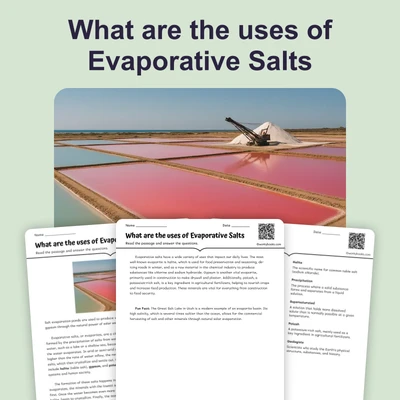
Grades 3–8
What are the uses of Evaporative Salts
Reading Passage
$1.50

Explore our collection of Chemical Reactions curriculum resources for grades K-8. From simple changes in matter to balancing equations, these worksheets, games, readers, and activities help students build understanding at every level. Find printable and digital materials for your classroom.
Reading Passage
Reading Passage
Reading Passage
Reading Passage
Reading Passage
Reading Passage · 5-PS1-4
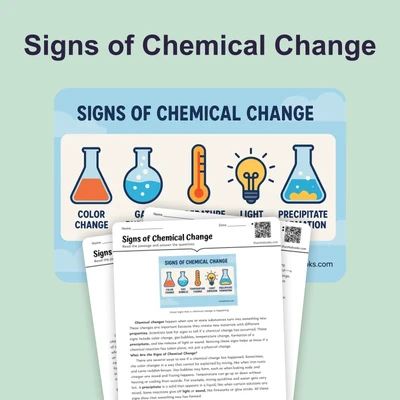
Reading Passage · MS-PS1-2
Three ways to use Workybooks — pick what fits.
Chemical Reactions are introduced in the earliest grades as students observe changes in matter, such as mixing baking soda and vinegar or rusting nails. In grades K-2, learners explore reversible and irreversible changes through hands-on activities and simple reading passages. By grades 3-5, they begin to identify reactants and products, understand conservation of mass, and conduct controlled experiments with guided worksheets and graphic organizers. In middle school (grades 6-8), students model chemical equations, explore reaction types (synthesis, decomposition, combustion), and apply concepts like catalysts and rates of reaction.
These scaffolded resources cover related concepts including states of matter, physical vs. chemical changes, atoms and molecules, and energy in reactions. Teacher-authored and standards-aligned, the materials include no-prep worksheets, interactive digital games, leveled readers, and hands-on lab activities. Whether you need independent practice, small group work, or whole-class instruction, this hub provides differentiated options to meet students where they are.
Use this hub to find the right level for your class, then differentiate across a mixed-ability room by selecting resources at different complexity levels. For whole-group instruction, project a digital game or use a shared reading passage. In small groups or literacy centers, students can work on printable worksheets or complete a hands-on activity. Assign independent practice or homework using digital or printable options. Use the graphic organizers and review sheets for intervention or assessment. The mix of printable and digital resources allows you to adapt to any setting, from one-to-one devices to traditional classrooms.
These resources align with grade-level Common Core State Standards for literacy and math as well as Next Generation Science Standards (NGSS) for physical science, covering topics from properties of matter to chemical reactions across grades K-8.
Yes, many of our Chemical Reactions worksheets are printable and ready to use. You can download and print them for classroom or home use. Some resources are also available in digital format for online learning. A membership is required to access all resources, though some are free.
Absolutely. Our Chemical Reactions worksheets for kids are designed for grades K-8, with age-appropriate content and activities. Younger students explore basic changes in matter, while older students dive into balancing equations and reaction types. All materials are teacher-authored and classroom-tested.
A Workybooks membership gives you full access to all worksheets, games, readers, and activities. Some resources are free, but most require a paid membership. Members can print and assign digital versions as needed.
Our hub offers resources across K-8, so you can select materials that match each student's level. For example, use simple picture-based activities for K-2 and more complex equation worksheets for grades 6-8. The scaffolded design allows you to adjust difficulty within the same topic.