Signs of Chemical Change
Interactive passage with audio narration, comprehension questions, and printable PDF.
By completing this purchase you agree to our Terms of Use and Privacy Policy. Your subscription renews automatically until you cancel. You can cancel anytime from your account settings. All sales are final and non-refundable. Digital content is available for download in your account immediately upon purchase.
What's included
Signs of Chemical Change preview and details
About this printable Signs of Chemical Change science reading passage, NGSS-aligned (Grades 5-8)
Sample passage and quiz from Signs of Chemical Change
Reading passage and comprehension quiz preview
Signs of Chemical Change
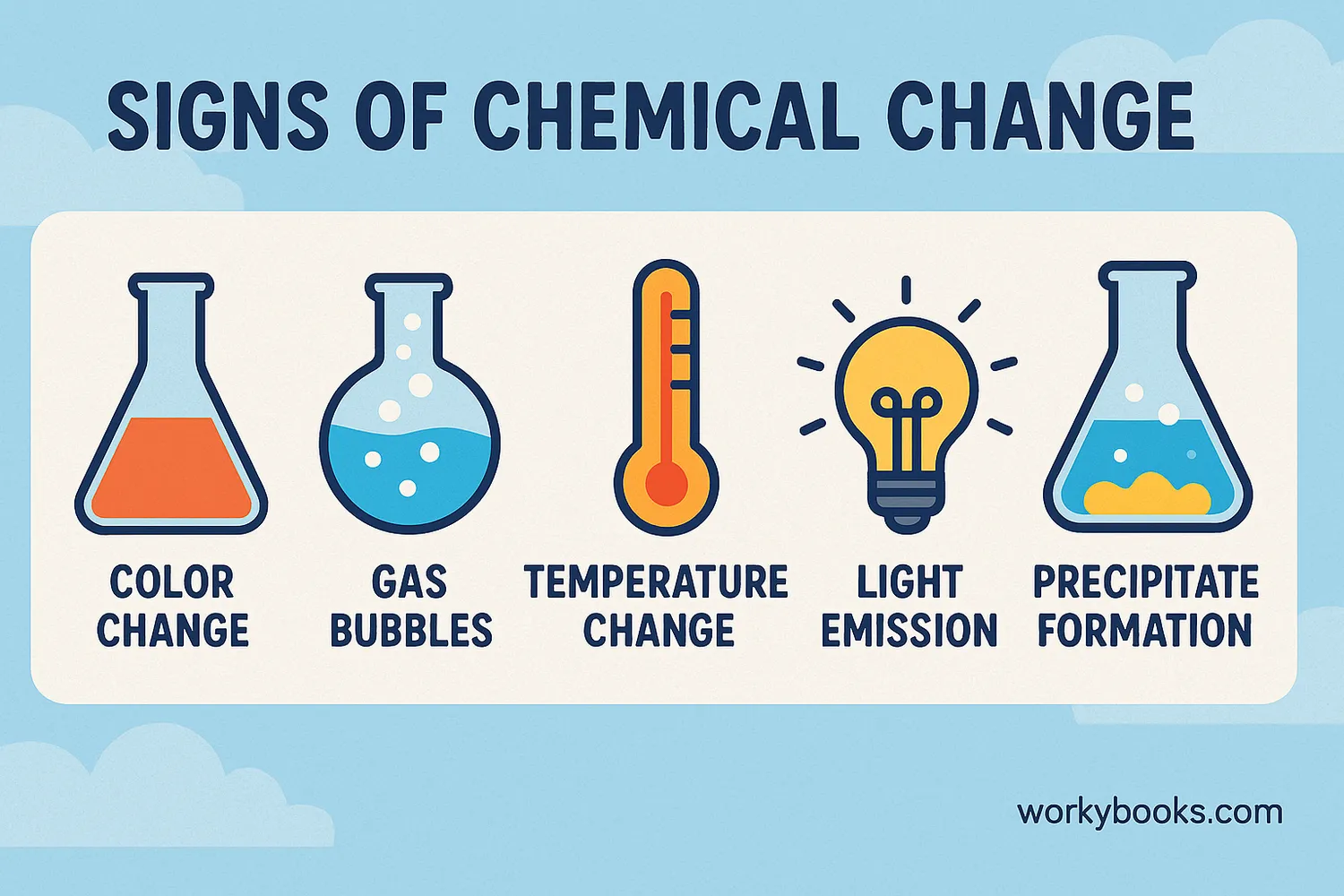
Chemical changes are critical events in science and daily life. When a chemical change happens, completely new substances are formed through the rearrangement of atoms. Identifying chemical changes is important because it helps us recognize when materials are fundamentally altered, rather than just changing in appearance or state. Scientists rely on several observable indicators to determine if a chemical reaction has occurred, such as color change, gas production, temperature shift, formation of a precipitate, and the release of light or sound. Understanding these signs is essential for distinguishing chemical changes from physical ones, which do not create new substances.
Observable Indicators of Chemical Change
Chemical reactions often produce visible or measurable effects. One key sign is a color change that cannot be explained by mixing colors, like when iron rusts from gray to reddish-brown due to the formation of new iron oxide compounds. The formation of gas bubbles is another indicator, as seen when baking soda reacts with vinegar to release carbon dioxide. Temperature changes, without adding or removing heat from outside, signal that energy is being absorbed or released during bond-making or breaking. For example, mixing quicklime and water produces enough heat to boil the mixture. A precipitate is a solid that forms and settles out of a liquid mixture, such as when mixing Epsom salt and baking soda solutions. Sometimes, chemical reactions release light or sound, like in fireworks or glow sticks. Each of these signs points to new substances being created, a hallmark of chemical change.
Distinguishing Chemical from Physical Changes
Not all observable changes indicate a chemical reaction. For example, boiling water produces bubbles, but these are just water vapor forming inside the liquid—a physical change, not a chemical one. The key difference is that in a chemical change, the material’s internal structure is altered, forming new substances with different properties. Physical changes, such as melting, dissolving, or freezing, may look dramatic but do not create new materials. Scientists use multiple signs together, along with evidence of new substance formation, to confirm a chemical change. For instance, burning wood creates ash, gas, and heat, clearly showing the transformation of matter.
Applications and Broader Implications
Understanding chemical changes has wide-reaching applications in medicine, environmental science, and industry. For example, detecting chemical changes helps doctors understand how medicines interact in the body or how pollution affects water quality. Engineers use controlled chemical reactions in manufacturing, while environmental scientists monitor chemical changes to track ecosystem health. Recognizing false positives—like bubbles from boiling—prevents mistakes in experiments and real-world decisions. Mastering the signs of chemical change supports safe laboratory work and advances scientific discovery.
In summary, chemical changes are revealed by specific indicators including color change, gas formation, temperature shifts, precipitate, and light or sound. Careful observation and understanding of these signs allow us to distinguish between physical and chemical processes, deepening our insight into the material world.
Interesting Fact:
Fireflies produce light through a chemical reaction called bioluminescence, which is a natural example of chemical change leading to visible light!
Comprehension quiz (10 questions)
1. What is a key difference between a chemical change and a physical change?
2. Which of the following is NOT a sign of chemical change mentioned in the passage?
3. What is a precipitate?
4. In the passage, which reaction is given as an example of gas bubbles being formed?
5. What does the word 'properties' mean in this passage?
6. What does 'light' refer to in the context of a chemical change?
7. Why is boiling water NOT considered a chemical change?
8. If you see a color change and a temperature increase in a reaction, what should you do to be sure it's a chemical change?
9. True or False: Physical changes always create new substances.
10. True or False: Fireworks and glow sticks are examples of chemical changes that release light or sound.
Perfect for the way you teach
- Build comprehension skills
- Auto-graded quiz
- Differentiated reading
- Read together at home
- Improve fluency
- Quiet reading time
- Reading curriculum support
- Independent practice
- Track Lexile growth