Slow Change: Rusting and Tarnishing — Reading Comprehension
Rate this
Premium Resource
Present
Present in classroom. No work saved
Assign
Classroom with student accounts, Track progress
Quick Play
No student accounts, assign with a link
Grades
3
4
5
6
PRINT+DIGITAL RESOURCE
This learning resource is available in interactive and printable formats. The interactive worksheet can be played online and assigned to students. The Printable PDF version can be downloaded and printed for completion by hand.
This NGSS-aligned reading passage introduces Grade 4-5 students to the science of slow changes in metals, focusing on rusting and tarnishing. Students will learn how rusting is a chemical reaction between iron, water, and oxygen, and how tarnishing affects metals like silver. The passage defines key terms, uses real-world examples such as rusty bikes and tarnished jewelry, and highlights the importance of protecting metals from corrosion. Included are a glossary, an English-Spanish translation, a multiple-choice quiz, and writing activities that support comprehension and scientific thinking. The resource is audio integrated and supports both English and Spanish learners, making it ideal for classroom or home use. Students are encouraged to connect scientific ideas to everyday life and think critically about cause and effect in nature.
CONTENT PREVIEW
Expand content preview
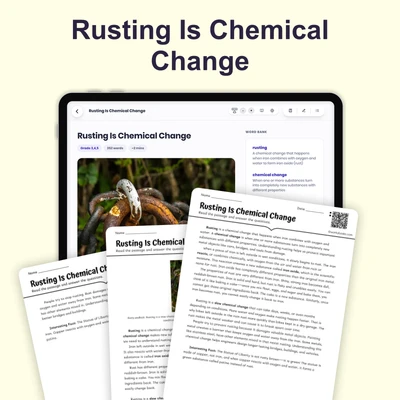
Rusting happens when iron or steel reacts with oxygen and water. Image by jarmoluk / Pixabay.
Rusting and tarnishing are examples of slow changes that happen to metals over time. These changes are called chemical reactions because the metal reacts with things around it, like air and water.
Rusting happens when iron or steel reacts with oxygen and water. This reaction forms a reddish-brown substance called rust. Rust is weak and flaky, and it can make metal objects break easily. For example, a bike left outside in the rain can start to rust, making it harder to use. Bridges, cars, and even playground equipment can rust if they are not protected.
Tarnishing is a similar slow change, but it usually happens to metals like silver or copper. When these metals react with substances in the air, like sulfur or oxygen, a thin, dark coating forms on their surface. This coating is called tarnish. Tarnished metal looks dull or dirty, but it is usually only on the surface. For example, silver jewelry can tarnish and lose its shiny look, but it can be cleaned and made shiny again.
Both rusting and tarnishing are examples of corrosion. Corrosion is the process where metals slowly break down because of chemical reactions with their environment. To prevent corrosion, people often paint metal, cover it with oil, or use special coatings. This helps keep the metal strong and looking new for longer.
Interesting Fact: The Statue of Liberty is green because its copper surface has tarnished over time, forming a protective layer called patina.
What causes rusting in iron?
Water and oxygenJust sunlightOnly waterOnly soil
What is tarnishing most common on?
Silver or copperWoodPlasticGlass
What is corrosion?
Slow breakdown of metalsTurning metal into plasticHeating metal quicklyPainting metal bright colors
Why do people paint metal objects?
To prevent corrosionTo make them softTo make them heavyTo help them float
What happens if a bike is left in rain?
It can rustIt gets lighterIt becomes plasticIt melts
How is tarnish different from rust?
Tarnish is only on surfaceTarnish is redTarnish is caused by waterTarnish is found on iron
Rust is a type of corrosion. True or false?
TrueFalse
What does 'patina' mean?
Protective green layer on copperA type of paintA metal toolA kind of rust
Perfect For:
👩🏫 Teachers
• Reading comprehension practice
• Auto-graded assessments
• Literacy skill development
👨👩👧👦 Parents
• Reading practice at home
• Comprehension improvement
• Educational reading time
🏠 Homeschoolers
• Reading curriculum support
• Independent reading practice
• Progress monitoring
Reading Features:
📖
Reading Passage
Engaging fiction or nonfiction text
❓
Comprehension Quiz
Auto-graded questions
📊
Instant Feedback
Immediate results and scoring
📄
Printable Version
Download for offline reading
🔊
Read Aloud
Voice-over with word highlighting
Reviews & Ratings
No reviews yet. Be the first to share your experience!
Related Content
Physical Properties of Matter
This comprehensive reading passage introduces grades 6-8 students to the concept of physical properties of matter, perfe...
MS-PS1-1
Changes in Matter
This engaging science passage introduces Grade 4-5 students to the concept of how matter can change, meeting NGSS standa...
What Are Physical Changes?
This engaging Grade 4-5 science passage introduces students to the concept of physical changes in matter, aligning with ...
Kinetic Theory of Matter
This middle school science reading passage introduces students to the kinetic theory of matter, aligning with NGSS MS-PS...
MS-PS1-4
Particle Model of Matter
This comprehensive science reading passage for grades 6-8 explores the particle model of matter, aligning with NGSS stan...
MS-PS1-1MS-PS1-4
The Nature of Science
This passage explores the nature of science for middle school students, aligning with NGSS standards MS-ETS1-4, MS-PS1-1...
MS-ETS1-4MS-PS1-1MS-LS1-1
Evaporation as Physical Change
This middle school science passage examines the process of evaporation, a fundamental physical change where a liquid tur...
MS-PS1-4
Physical Changes: Deposition
This middle school science passage explores the concept of deposition, a type of physical change where matter transition...
MS-PS1-4
Sublimation as Physical Change
This educational passage for grades 6-8 explores the science of sublimation—a physical change where a solid transforms d...
MS-PS1-4
Physical Changes: Condensation
This middle school science passage explores the process of condensation, the physical change where a gas becomes a liqui...
MS-PS1-4
Is Evaporation a Physical Change
"This reading passage is designed for middle school students to explore the concept of evaporation and its classificatio...
Chemical Properties of Matter
This engaging middle school science passage explores the chemical properties of matter, focusing on how these properties...
MS-PS1-2
Science Vocabulary
This worksheet on domain-specific words will help students learn some science vocabulary. Students will be asked to matc...
L.3.6L.3.4.A
Simple Machines Science Report
This science writing task requires students to clearly explain how three simple machines work using precise domain-speci...
W.5.4
Matter States Word Sort
This interactive word sort focuses on helping students understand the different states of matter through real-world exam...
PS1.A
The Idea of the Atom
This informational science passage introduces middle school students (grades 6-8) to the concept that all matter is made...
MS-PS1-1
Matter States Word Sort
This classification activity helps students understand how particles are arranged in different states of matter. Student...
5-PS1-1
What Is Density?
This comprehensive science passage introduces middle school students (grades 6-8) to the concept of density, aligned wit...
MS-PS1-1
What Is Earth Science?
This engaging middle school science passage introduces students to the field of Earth science, aligning with NGSS standa...
MS-ESS1MS-ESS2MS-ESS3SEP
Citizen Science and Ecological Monitoring
This engaging passage for grades 6-8 introduces the concept of citizen science and its critical role in ecological monit...