what is a Chemical Reaction — Reading Comprehension
Rate this
Premium Resource
Present
Present in classroom. No work saved
Assign
Classroom with student accounts, Track progress
Quick Play
No student accounts, assign with a link
Grades
3
4
5
6
7
8
PRINT+DIGITAL RESOURCE
This learning resource is available in interactive and printable formats. The interactive worksheet can be played online and assigned to students. The Printable PDF version can be downloaded and printed for completion by hand.
This middle school science reading passage, aligned with NGSS standards, provides a clear and direct explanation of what a chemical reaction is. The passage defines chemical reactions as processes that rearrange atoms to form new substances, in contrast to physical changes. It introduces key vocabulary such as reactants and products and explains the fundamental principle of the Law of Conservation of Mass. Students will learn to identify common signs of a chemical reaction, such as a change in color, temperature, or the formation of a gas or precipitate. The text connects these concepts to real-world examples, including photosynthesis and the rusting of iron, making the topic relatable for students. This content is designed to support middle school curriculum, focusing on core ideas about matter and its interactions.
CONTENT PREVIEW
Expand content preview
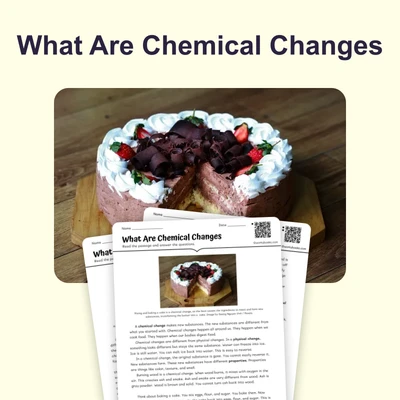
A chemical reaction, where reactants (two liquids) combine to form new products with different properties.
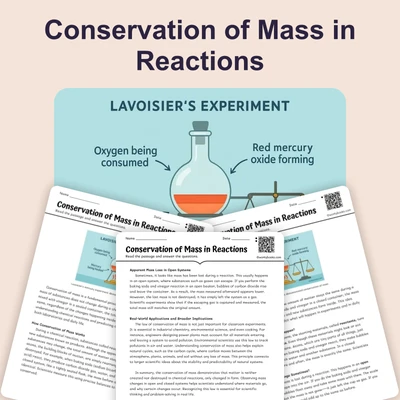
A chemical reaction is a process that rearranges the atoms of one or more substances, called reactants, to form new and different substances, known as products. Unlike a physical change, which alters a substance's appearance but not its chemical identity (like melting ice), a chemical reaction creates something entirely new. The atoms themselves are not created or destroyed; they are simply rearranged to form new molecules with new properties. This fundamental principle is known as the Law of Conservation of Mass, which states that the total mass of the reactants before a reaction is equal to the total mass of the products after the reaction.
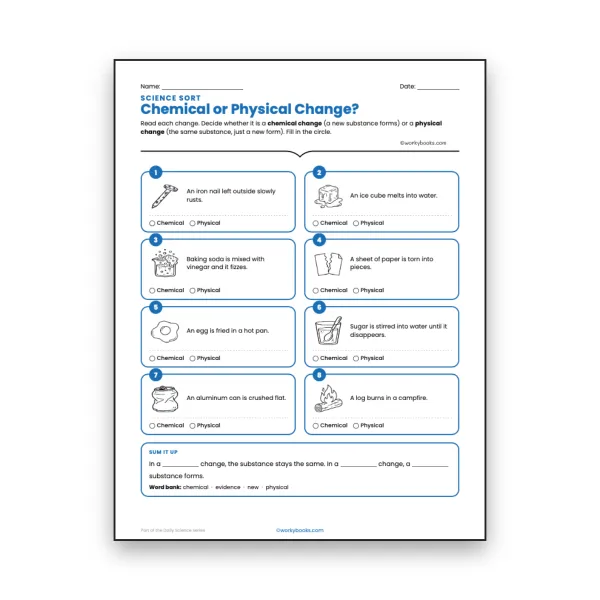
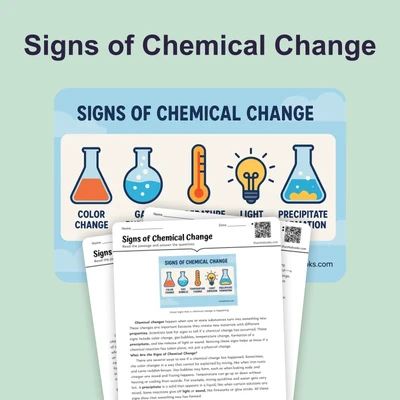
Evidence of a chemical reaction can often be observed in everyday life. For example, when you bake a cake, the liquid batter (reactants) transforms into a solid, fluffy cake (products). This is a result of a complex series of chemical reactions. Similarly, when an iron nail is left outside, it reacts with oxygen in the air to form rust. This is a visible color change, a common sign that a chemical reaction has occurred. Other signs include the production of a gas (like fizzing from an antacid tablet in water), a change in temperature (like an instant cold pack getting cold), or the formation of a solid precipitate in a liquid.
Chemical reactions are essential to life and technology. Photosynthesis is a crucial chemical reaction where plants use sunlight to convert carbon dioxide and water into glucose (sugar) and oxygen, providing food for themselves and oxygen for us to breathe. Another example is the combustion reaction that happens in a car engine, where gasoline reacts with oxygen to release energy, powering the car. Understanding these reactions allows scientists and engineers to create new materials, develop medicines, and solve complex problems.
Fun Fact: The human body uses thousands of different chemical reactions every second to digest food, move muscles, and even think!
What is the main difference between a chemical reaction and a physical change?
A physical change rearranges atoms.A chemical reaction creates new substances.A chemical reaction changes a substance's state.A physical change is always reversible.
What are the starting substances in a chemical reaction called?
MoleculesProductsReactantsCompounds
The Law of Conservation of Mass states that during a chemical reaction, the total mass of the reactants is...
less than the total mass of the products.greater than the total mass of the products.not related to the total mass of the products.equal to the total mass of the products.
Which of the following is an example of a chemical reaction mentioned in the passage?
Ice melting into water.Sawing a piece of wood.Water boiling into steam.An iron nail rusting.
Which of the following would be a sign that a chemical reaction has occurred?
A substance changes color.A substance is cut into smaller pieces.A substance freezes.A substance dissolves in water.
Based on the passage, what is the primary function of chemical reactions in living organisms, such as plants?
To create physical changes.To produce new materials.To release energy.To rearrange atoms to form new molecules.
What is the central idea of the passage?
Chemical reactions are always visible.Photosynthesis is the most important reaction.Chemical reactions are processes that create new substances by rearranging atoms.The Law of Conservation of Mass is a complex scientific theory.
You mix two clear liquids together, and a white, powdery substance suddenly forms at the bottom of the container. What has most likely happened?
A physical change has occurred.The liquids have dissolved.The liquids have frozen.A chemical reaction has formed a precipitate.
Perfect For:
👩🏫 Teachers
• Reading comprehension practice
• Auto-graded assessments
• Literacy skill development
👨👩👧👦 Parents
• Reading practice at home
• Comprehension improvement
• Educational reading time
🏠 Homeschoolers
• Reading curriculum support
• Independent reading practice
• Progress monitoring
Reading Features:
📖
Reading Passage
Engaging fiction or nonfiction text
❓
Comprehension Quiz
Auto-graded questions
📊
Instant Feedback
Immediate results and scoring
📄
Printable Version
Download for offline reading
🔊
Read Aloud
Voice-over with word highlighting
Reviews & Ratings
No reviews yet. Be the first to share your experience!
Related Content
Physical Properties of Matter
This comprehensive reading passage introduces grades 6-8 students to the concept of physical properties of matter, perfe...
MS-PS1-1
Chemical Properties of Matter
This engaging middle school science passage explores the chemical properties of matter, focusing on how these properties...
MS-PS1-2
Changes in Matter
This engaging science passage introduces Grade 4-5 students to the concept of how matter can change, meeting NGSS standa...
Matter States Word Sort
This classification activity helps students understand how particles are arranged in different states of matter. Student...
5-PS1-1
Matter States Word Sort
This interactive word sort focuses on helping students understand the different states of matter through real-world exam...
PS1.A
Is Evaporation a Physical Change
"This reading passage is designed for middle school students to explore the concept of evaporation and its classificatio...
What Are Physical Changes?
This engaging Grade 4-5 science passage introduces students to the concept of physical changes in matter, aligning with ...
Properties of Addition
This worksheet on the properties of addition will help students to practice this skill. All of the properties are define...
3.OA.B.5
Particle Model of Matter
This comprehensive science reading passage for grades 6-8 explores the particle model of matter, aligning with NGSS stan...
MS-PS1-1MS-PS1-4
Particle Movement Sort
This classification activity helps students understand particle movement in different materials. Students categorize sub...
5-PS1-1
Sorting Materials by Properties
In the 'Sorting Materials by Properties' activity, students sort various materials into categories such as 'Hard and Rig...
Kinetic Theory of Matter
This middle school science reading passage introduces students to the kinetic theory of matter, aligning with NGSS MS-PS...
MS-PS1-4
Properties of Addition— Commutative
This worksheet is perfect for practicing the commutative property. Students will practice this property as well as their...
1.OA.B.3-3
The Nature of Science
This passage explores the nature of science for middle school students, aligning with NGSS standards MS-ETS1-4, MS-PS1-1...
MS-ETS1-4MS-PS1-1MS-LS1-1
Science Vocabulary
This worksheet on domain-specific words will help students learn some science vocabulary. Students will be asked to matc...
L.3.6L.3.4.A
The Melting Point of Substances
This middle school science reading passage, titled 'The Melting Point of Substances', explores the physical property kno...
5-PS1MS-PS1-4RI.6.3RI.7.1
Properties of Communication Tools
The 'Properties of Communication Tools' word sort activity is crafted for first-grade students to meet NGSS 1-PS4-4 stan...
Simple Machines Science Report
This science writing task requires students to clearly explain how three simple machines work using precise domain-speci...
W.5.4
Temperature Effects Sort
This classification activity helps students understand how temperature affects matter. Students categorize various chang...
5-PS1-2
The Nature of Life Science
This passage, aligned with NGSS MS-LS1-1, introduces students in grades 6-8 to the foundational concepts of life science...