
Passage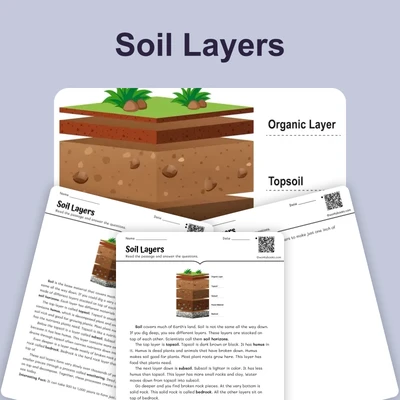
Grades 3–5
Soil Layers
Reading Passage · NGSS 4-ESS2-1
$1.50

Explore our comprehensive collection of soil curriculum resources for grades K-8. This hub offers printable and digital worksheets, games, readers, and activities that build understanding of soil composition, properties, and importance. Perfect for elementary teachers and parents seeking no-prep, standards-aligned materials.
Reading Passage · NGSS 4-ESS2-1
Reading Passage · MS-ESS2-2
Reading Passage · MS-ESS2-2
Reading Passage
Reading Passage
Three ways to use Workybooks — pick what fits.
Soil learning progresses from simple observations in kindergarten to complex investigations by upper elementary. Young students explore soil as a natural material, describing its color, texture, and components like sand, silt, and clay. They conduct simple experiments to observe how soil holds water and supports plant growth. By grades 3-5, students analyze soil profiles, understand the role of decomposers, and investigate how weathering and erosion shape soil. They learn about soil conservation and its importance in ecosystems. Related concepts include humus, nutrients, permeability, and the layers of soil (topsoil, subsoil, bedrock).
Our resources build skills in observation, measurement, data collection, and scientific reasoning. Students practice using tools like magnifiers and sieves, recording data, and drawing conclusions. Activities include reading passages about soil formation, graphic organizers for comparing soil types, and interactive games that reinforce vocabulary. These teacher-authored materials are differentiated and scaffolded to support diverse learners across the grade range.
Teachers can use this hub to select resources that match their class's current level, whether introducing soil basics in kindergarten or deepening understanding in fifth grade. For whole-group instruction, use digital readers or anchor charts. Small groups can rotate through hands-on stations with printable worksheets and games. Use graphic organizers for independent practice or literacy centers. Assign homework that reinforces key concepts, or use quick assessments to check understanding. For intervention, choose scaffolded activities that break down ideas. The mix of printable and digital resources allows easy differentiation for mixed-ability classrooms, ensuring every student can access the right challenge.
These resources align with Common Core State Standards for reading informational text and writing, as well as Next Generation Science Standards for Earth and space sciences, across grades K-5. They support skills such as asking questions, planning investigations, and communicating evidence.
Yes, many of our soil worksheets are printable and ready to use in your classroom. You can download and print them for hands-on learning. Some resources are free, while others require a membership. Look for the printable icon to identify them.
Absolutely. Our soil worksheets for kids span kindergarten through grade 5, with content tailored to each grade level. Younger students focus on basic properties, while older students explore soil formation and conservation. You can filter by grade to find the right fit.
In addition to worksheets, we offer interactive games, reading passages, graphic organizers, and hands-on activity ideas. These resources help students explore soil through multiple modalities, from digital simulations to printable lab sheets.
Our resources include scaffolded versions for different skill levels. Use simpler activities for students needing support and more complex investigations for advanced learners. Mix printable and digital options to accommodate various learning preferences and classroom setups.