How Does Soil Form From Rock
Interactive passage with audio narration, comprehension questions, and printable PDF.
By completing this purchase you agree to our Terms of Use and Privacy Policy. Your subscription renews automatically until you cancel. You can cancel anytime from your account settings. All sales are final and non-refundable. Digital content is available for download in your account immediately upon purchase.
What's included
How Does Soil Form From Rock preview and details
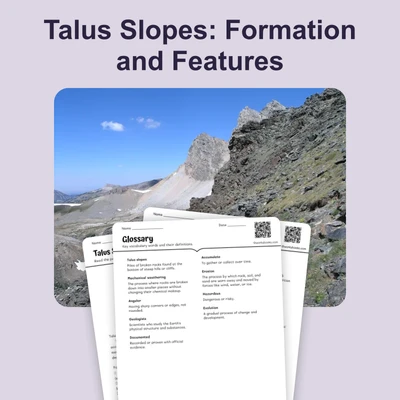
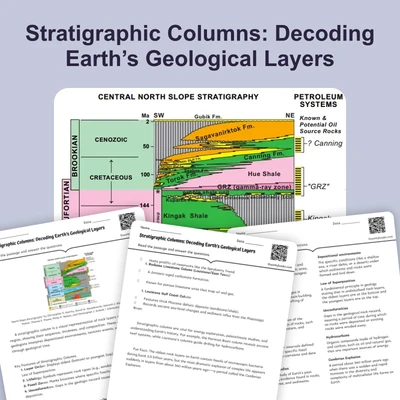
About this printable How Does Soil Form From Rock science reading passage, NGSS-aligned (Grades 5-8)
Sample passage and quiz from How Does Soil Form From Rock
Reading passage and comprehension quiz preview
How Does Soil Form From Rock
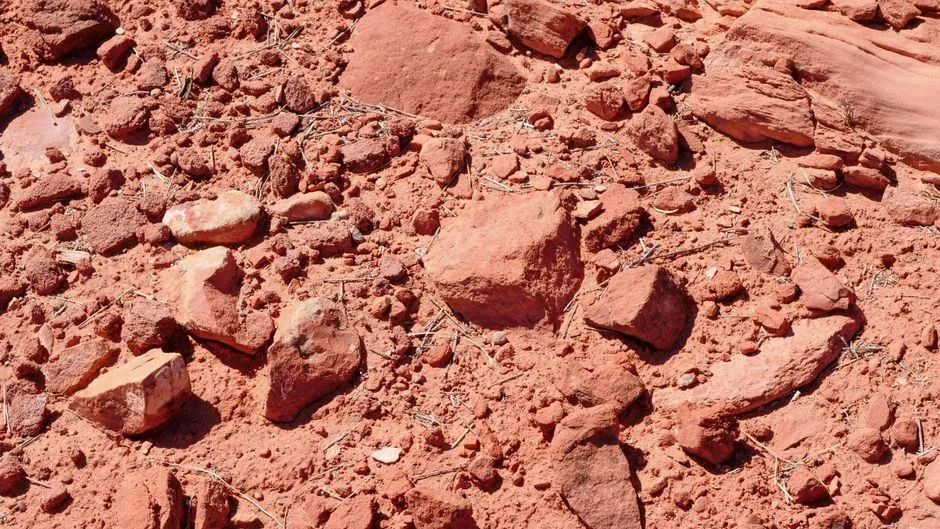
"A view of dry red soil with scattered stones and rocks in an arid environment." by Kindel Media / Pexels.
Soil forms from solid rock through a process called weathering. Over very long periods, rock breaks down into smaller and smaller pieces. These pieces eventually become the mineral particles that make up soil. This transformation connects the hard ground beneath mountains to the soft dirt in gardens.
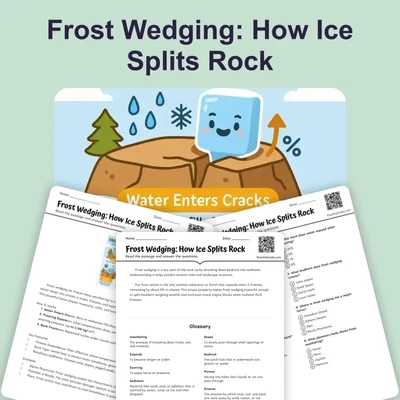
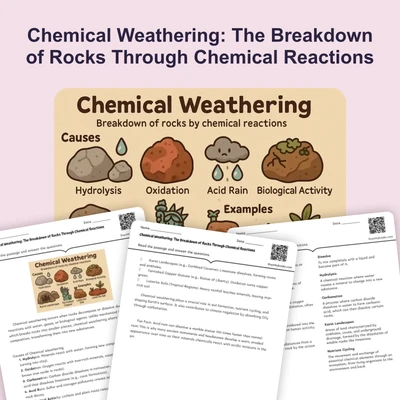
The process begins with bedrock, which is solid rock deep underground. Mechanical weathering breaks bedrock into smaller fragments without changing its chemical composition. Water seeps into cracks and freezes, expanding and splitting the rock apart. Plant roots grow into cracks and push rocks apart. Temperature changes cause rocks to expand and contract, creating fractures. Chemical weathering changes the rock's chemical structure. Rainwater contains weak acids that dissolve certain minerals in rock. Oxygen in air can react with iron in rocks, causing rust-like changes. These two types of weathering work together to break down bedrock.
As weathering continues, broken rock fragments accumulate at Earth's surface. Scientists call the original rock the parent material because it determines many properties of the resulting soil. Granite parent material creates sandy soil, while limestone creates clay-rich soil. However, broken rock alone is not true soil. Plants begin growing in the rock fragments, and when they die, their remains decay. This decaying plant and animal matter is called organic matter. Organic matter mixes with mineral particles to create fertile soil that can support more plant life.
Evidence shows that soil formation happens extremely slowly. Scientists estimate it can take 500 to 1,000 years to form just one inch of topsoil, the nutrient-rich upper layer. In the Midwest United States, prairie soils developed over 10,000 years following the last ice age. The parent material was glacial sediment left behind as ice sheets melted. This slow formation rate explains why soil lost to erosion is nearly impossible to replace on human timescales.
Understanding soil formation matters because soil supports almost all terrestrial life. Crops depend on soil for nutrients and water. When erosion removes topsoil faster than weathering can replace it, agricultural land loses productivity. Protecting existing soil is far easier than creating new soil. The ground beneath our feet represents thousands of years of weathering and organic accumulation, making it a precious and limited resource.
Interesting Fact: A single tablespoon of healthy topsoil contains more living organisms than there are people on Earth, including bacteria, fungi, and tiny animals that help break down organic matter.
Comprehension quiz (10 questions)
1. What is the solid rock deep underground that soil eventually forms from called?
2. Which process breaks rock into smaller pieces WITHOUT changing its chemical composition?
3. What does the term 'parent material' mean in the context of soil formation?
4. Based on the passage, what role does organic matter play in soil formation?
5. Why is soil lost to erosion so difficult to replace?
6. If granite is the parent material for a soil, what type of soil would likely form?
7. How do mechanical and chemical weathering work together in soil formation?
8. Which scenario best demonstrates how temperature changes cause mechanical weathering?
9. True or False: Broken rock fragments alone are considered true soil.
10. True or False: Scientists estimate it can take 500 to 1,000 years to form just one inch of topsoil.
Perfect for the way you teach
- Build comprehension skills
- Auto-graded quiz
- Differentiated reading
- Read together at home
- Improve fluency
- Quiet reading time
- Reading curriculum support
- Independent practice
- Track Lexile growth