Reading PassagePremium

What Are Asteroids

Interactive passage with audio narration, comprehension questions, and printable PDF.

No ratings yet
Grades 5–8ScienceElaEnglish · SpanishInteractive · Printable
Aligned toMS-ESS1-3
Just this resource
$1.50
One-time purchase
Best value
Unlock everything
$49.99$29.99/yr
40% off until Aug 1 — 10,000+ resources
Renews at $49.99/year.
Unlock above to use these actions

What's included

Reading passage
Audio narration
Comprehension quiz
Writing activity
Glossary & flashcards
Differentiated version
Spanish translation

What Are Asteroids preview and details

About this printable What Are Asteroids science reading passage, NGSS-aligned (Grades 5-8)

This comprehensive middle school science reading passage explores asteroids as rocky and metallic objects that orbit the Sun. Students in grades 6-8 will learn how asteroids are leftovers from the early solar system that never coalesced into planets. The passage is aligned with NGSS standards MS-ESS1.B and MS-ESS1-3, focusing on Earth and the solar system. Through clear explanations and real-world examples, students discover why asteroids remain small and irregularly shaped, where most asteroids are located in our solar system, and how scientists study these ancient objects to understand planetary formation. The audio-integrated passage includes vocabulary support with key terms like asteroid, orbit, solar system, coalesce, irregular, composition, asteroid belt, and planetesimal. Differentiated versions support English Language Learners and struggling readers while maintaining content depth. Engaging activities include multiple-choice comprehension questions, writing prompts, and graphic organizers that help students analyze asteroid characteristics and compare them to planets.
Written by Workybooks TeamPublished by Workybooks
Preview

Sample passage and quiz from What Are Asteroids

Reading passage and comprehension quiz preview

What Are Asteroids
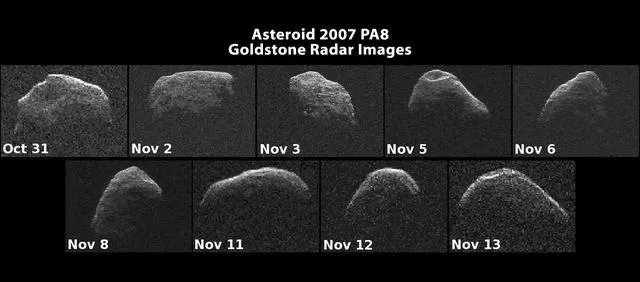
Nine Radar Images of Asteroid PA8

Asteroids are rocky and metallic objects that orbit the Sun. These space objects never grew large enough to become planets. "Nine Radar Images of Asteroid PA8" / NASA 

Asteroids are rocky and metallic objects that orbit the Sun. These space objects never grew large enough to become planets. Scientists explain that asteroids are leftovers from the early solar system that formed over 4.6 billion years ago. When our solar system was young, dust and rock particles collided and stuck together. Most of these particles joined to form planets. However, some pieces never coalesced into larger bodies. These remaining fragments became the asteroids we observe today.

Most asteroids are small and have irregular shapes. Evidence shows that asteroids range in size from tiny pebbles to objects hundreds of kilometers wide. Unlike planets, which are large enough for gravity to pull them into spherical shapes, asteroids remain jagged and lumpy. Their composition varies, but many contain rock, metal, or a mixture of both materials. Scientists observe that some asteroids are made mostly of iron and nickel. Others consist primarily of rocky minerals similar to those found on Earth.

The asteroid belt is a region between Mars and Jupiter where most asteroids are located. This belt contains millions of asteroids orbiting the Sun. Scientists study asteroids because they provide clues about the early solar system. In 2001, NASA's NEAR Shoemaker spacecraft landed on asteroid Eros. This mission revealed detailed information about asteroid surface features and composition. Data from this mission helped scientists understand how planetesimals, or small planetary building blocks, behaved billions of years ago.

Understanding asteroids matters because they represent the original building blocks of planets. By studying these ancient objects, scientists can learn how Earth and other planets formed. Asteroids also help us understand the processes that shaped our solar system. Some asteroids may contain water and organic materials that could have contributed to life on Earth. Research on asteroids connects us to the earliest history of our planetary neighborhood.

Interesting Fact: The total mass of all asteroids in the asteroid belt is less than the mass of Earth's Moon. If all asteroids were combined into one object, it would be smaller than our Moon.

Comprehension quiz (10 questions)

1. What are asteroids?

Rocky and metallic objects that orbit the Sun but never became planets
Large planets that formed in the early solar system
Moons that orbit around Jupiter and Mars
Comets made entirely of ice and dust

2. According to the passage, why did asteroids never grow large enough to become planets?

They were destroyed by collisions with other objects
They never coalesced into larger bodies during solar system formation
They were pushed out of the solar system by the Sun
They melted and turned into gas

3. Where are most asteroids located in our solar system?

Between Earth and Mars
Beyond Neptune in the outer solar system
Between Mars and Jupiter in the asteroid belt
Orbiting around the Sun closer than Mercury

4. What does the word 'composition' mean in the context of the passage?

The speed at which asteroids travel
The shape and size of asteroids
The materials that make up asteroids
The age of asteroids

5. What does the term 'irregular' mean when describing asteroid shapes?

Perfectly round and smooth
Uneven, jagged, and not symmetrical
Extremely large in size
Made of only one type of material

6. Why do scientists study asteroids?

To find new places for humans to live
To learn about the early solar system and how planets formed
To discover new types of metals for manufacturing
To predict weather patterns on Earth

7. Based on the passage, what can you infer about the relationship between an object's size and its shape?

Smaller objects are always perfectly round
Size does not affect an object's shape at all
Larger objects have enough gravity to become spherical, while smaller objects remain irregular
All objects in space have the same shape regardless of size

8. If an asteroid contains water and organic materials, how might this be important for understanding Earth?

It shows that asteroids can support human life
It suggests asteroids may have contributed materials necessary for life on Earth
It proves that Earth was once an asteroid
It means asteroids are made of the same materials as the Moon

9. True or False: All asteroids in the asteroid belt combined have more mass than Earth's Moon.

True
False

10. True or False: Asteroids are leftovers from the early solar system that formed over 4.6 billion years ago.

True
False
Who it's for

Perfect for the way you teach

Teachers
  • Build comprehension skills
  • Auto-graded quiz
  • Differentiated reading
Parents
  • Read together at home
  • Improve fluency
  • Quiet reading time
Homeschoolers
  • Reading curriculum support
  • Independent practice
  • Track Lexile growth
Topics

Reviews & Ratings

No reviews yet. Be the first to share your experience!

More reading you might love

20 more
Passage
Sunspots and Solar Flares - reading educational content
Grades 4–5

Sunspots and Solar Flares

earth science · RI.4.1

Free
Passage
The Hottest Planet in the Solar System - reading educational content
Grades 3–7

The Hottest Planet in the Solar System

science · MS-ESS1-3

Free
Passage
Mercury: Closest to the Sun - reading educational content
Grades 5–8

Mercury: Closest to the Sun

science · MS-ESS1-2

$1.50
Passage
Venus: Earth's Twin? - reading educational content
Grades 5–8

Venus: Earth's Twin?

science · MS-ESS1-2

$1.50
Passage
Mars: The Red Planet - reading educational content
Grades 5–8

Mars: The Red Planet

science · MS-ESS1-2

$1.50
Passage
What Is the Solar System? - reading educational content
Grades 5–8

What Is the Solar System?

science · MS-ESS1-2

$1.50
Passage
Structure of the Solar System - reading educational content
Grades 5–8

Structure of the Solar System

science · MS-ESS1-2

$1.50
Passage
Scale of the Solar System - reading educational content
Grades 5–8

Scale of the Solar System

science · MS-ESS1-3

$1.50
Passage
Exploration of the Solar System - reading educational content
Grades 5–8

Exploration of the Solar System

science · MS-ESS1-3

$1.50
Passage
Optical Telescopes - reading educational content
Grades 5–8

Optical Telescopes

science · MS-ESS1-3

$1.50
Passage
Future of Alien Search - reading educational content
Grades 5–8

Future of Alien Search

science · MS-ESS1-3

$1.50
Passage
Communicating with Aliens - reading educational content
Grades 5–8

Communicating with Aliens

science · MS-ESS1-3

$1.50
Passage
Measuring Distances in Space - reading educational content
Grades 5–8

Measuring Distances in Space

earth science · MS-ESS1-3

$1.50
Passage
 Astronomy - reading educational content
Grades 5–8

Astronomy

earth science · MS-ESS1-2

$1.50
Passage
The Solar System - reading educational content
Grades 5–8

The Solar System

science · MS-ESS1-2

$1.50
Passage
The Inner Planets - reading educational content
Grades 5–8

The Inner Planets

science · MS-ESS1-2

$1.50
Passage
The Outer Planets - reading educational content
Grades 5–8

The Outer Planets

science · MS-ESS1-2

$1.50
Passage
Light-Years and Cosmic Distances - reading educational content
Grades 5–8

Light-Years and Cosmic Distances

science · MS-ESS1-3

$1.50
Passage
Space Stations - reading educational content
Grades 5–8

Space Stations

science · MS-ESS1-3

$1.50
Passage
Types of Spacecraft - reading educational content
Grades 5–8

Types of Spacecraft

science · MS-ESS1-3

$1.50
Copyright © 2026 Workybooks. Made with ♥ in California.