Why Do Roller Coasters Go So Fast — Reading Comprehension
Rate this
Premium Resource
Present
Present in classroom. No work saved
Assign
Classroom with student accounts, Track progress
Quick Play
No student accounts, assign with a link
Grades
3
4
5
Standards
NGSS 4-PS3-3
PRINT+DIGITAL RESOURCE
This learning resource is available in interactive and printable formats. The interactive worksheet can be played online and assigned to students. The Printable PDF version can be downloaded and printed for completion by hand.
This engaging 250-word reading passage helps Grade 4 students understand energy transformation through the familiar context of roller coasters. Aligned to NGSS standard 4-PS3-3, the passage explains how gravitational potential energy converts to kinetic energy as a roller coaster moves from the top of a hill to the bottom. Students learn why the first hill must be the tallest and why subsequent hills get progressively shorter due to energy loss from friction and air resistance. The passage uses age-appropriate language and real-world examples to build foundational understanding of key concepts including potential energy, kinetic energy, energy transformation, friction, and air resistance. Audio-integrated features support diverse learners by providing text-to-speech functionality. The passage includes bolded vocabulary terms with immediate definitions, making complex physics concepts accessible to fourth graders. Complementary activities include multiple-choice questions testing recall and comprehension, writing prompts requiring students to explain and apply energy concepts, and graphic organizers that help students visualize the cause-and-effect relationships in energy transformation. This resource provides teachers with a complete lesson package for introducing physical science concepts in an exciting, memorable way.
CONTENT PREVIEW
Expand content preview
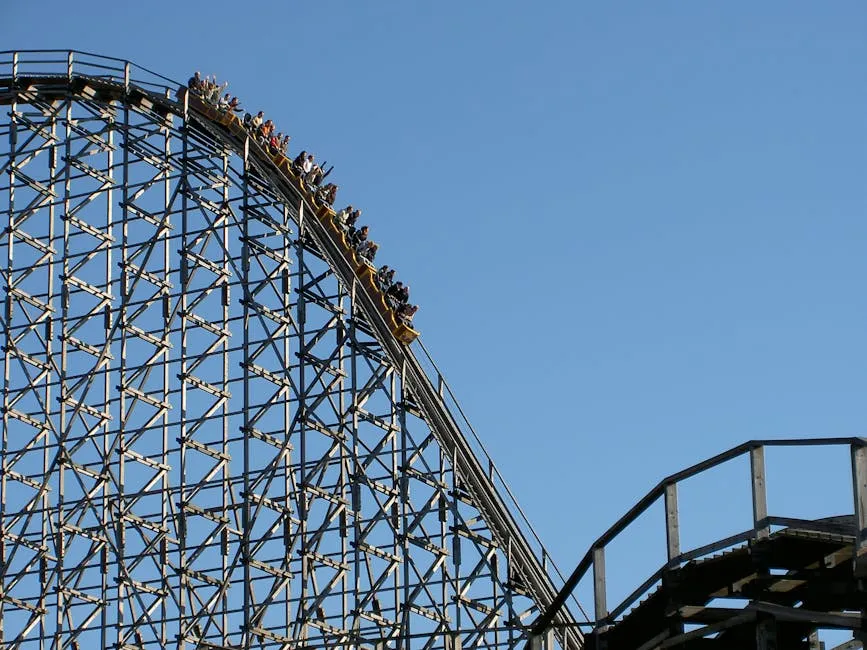
The higher the coaster climbs, the more potential energy it has. Image credit Angie / Pexels.
Roller coasters are exciting rides that show us how energy works. When a roller coaster is pulled to the top of the first hill, it gains potential energy—stored energy that comes from being up high. The higher the coaster climbs, the more potential energy it has. This is similar to how a book on a high shelf has more potential energy than one on the floor.
As the coaster drops down the hill, the potential energy changes into kinetic energy—the energy of motion. This change is called energy transformation. The taller the first hill, the more potential energy the coaster has, and the faster it goes at the bottom. That's why the first hill is always the tallest on a roller coaster.
You might notice that each hill after the first one is shorter. This happens because some energy is lost as the coaster moves. Friction between the wheels and the track, plus air resistance pushing against the coaster, changes some of the kinetic energy into heat. This means less energy is available to climb the next hill. Engineers design roller coasters knowing that energy transforms and some is always lost to friction and air resistance, making the ride both thrilling and safe.
What is potential energy?
Energy from being up highEnergy from moving fastEnergy from frictionEnergy from air resistance
What happens as the coaster drops?
It gains potential energyPotential energy becomes kinetic energyIt loses all energyFriction increases potential energy
Why is the first hill tallest?
To look more excitingTo give most potential energyTo create more frictionTo slow the coaster down
Why do later hills get shorter?
They are easier to buildRiders prefer shorter hillsEnergy is lost to frictionThey have more potential energy
What does friction create?
More kinetic energyHeat energyPotential energyAir resistance
A taller hill gives more speed.
TrueFalse
What slows the coaster down?
Potential energy and heightFriction and air resistanceSpeed and motionHills and drops
What is kinetic energy?
Stored energy from heightEnergy of motionEnergy lost to frictionEnergy from air
Perfect For:
👩🏫 Teachers
• Reading comprehension practice
• Auto-graded assessments
• Literacy skill development
👨👩👧👦 Parents
• Reading practice at home
• Comprehension improvement
• Educational reading time
🏠 Homeschoolers
• Reading curriculum support
• Independent reading practice
• Progress monitoring
Reading Features:
📖
Reading Passage
Engaging fiction or nonfiction text
❓
Comprehension Quiz
Auto-graded questions
📊
Instant Feedback
Immediate results and scoring
📄
Printable Version
Download for offline reading
🔊
Read Aloud
Voice-over with word highlighting
Reviews & Ratings
No reviews yet. Be the first to share your experience!
Related Content
Motion After Collisions
This engaging 250-word science passage helps Grade 4-5 students understand Motion After Collisions, aligned with NGSS st...
NGSS 4-PS3-3
Sound from Collisions
This 250-word reading passage introduces fourth-grade students to the concept of sound production through collisions, al...
NGSS 4-PS3-3
Heat from Collisions
This comprehensive Grade 4 physical science reading passage explores how heat is produced through collisions and frictio...
NGSS 4-PS3-3
Predicting Collisions
This engaging 250-word science passage helps Grade 4-5 students understand how scientists predict collision outcomes by ...
NGSS 4-PS3-3
What Is a Collision
This engaging science passage introduces Grade 4-5 students to the concept of collisions and energy transfer, aligned wi...
NGSS 4-PS3-3
Modeling Collisions
This engaging 250-word science passage teaches Grade 4-5 students about modeling collisions and how scientists use model...
NGSS 4-PS3-3
What Happens When Cars Collide
This 250-word reading passage introduces fourth-grade students to the concept of energy transfer and transformation duri...
NGSS 4-PS3-3
Why Do Helmets Protect Your Head
This 250-word reading passage explores how helmets protect your head during collisions, aligned with NGSS 4-PS3-3 and ph...