

Rise of Civilizations
A bundle of 7 resources — buy once and get every item to download and assign, individually or all together.
By completing this purchase you agree to our Terms of Use and Privacy Policy. Your subscription renews automatically until you cancel. You can cancel anytime from your account settings. All sales are final and non-refundable. Digital content is available for download in your account immediately upon purchase.
Items included in this bundle
7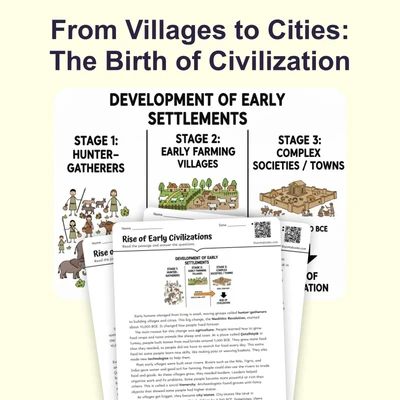
About this bundle
This comprehensive World History and Social Studies Resource is expertly designed to help middle school students master the key developments, milestones, and transitions that led to the rise of early human civilizations. Use this engaging material to clarify the critical shift from nomadic hunter-gatherer societies to permanent settlements, the profound impact of geography and climate, and the development of early cities, technology, social structures, and kingdoms.
About this Resource: The material provides a clear, conceptual framework using accessible language and historical evidence to make complex ancient history topics easy for students to understand. It explores how human innovation, geography, and environmental challenges combined to shape the ancient world. Each topic features differentiated reading selections and highly structured activities that encourage critical historical analysis.
The topics included in this resource are:
- Villages to Cities
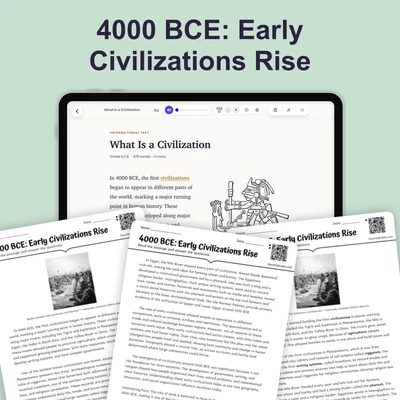
- What Is a Civilization
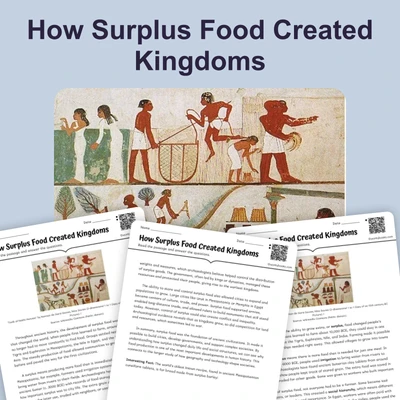
- Surplus and Civilization Growth
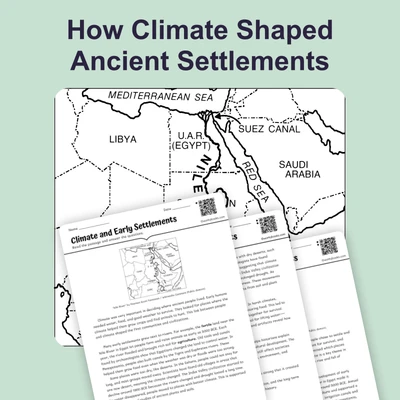
- Climate and Early Civilizations
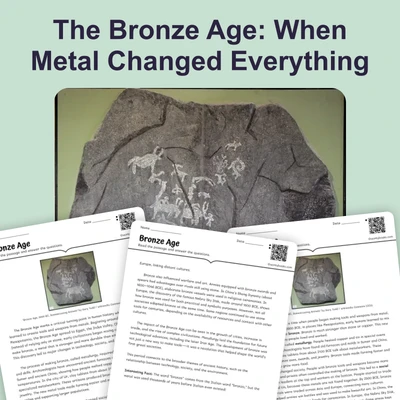
- The Bronze Age Begins
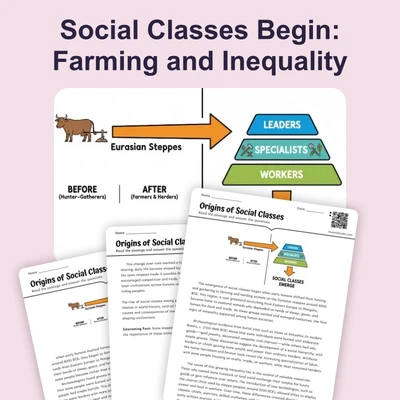
- Origins of Social Classes
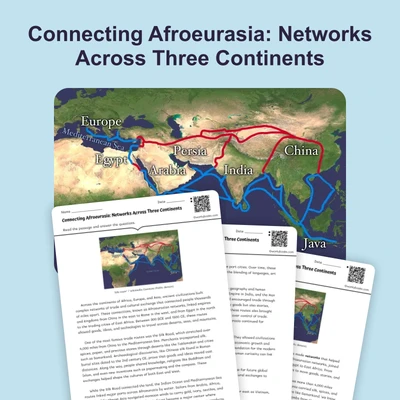
- Afro-Eurasian Trade Networks
This Phygital — Print and Interactive Version — gives you more options in your classroom. Available as both a print-and-go worksheet and an interactive digital lesson, it ensures a smooth and engaging learning experience. With interactive features including QR code access, built-in read-aloud audio support, auto-graded quizzes, digital flashcards, interactive matching, and typing-enabled writing activities, this lesson works seamlessly on any device with no app setup required!
What's Included:
- Reading Passages: Detailed, illustrated, and fully differentiated passages provided in two leveled versions (Level 1: Simplified and Level 2: Detailed) to support mixed-ability classrooms and tiered instruction. All passages are fully bilingual, available in both English and Spanish, exploring the transition from mobile bands to complex urban centers.
- Glossary: A dedicated section for each topic defining core historical vocabulary words such as Hunter-Gatherers, Neolithic Revolution, Agriculture, City-States, Hierarchies, Surplus, Granary, Dynasty, Irrigation, Metallurgy, Pastoral Nomads, and Trade Networks.
- Quiz: Comprehensive 8-question multiple-choice comprehension quizzes for each unit to evaluate student understanding of major historical events, geographic factors, and core concepts.
- Writing Activity: Open-ended comprehension, analytical, and critical thinking questions that challenge students to synthesize historical information, cite evidence from the text, and explain complex historical relationships in their own words.
- Graphic Organizers: Double-sided analytical tables including Cause-and-Effect Tables and Chronological Development Tables for each topic to guide students in sequencing major eras, identifying turning points, and understanding historical significance.
- Answer Key: Complete answer keys for all multiple-choice quiz questions and detailed, suggested answers for writing activities and graphic organizers, making grading simple and saving you valuable prep time.
Learning Objectives: Students will be able to:
- Explain how the development of agriculture during the Neolithic Revolution drove the critical transition from nomadic hunter-gatherers to permanent village and city settlements.
- Analyze the crucial role of geography and major river systems (such as the Nile, Tigris, Euphrates, Indus, and Yellow rivers) in providing fertile soil, water management, and trading routes for early communities.
- Describe how the production, storage, and management of surplus food led to social specialization, social hierarchies, and the emergence of early centralized governments, dynasties, and kingdoms.
- Evaluate the impact of climate conditions and environmental shifts (such as prolonged droughts or changing river patterns) on human migration, adaptation, and the decline or relocation of ancient settlements.
- Identify the significance of technological innovations—including irrigation systems, plows, the wheel, metallurgy (bronze-making), and chariots—in transforming ancient agriculture, warfare, and status display.
- Understand how early writing systems, such as cuneiform and hieroglyphics, developed to keep records of trade, laws, and ceremonies, and recognize their value as primary sources for historians.
- Trace the origins of social classes and economic inequality among pastoral nomads of the Eurasian steppes and early city-state residents.
- Examine how ancient Afroeurasian trade networks (like the Silk Road and maritime sea routes) connected distant empires from China to Rome, facilitating commercial and cultural exchange.
Perfect for the way you teach
- Assign in one click
- Track progress per student
- Auto-graded results
- Practice at home
- Print or do on-screen
- Build skill mastery
- Standards-aligned
- Self-paced
- Ready-to-use today