Afro-Eurasian Trade Networks
Interactive passage with audio narration, comprehension questions, and printable PDF.
By completing this purchase you agree to our Terms of Use and Privacy Policy. Your subscription renews automatically until you cancel. You can cancel anytime from your account settings. All sales are final and non-refundable. Digital content is available for download in your account immediately upon purchase.
What's included
Part of this bundle

Afro-Eurasian Trade Networks preview and details
About this printable Afro-Eurasian Trade Networks reading passage (Grades 6-8)
Sample passage and quiz from Afro-Eurasian Trade Networks
Reading passage and comprehension quiz preview
Afro-Eurasian Trade Networks
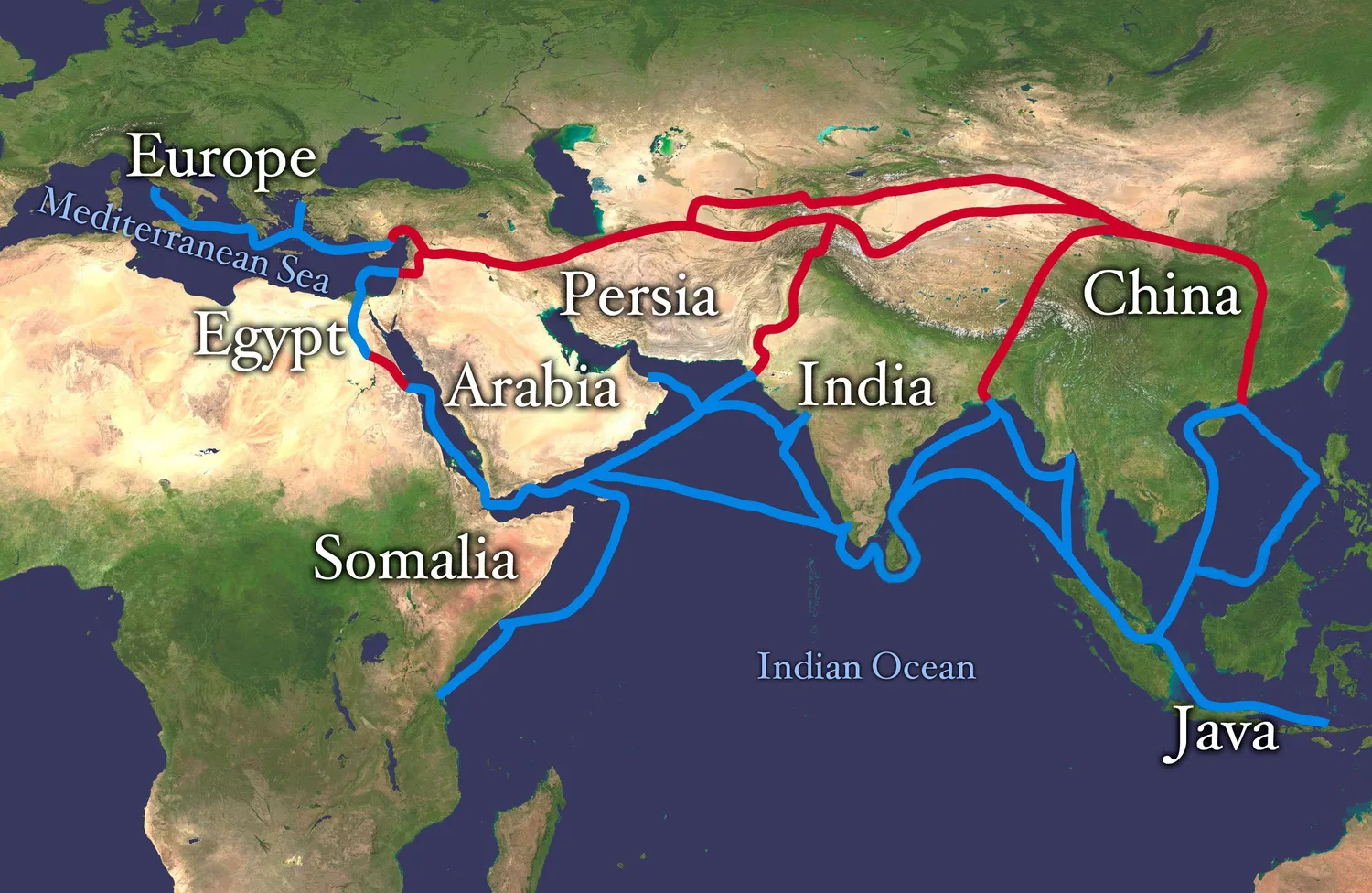
"Silk route" / Wikimedia Commons (Public domain).
Across the continents of Africa, Europe, and Asia, ancient civilizations built complex networks of trade and cultural exchange that connected people thousands of miles apart. These connections, known as Afroeurasian networks, linked empires and kingdoms from China in the east to Rome in the west, and from Egypt in the north to the trading cities of East Africa. Between 300 BCE and 1500 CE, these routes allowed goods, ideas, and technologies to travel across deserts, seas, and mountains.
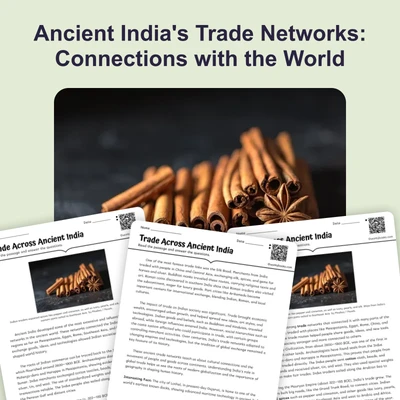
One of the most famous trade routes was the Silk Road, which stretched over 4,000 miles from China to the Mediterranean Sea. Merchants transported silk, spices, paper, and precious stones through deserts like the Taklamakan and cities such as Samarkand. Archaeological discoveries, like Chinese silk found in Roman burial sites dated to the 2nd century CE, prove that goods and ideas moved vast distances. Along the way, people shared knowledge, religions like Buddhism and Islam, and even new inventions such as papermaking and the compass. These exchanges helped shape the cultures of both East and West.
While the Silk Road connected the land, the Indian Ocean and Mediterranean Sea routes linked major ports across Afroeurasia by water. Sailors from Arabia, Africa, India, and Southeast Asia navigated monsoon winds to carry gold, ivory, textiles, and ceramics. The ancient city of Alexandria in Egypt became a major center where goods from Africa and Asia were exchanged for Roman coins and European products. Written accounts from travelers such as Ibn Battuta in the 14th century describe the bustling trade and diverse populations found in these port cities. Over time, these sea routes connected distant societies, allowing for the blending of languages, art styles, and beliefs.
The development of these networks was shaped by geography and human innovation. Empires like the Roman Empire, the Gupta Empire in India, and the Han Dynasty in China built roads, protected merchants, and encouraged trade through treaties and taxes. Caravans and ships carried not only goods but also stories, scientific knowledge, and artistic traditions. However, these routes also brought challenges, such as the spread of diseases and conflicts over control of trade. Despite these difficulties, the connections across Afroeurasia continued for centuries, adapting as empires rose and fell.
Afroeurasian networks changed the course of history. They allowed civilizations to gain new resources, technologies, and ideas, leading to economic growth and cultural development. These ancient connections laid the foundation for the modern globalized world, showing how geography, innovation, and human curiosity can link societies across continents.
Transition: The growth of Afroeurasian networks set the stage for future global interactions, making it possible for new trade routes and cultural exchanges to emerge in later historical periods.
Interesting Fact: Archaeologists have found Roman coins as far east as Vietnam, showing just how far ancient trade networks reached.
Comprehension quiz (8 questions)
1. Which route connected China and the Mediterranean?
2. What goods did merchants carry on sea routes?
3. Which city was a trade center in Egypt?
4. How did geography shape trade?
5. What effect did networks have on civilizations?
6. Why did empires build roads and protect merchants?
7. Roman coins have been found in Vietnam.
8. What is a 'network'?
Perfect for the way you teach
- Build comprehension skills
- Auto-graded quiz
- Differentiated reading
- Read together at home
- Improve fluency
- Quiet reading time
- Reading curriculum support
- Independent practice
- Track Lexile growth