This reading passage explores the critical transformation from early human hunter-gatherer societies to the development of villages and cities, marking the birth of civilization. Students will discover how the Agricultural Revolution allowed people to settle in one place, leading to the rise of complex societies along rivers such as the Tigris, Euphrates, Nile, and Indus. The passage highlights archaeological evidence, such as the site of Çatalhöyük, and discusses the significance of social hierarchy, technological innovation, and adaptation. Activities aligned with CA HSS 6.1 and CCSS RI.6.1 deepen understanding through multiple choice, writing, graphic organizers, and Spanish translation, fostering historical thinking skills. Also includes a read-aloud audio option.
Written by Workybooks TeamPublished by Workybooks
Preview
Sample passage and quiz content
CONTENT PREVIEW
Expand content preview
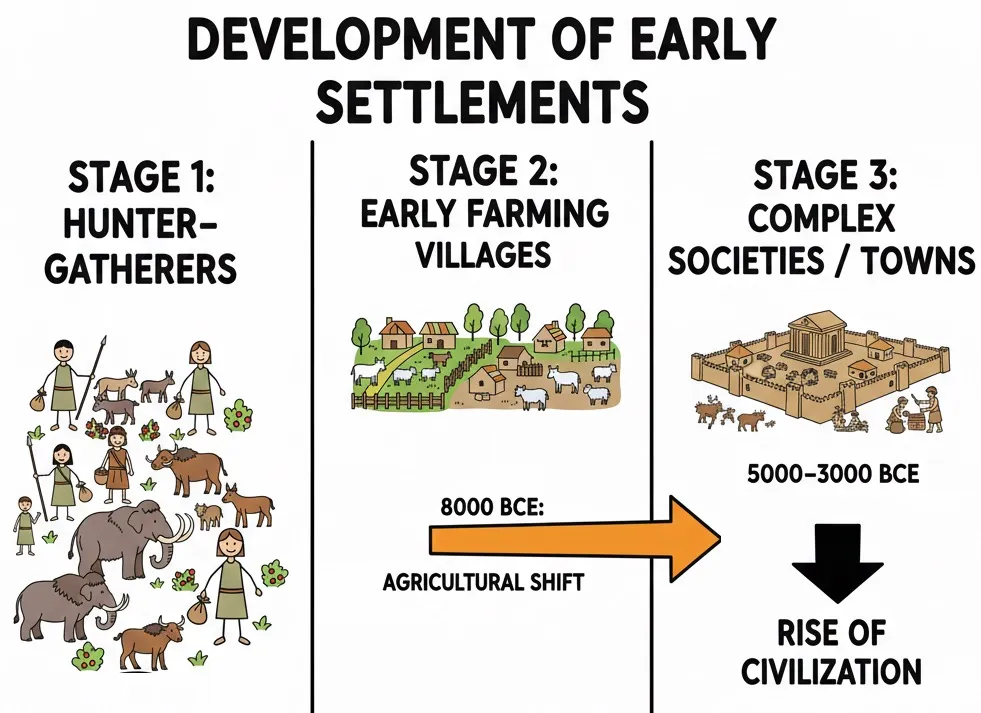
Throughout ancient history, early humans made a critical transition from living as nomadic hunter-gatherers to settling in permanent villages and, eventually, building the world’s first cities. This change, known as the Neolithic Revolution, began around 10,000 BCE and reshaped human societies forever.
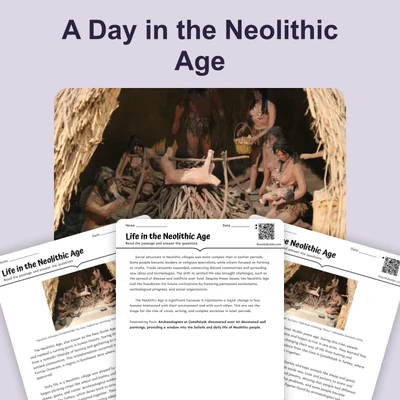
The most important factor driving this shift was the development of agriculture. Early humans learned to plant crops like wheat, barley, and rice, and to domesticate animals such as sheep, goats, and cattle. Archaeological evidence from sites like Çatalhöyük in modern-day Turkey shows that by about 7,000 BCE, people were building permanent houses from mud bricks and organizing their lives around farming. This new way of life allowed families to produce surplus food, which meant not everyone had to search for food each day. As a result, some people could focus on other skills, such as making pottery, weaving, or developing new technologies.
Settling near rivers was crucial for these early communities. Rivers like the Tigris and Euphrates in Mesopotamia, the Nile in Egypt, and the Indus in South Asia provided fertile soil and water for crops. These rivers also made it possible to trade surplus goods with neighboring groups. Over time, villages grew larger and more complex. Leaders emerged to organize labor, settle disputes, and oversee religious rituals. This led to the creation of social hierarchies, where some people had more power or wealth than others. Archaeologists have found evidence of this in ancient burial sites, where some graves contain valuable objects, suggesting a division of status.
The growth of villages eventually led to the rise of city-states—independent cities with their own governments and cultures. By 3,500 BCE, cities such as Uruk in Mesopotamia had thousands of residents, monumental architecture, and written records. The move from small villages to bustling cities was not always smooth. Population growth, competition for land, and changing climate sometimes caused conflict or forced people to adapt. However, these challenges also sparked new inventions, like irrigation systems and plows, that helped societies thrive.
The transition from village life to city-building marks one of the most significant changes in human history. It laid the foundation for complex civilizations, shaped by geography, technology, and social organization. Studying this period helps us understand how humans adapted to their environment and created the diverse cultures that still influence our world today.
This transformation from mobile bands to settled communities connects to broader themes in history, such as the relationship between people and their environment, the development of government, and the rise of culture and technology.
Interesting Fact: Some of the oldest known wall paintings, showing scenes of daily village life, were discovered at Çatalhöyük and are over 8,000 years old!
What was the Neolithic Revolution?
Start of farming and settlingRise of empiresInvention of metal toolsBuilding of pyramids
Where is Çatalhöyük located?
Modern-day TurkeyEgyptChinaGreece
Which rivers supported early villages?
Tigris, Euphrates, Nile, IndusAmazon, Mississippi, SeineYangtze, Thames, VolgaDanube, Hudson, Congo
Why did social hierarchies develop?
Villages became complexFarming endedRivers dried upPeople stopped trading
How did climate affect early societies?
Created new challengesMade farming impossibleStopped tradeEnded village life
What is a city-state?
Independent city with own governmentA group of villagesA farming toolA village leader
Çatalhöyük is one of the oldest villages. True or false?
TrueFalse
What does 'agriculture' mean?
Growing crops and raising animalsBuilding housesTrading goodsWriting records
Who it's for
Perfect for the way you teach
Teachers
Build comprehension skills
Auto-graded quiz
Differentiated reading
Parents
Read together at home
Improve fluency
Quiet reading time
Homeschoolers
Reading curriculum support
Independent practice
Track Lexile growth
Topics
ancient historyearly humanscivilizationNeolithicagriculturevillagescity-statesdomesticationCA HSS 6.1CCSS RI.6.1
Reviews & Ratings
No reviews yet. Be the first to share your experience!
More reading you might love
20 more
Lost City of Pompeii
This engaging passage explores the ancient Roman city of Pompeii, which was buried by the eruption of Mount Vesuvius in ...
CA HSS 6.1RH.6-8.2RH.6-8.4RH.6-8.7
Minoan Civilization
This engaging history reading passage explores the Minoans, one of the earliest civilizations of the Bronze Age located ...
CA HSS 6.1RH.6-8.1RH.6-8.4
How Ancient Ideas Spread
This history reading passage explores the concept of cultural diffusion and its significance in shaping ancient civiliza...
CA HSS 6.16.2TEKS 113.18(B)(1)(A)RI.6.3
First Humans
This engaging history reading passage explores the evolution of early humans, tracing the journey from the earliest homi...
CA HSS 6.1RH.6-8.1RH.6-8.2W.6.2
Who Were the Neanderthals
This engaging history reading passage explores the fascinating world of the Neanderthals, our ancient relatives who live...
CA HSS 6.1TEKS 6.2RI.6.1RI.6.4
Early Human Cognition
This engaging reading passage explores the Cognitive Revolution, a major turning point in human history that occurred ar...
CA HSS 6.1CCSS.RI.6.1CCSS.RI.6.2CCSS.RI.6.4
Valmiki and the Ramayana
This ancient history reading passage explores the life and legacy of Valmiki, the celebrated poet credited with composin...
CA HSS 6.1CCSS.ELA-LITERACY.RH.6-8.1CCSS.ELA-LITERACY.RH.6-8.2
China's Terracotta Army
This passage explores the fascinating discovery of the Terra-Cotta Army near Xi’an, China, and its significance in ancie...
CA HSS 6.1CCSS RH.6-8.1CCSS RH.6-8.4CCSS RH.6-8.7
Dead Sea Scrolls Discovery
This passage explores the remarkable discovery of the Dead Sea Scrolls, one of history’s most significant archaeological...
CA HSS 6.1CCSS.RI.6.1CCSS.RI.6.3
Life as a Hunter-Gatherer
This engaging history reading passage explores the ways early humans survived and spread across continents by foraging, ...
CA HSS 6.1RI.6.1RI.6.4RI.7.1
Human Impact on Extinctions
This passage explores how Paleolithic people, or early humans, shaped their environment through the use of fire, hunting...
CA HSS 6.1CCSS RH.6-8.2CCSS RI.6.4
Stone Age Settlements
Explore how early humans in the Paleolithic Era built shelters such as caves and huts to survive harsh climates. This pa...
CA HSS 6.1CCSS.RI.6.3CCSS.RI.7.1CCSS.RI.8.2
How Early Humans Survived the Ice Age
This passage explores how Paleolithic people adapted to a variety of landscapes, including coastal regions, mountains, p...
CA HSS 6.1CCSS RH.6-8.1CCSS RH.6-8.2CCSS RH.6-8.4
Life in the Neolithic Age
This engaging passage explores what life was like during a typical day in the Neolithic Age, a pivotal era in ancient hi...
CA HSS 6.1CCSS RH.6-8.2CCSS RH.6-8.4
Ramayana Epic of India
This passage introduces students to the epic of the Ramayana and its role in teaching the concept of dharma within ancie...
CA HSS 6.1RI.6.1RI.6.4RI.7.1
How Artifacts Are Restored
This engaging passage explores how scientists, especially archaeologists and conservators, protect and restore artifacts...
CA HSS 6.1RI.6.1RH.6-8.2
Ancient World Literature
This passage explores the importance of ancient stories and poems from civilizations such as Greece, India, and Israel. ...
CA HSS 6.1CCSS.RI.6.1CCSS.RI.6.4
What Was the Neolithic Revolution
This comprehensive history reading passage explores the Neolithic Revolution, focusing on how early humans transitioned ...
CA HSS 6.1CCSS RH.6-8.2CCSS RH.6-8.4CCSS RH.6-8.7
Neanderthals and Homo Sapiens
This reading passage explores the fascinating interactions between Homo sapiens and Neanderthals in ancient Europe, focu...
CA HSS 6.1CCSS.RI.6.3CCSS.RI.6.4
First Humans Reach Australia
This reading passage explores the journey of early humans who reached Australia by crossing the ocean over 60,000 years ...