Surplus and Civilization Growth
Interactive passage with audio narration, comprehension questions, and printable PDF.
By completing this purchase you agree to our Terms of Use and Privacy Policy. Your subscription renews automatically until you cancel. You can cancel anytime from your account settings. All sales are final and non-refundable. Digital content is available for download in your account immediately upon purchase.
What's included
Part of this bundle

Surplus and Civilization Growth preview and details
About this printable Surplus and Civilization Growth reading passage (Grades 6-8)
Sample passage and quiz from Surplus and Civilization Growth
Reading passage and comprehension quiz preview
Surplus and Civilization Growth
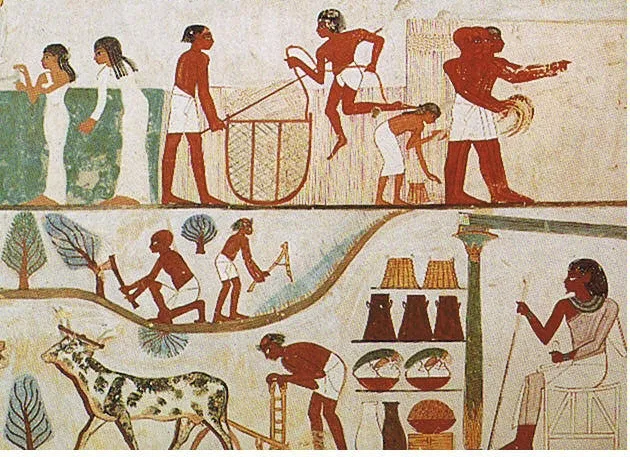
"Tomb of Nakht Harvest" by Norman de Garis Davies, Nina Davies (2-dimensional 1 to 1 Copy of an 15th century BC Picture) /
Source: Wikimedia Commons (Public domain).
Throughout ancient history, the development of surplus food was a turning point that changed the world. When people first learned to farm, around 10,000 BCE, they no longer had to move constantly to find food. Groups settled near rivers like the Tigris and Euphrates in Mesopotamia, the Nile in Egypt, and the Indus River in South Asia. The steady production of food allowed communities to grow larger than ever before and paved the way for the first civilizations.
A surplus means producing more food than is immediately needed. In Mesopotamia, for example, farmers used irrigation systems as early as 6000 BCE to bring water from rivers to their fields. Archaeologists have found clay tablets from ancient Sumer (c. 3000 BCE) with records of food storage and distribution, showing how important surplus was to city life. The extra grain and crops could be stored in granaries for later use, traded with neighbors, or used to feed workers building temples and city walls.
Surplus food changed how societies were organized. Not everyone had to farm; some people became artisans, priests, or rulers. This led to the rise of social hierarchy, with different classes of people performing different jobs. In ancient Egypt, for instance, workers who built the pyramids were often paid in bread and beer from state granaries. Written records from the Indus Valley show standardized weights and measures, which archaeologists believe helped control the distribution of surplus goods. The government, often led by kings or dynasties, managed these resources and protected their people, giving rise to the earliest kingdoms.
The ability to store and control surplus food also allowed cities to expand and populations to grow. Large cities like Uruk in Mesopotamia or Memphis in Egypt became centers of culture, trade, and power. Surplus food supported armies, enabled long-distance trade, and allowed rulers to build monuments that still stand today. However, control of surplus could also create conflict and inequality. Archaeological evidence reveals that as kingdoms grew, so did competition for land and resources, which sometimes led to war.
In summary, surplus food was the foundation of ancient civilizations. It made it possible to build cities, develop governments, and support complex societies. By understanding how surplus changed daily life and social structures, we can see why food production is one of the most important developments in human history. This connects to the larger study of how geography and technology shape societies.
Interesting Fact: The world’s oldest known recipe, found in ancient Mesopotamian cuneiform tablets, is for bread made from surplus barley!
Comprehension quiz (8 questions)
1. What does surplus food mean?
2. Where did early civilizations often settle?
3. Which job became possible because of surplus?
4. How did irrigation help farmers?
5. What did kings or dynasties do with surplus?
6. What effect did surplus food have?
7. Surplus food led to cities growing. True or false?
8. What is a granary?
Perfect for the way you teach
- Build comprehension skills
- Auto-graded quiz
- Differentiated reading
- Read together at home
- Improve fluency
- Quiet reading time
- Reading curriculum support
- Independent practice
- Track Lexile growth