This 400-500 word informational science passage is designed for middle school students in grades 6-8 and addresses the common misconception about gravity and falling objects. Aligned with NGSS standard MS-PS2-4 and disciplinary core idea MS-PS2.B, the passage explains that gravity does pull harder on heavier objects, but those objects also have more inertia and resist motion more. The result is that all objects in free fall accelerate at the same rate regardless of mass. The passage includes real-world examples, clear explanations of force, mass, and acceleration, and an interesting fact about astronaut experiments on the Moon. Audio-integrated features support diverse learners. The content includes a simplified differentiated version, Spanish translations, glossary terms, multiple-choice questions, writing activities, and graphic organizers to reinforce understanding of gravitational force and motion concepts.
Written by Workybooks TeamPublished by Workybooks
Preview
Sample passage and quiz content
CONTENT PREVIEW
Expand content preview
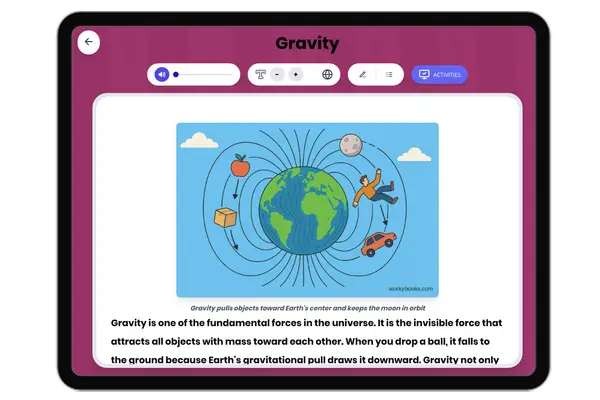
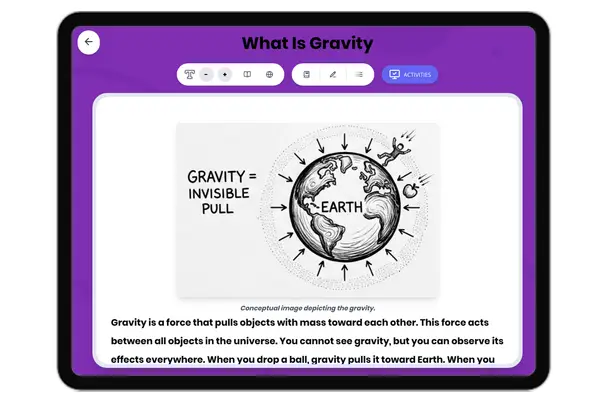
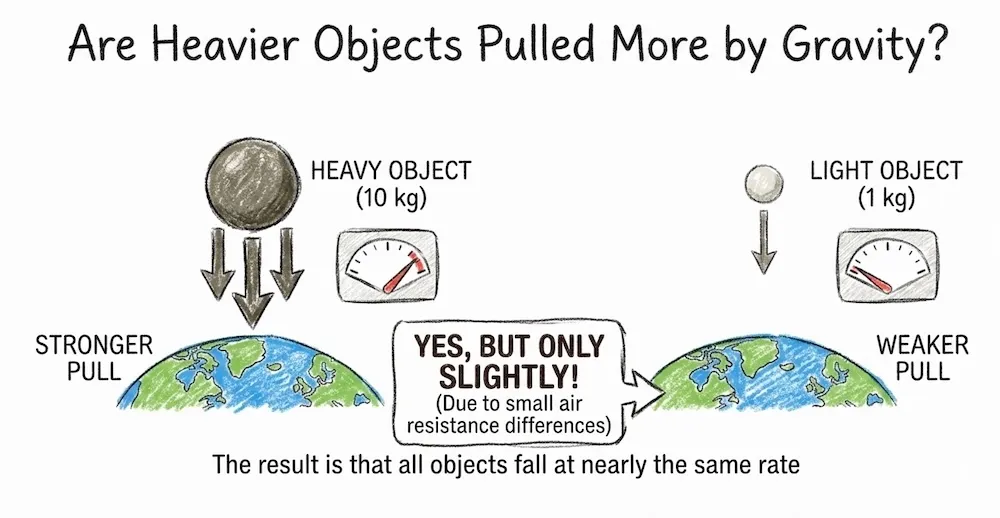
Gravity does pull more strongly on objects with greater mass, but this does not mean heavier objects fall faster. Scientists explain that all objects in free fall accelerate toward Earth at the same rate, regardless of their mass.
Does gravity pull harder on heavier objects? The answer may surprise you. Gravity does pull more strongly on objects with greater mass, but this does not mean heavier objects fall faster. Scientists explain that all objects in free fall accelerate toward Earth at the same rate, regardless of their mass.
To understand this concept, we need to examine two important ideas: force and inertia. Gravity exerts a greater force on heavier objects. A bowling ball experiences more gravitational pull than a marble. However, heavier objects also have more inertia, which means they resist changes in motion more than lighter objects. The bowling ball needs more force to accelerate than the marble does. Evidence shows these two factors balance each other perfectly.
The relationship between force, mass, and acceleration can be expressed mathematically. When gravity pulls on an object, the force increases with mass. At the same time, the resistance to motion also increases with mass. These effects cancel out, resulting in the same acceleration for all objects. Scientists measure this acceleration at approximately 9.8 meters per second squared near Earth's surface.
In 1971, astronaut David Scott conducted a famous experiment on the Moon. He dropped a hammer and a feather at the same time. Without air resistance, both objects hit the lunar surface simultaneously. This demonstration confirmed what scientist Galileo Galilei had proposed centuries earlier. The Moon experiment provided clear evidence that mass does not affect how fast objects fall in a vacuum.
Understanding gravity and motion matters for many real-world applications. Engineers design spacecraft and satellites using these principles. Scientists study falling objects to learn about gravitational force and planetary motion. This knowledge helps us predict how objects move through space and atmosphere. The concept also reminds us that scientific understanding often challenges our everyday observations and initial assumptions.
Interesting Fact: If you could remove all air from a tall tube, a feather and a brick dropped together would hit the bottom at exactly the same moment, even though gravity pulls much harder on the brick.
According to the passage, does gravity pull harder on heavier objects?
Yes, gravity pulls harder on objects with greater massNo, gravity pulls equally on all objectsOnly on Earth, but not on other planetsOnly when objects are falling through air
Why do all objects fall at the same rate in free fall?
Because gravity is weaker on lighter objectsBecause heavier objects have less inertiaBecause the greater force on heavier objects is balanced by their greater inertiaBecause air resistance affects all objects equally
What does 'inertia' mean in the context of this passage?
The speed at which an object fallsThe resistance an object has to changes in motionThe force of gravity on an objectThe weight of an object
What is the acceleration rate for falling objects near Earth's surface?
5.2 meters per second squared9.8 meters per second squared12.4 meters per second squared15.6 meters per second squared
What did astronaut David Scott's experiment on the Moon demonstrate?
That heavier objects fall faster than lighter objectsThat gravity is stronger on the Moon than on EarthThat a hammer and feather fall at the same rate without air resistanceThat the Moon has no gravity
Which scientist first proposed that all objects fall at the same rate?
Isaac NewtonAlbert EinsteinGalileo GalileiDavid Scott
If a bowling ball and marble are dropped in a vacuum, which hits the ground first?
The bowling ball hits firstThe marble hits firstThey hit at the same timeIt depends on the height they are dropped from
How does understanding gravity and motion help engineers?
It helps them design spacecraft and satellitesIt helps them predict weather patternsIt helps them build stronger buildingsIt helps them create new materials
True or False: Heavier objects need more force to accelerate than lighter objects.
TrueFalse
True or False: The mass of an object affects how fast it falls in free fall.