Weightlessness and Microgravity — Reading Comprehension
Rate this
Premium Resource
Present
Present in classroom. No work saved
Assign
Classroom with student accounts, Track progress
Quick Play
No student accounts, assign with a link
Grades
5
6
7
8
Standards
MS-PS2-4
MS-ESS1-2
PRINT+DIGITAL RESOURCE
This learning resource is available in interactive and printable formats. The interactive worksheet can be played online and assigned to students. The Printable PDF version can be downloaded and printed for completion by hand.
This science reading passage for middle school students explores the phenomenon of weightlessness and microgravity. Aligned to NGSS standards MS-PS2-4 and MS-ESS1-2, it explains why astronauts on the International Space Station (ISS) feel weightless, dispelling the misconception that there is no gravity in orbit. Students will learn how the ISS and its occupants are in a state of continuous freefall, resulting in microgravity conditions. The passage discusses the effects of microgravity on the human body, including fluid shifts, muscle and bone weakening, and balance issues, as well as the health challenges and benefits for scientific research. It integrates key concepts from physics and life sciences and encourages scientific thinking about forces and motion. The content is audio integrated for accessibility and includes activities such as quizzes, writing prompts, and graphic organizers to support learning.
CONTENT PREVIEW
Expand content preview
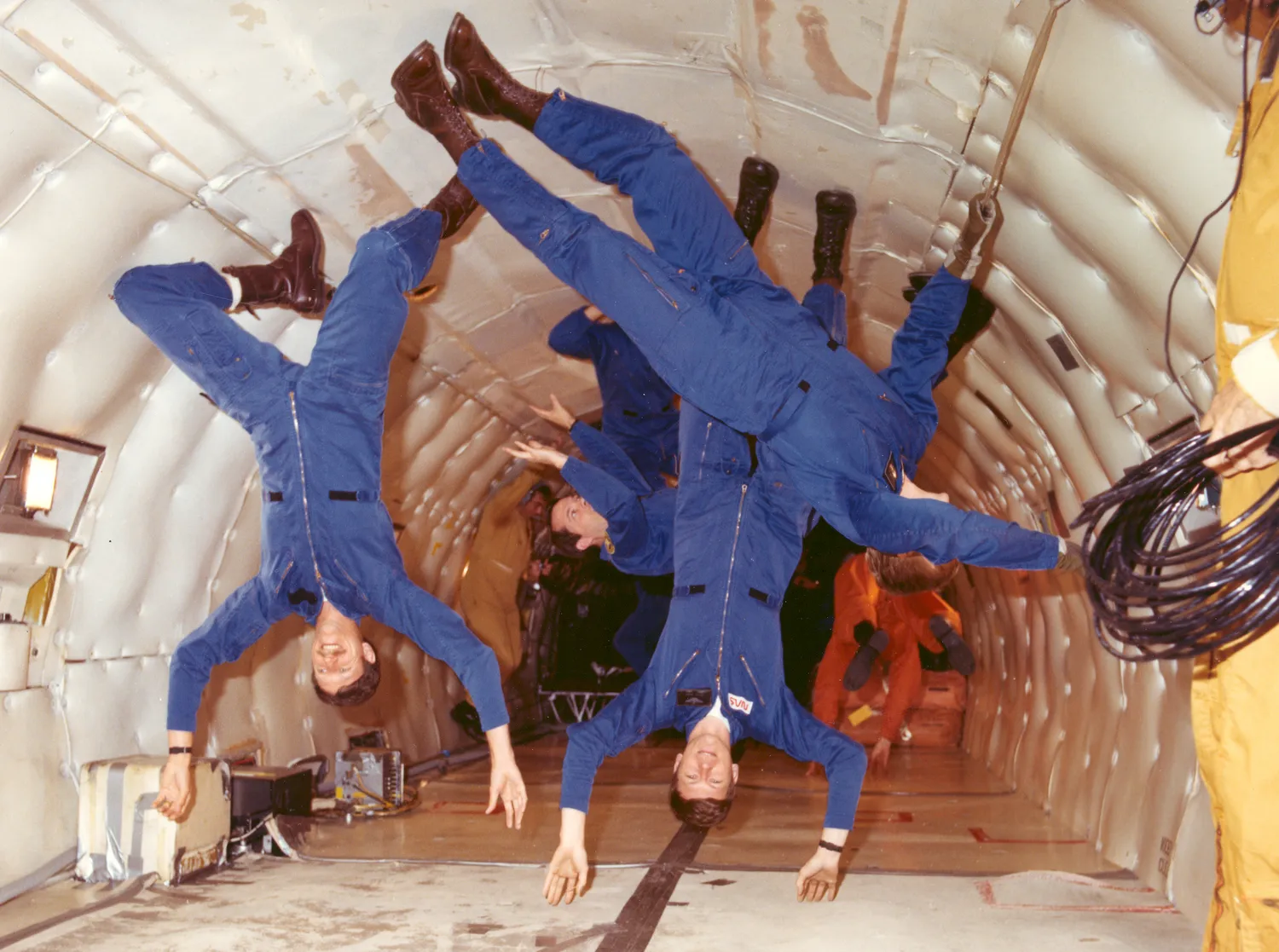
"Astronauts in weightlessness" by NASA / Wikimedia Commons (Public domain).
Weightlessness is a condition commonly experienced by astronauts aboard the International Space Station (ISS), and it plays a crucial role in advancing our understanding of science and human health. Many people believe astronauts float because there is no gravity in space. However, this is a misconception. In fact, gravity at the ISS is nearly as strong as on Earth’s surface—about 90% as strong. The real explanation for weightlessness lies in the nature of orbit and the concept of freefall.
How Weightlessness Happens: The Science of Freefall
Objects in orbit, including the ISS and its crew, are constantly falling toward Earth due to gravity. However, they are also moving forward at a high speed—over 28,000 kilometers per hour. This combination causes the ISS to continuously "miss" the Earth as it falls, creating a state of perpetual freefall. Because the astronauts and everything inside the ISS are falling at the same rate, there are no internal support forces acting on their bodies. This results in the sensation of weightlessness. The correct scientific term for this state is microgravity, meaning that the effects of gravity are greatly reduced but not entirely absent. Microgravity allows scientists to study physical and biological processes in ways impossible on Earth.
Effects on the Human Body and Scientific Research
Microgravity produces noticeable changes in the human body. Without Earth's gravity pulling fluids down, bodily fluids shift toward the head, causing puffy faces and nasal congestion. Over time, muscles and bones weaken because they are not used as much, leading to health challenges for astronauts. The vestibular system—responsible for balance and spatial orientation—can become confused, causing motion sickness or balance problems. Despite these difficulties, microgravity provides a unique environment for scientific experiments, such as studying the growth of protein crystals or observing how flames behave. Some of these experiments can lead to medical and technological advances on Earth.
Training, Misconceptions, and Broader Implications
Astronauts must prepare for microgravity before traveling to space. They train in special aircraft, sometimes called the "vomit comet," which flies in parabolic paths to simulate weightlessness for short periods. Understanding microgravity helps scientists design better spacecraft and develop ways to keep astronauts healthy during long missions. It also challenges us to rethink our basic ideas about force, motion, and gravity. Recognizing that weightlessness is not the absence of gravity but a result of continuous freefall is essential for understanding how orbiting systems work.
Studying weightlessness and microgravity not only helps us plan future space missions but also deepens our knowledge of physics and the human body. These insights can lead to innovations for both space exploration and life on Earth.
Interesting Fact: Even though astronauts appear to float freely, they are actually falling around Earth at thousands of kilometers per hour—never truly escaping gravity!
Why do astronauts on the ISS feel weightless?
Because they are in continuous freefall around Earth.Because there is no gravity in space.Because the ISS has no mass.Because they are farther from the Sun.
What is the scientific term for the 'weightless' condition experienced in orbit?
SupergravityAnti-gravityMicrogravityMagnetism
What causes the ISS to stay in orbit around Earth?
It is being pushed by the Sun.It moves forward fast enough to keep missing Earth as it falls.There is no gravity in space.It is attached by a cable to the Moon.
Which of the following is an effect of microgravity on the human body?
Bones and muscles become stronger.Fluids shift toward the head.Gravity increases inside the ISS.Astronauts can breathe underwater.
What does the term 'parabolic path' mean in the context of astronaut training?
A straight flight path to space.A curved flight that creates short periods of weightlessness.A path that circles the Moon.A path underwater.
In the passage, what does 'support force' refer to?
The force from the rocket engines.The force that pushes up against your body, like the floor on your feet.The force of wind in the ISS.The force of magnets in space.
Why is microgravity useful for scientific experiments?
It makes experiments easier to see on Earth.It allows scientists to study processes that can't be observed under normal gravity.It creates stronger gravity for better results.It helps astronauts grow taller.
True or False: Gravity at the ISS is only about 10% as strong as at Earth's surface.
TrueFalse
True or False: The vestibular system is responsible for balance and spatial orientation.
TrueFalse
Which of the following is a misconception addressed in the passage?
Astronauts on the ISS float because there is zero gravity.Microgravity allows for unique experiments.Astronauts train on special aircraft.Gravity affects fluids in the human body.
Perfect For:
👩🏫 Teachers
• Reading comprehension practice
• Auto-graded assessments
• Literacy skill development
👨👩👧👦 Parents
• Reading practice at home
• Comprehension improvement
• Educational reading time
🏠 Homeschoolers
• Reading curriculum support
• Independent reading practice
• Progress monitoring
Reading Features:
📖
Reading Passage
Engaging fiction or nonfiction text
❓
Comprehension Quiz
Auto-graded questions
📊
Instant Feedback
Immediate results and scoring
📄
Printable Version
Download for offline reading
🔊
Read Aloud
Voice-over with word highlighting
Reviews & Ratings
No reviews yet. Be the first to share your experience!
Related Content
Comets
This middle school science passage explores the fascinating world of comets, commonly known as 'dirty snowballs.' Studen...
MS-ESS1-2
Mercury: Closest to the Sun
This comprehensive, standards-aligned passage explores Mercury—the smallest and closest planet to the Sun. Students in g...
MS-ESS1-2MS-ESS1-3
Venus: Earth's Twin?
This comprehensive science passage for grades 6-8 examines Venus—often called Earth's twin—by exploring its similarities...
MS-ESS1-2MS-ESS1-3
Earth: Our Home Planet
This comprehensive science passage for grades 6-8 explores Earth’s unique characteristics and the interconnected systems...
MS-ESS1-2
Mars: The Red Planet
This middle school science passage explores Mars, the Red Planet, providing students in grades 6-8 with a comprehensive ...
MS-ESS1-2MS-ESS1-3
What Is Gravity?
This comprehensive middle school science reading passage explores the concept of gravity, aligning with NGSS standards M...
MS-ESS1-2MS-PS2-4
Kepler's Laws of Planetary Motion
This comprehensive middle school science passage explores Kepler's Laws of Planetary Motion, meeting NGSS Standard MS-ES...
MS-ESS1-2
Tides and Tidal Forces
This middle school science passage explores the mechanisms of tides and tidal forces, aligning with NGSS standards MS-ES...
MS-ESS1-1MS-ESS1-2
Escape Velocity and Space Travel
This middle school science passage introduces students to the concept of escape velocity—the minimum speed required to b...
MS-ESS1-2MS-PS2-4
Orbits and Orbital Motion
This middle school science passage, aligned with NGSS MS-ESS1-2 and MS-PS2-4, explores the science of orbits and orbital...
MS-ESS1-2MS-PS2-4
What Is the Solar System?
This passage provides a comprehensive overview of the solar system for grades 6-8, aligned with NGSS standards MS-ESS1-2...
MS-ESS1-2MS-ESS1-3
Structure of the Solar System
This comprehensive science reading passage introduces middle school students (grades 6-8) to the structure of the solar ...
MS-ESS1-2MS-ESS1-3
Moons of the Solar System
This comprehensive passage, designed for grades 6-8 and aligned to NGSS standard MS-ESS1-2, delves into the fascinating ...
MS-ESS1-2
Defining Life: What Are We Looking For?
This informational science passage for middle school students explores the question: What is life, and how do we define ...
MS-LS1-1MS-ESS1-2
Astronomy
This comprehensive reading passage introduces middle school students to the science of astronomy, which is the study of ...
MS-ESS1-2MS-ESS1-3MS-PS4-2MS-ETS1-1
The Solar System
This middle school science passage introduces students to the solar system, aligning with NGSS standards MS-ESS1-2 and M...
MS-ESS1-2MS-ESS1-3
Gravity and Orbits
This comprehensive passage for grades 6-8 explains the science of gravity and orbits, aligning with NGSS standard MS-ESS...
MS-ESS1-2
The Inner Planets
This comprehensive science passage for grades 6-8 explores the inner (terrestrial) planets of our solar system—Mercury, ...
MS-ESS1-2MS-ESS1-3
The Outer Planets
This engaging science passage for grades 6-8 introduces students to the outer planets—Jupiter, Saturn, Uranus, and Neptu...