Did an Apple Really Hit Newton on the Head
Interactive passage with audio narration, comprehension questions, and printable PDF.
By completing this purchase you agree to our Terms of Use and Privacy Policy. Your subscription renews automatically until you cancel. You can cancel anytime from your account settings. All sales are final and non-refundable. Digital content is available for download in your account immediately upon purchase.
What's included
Did an Apple Really Hit Newton on the Head preview and details
About this printable Did an Apple Really Hit Newton on the Head science reading passage, NGSS-aligned (Grades 5-8)
Sample passage and quiz from Did an Apple Really Hit Newton on the Head
Reading passage and comprehension quiz preview
Did an Apple Really Hit Newton on the Head?
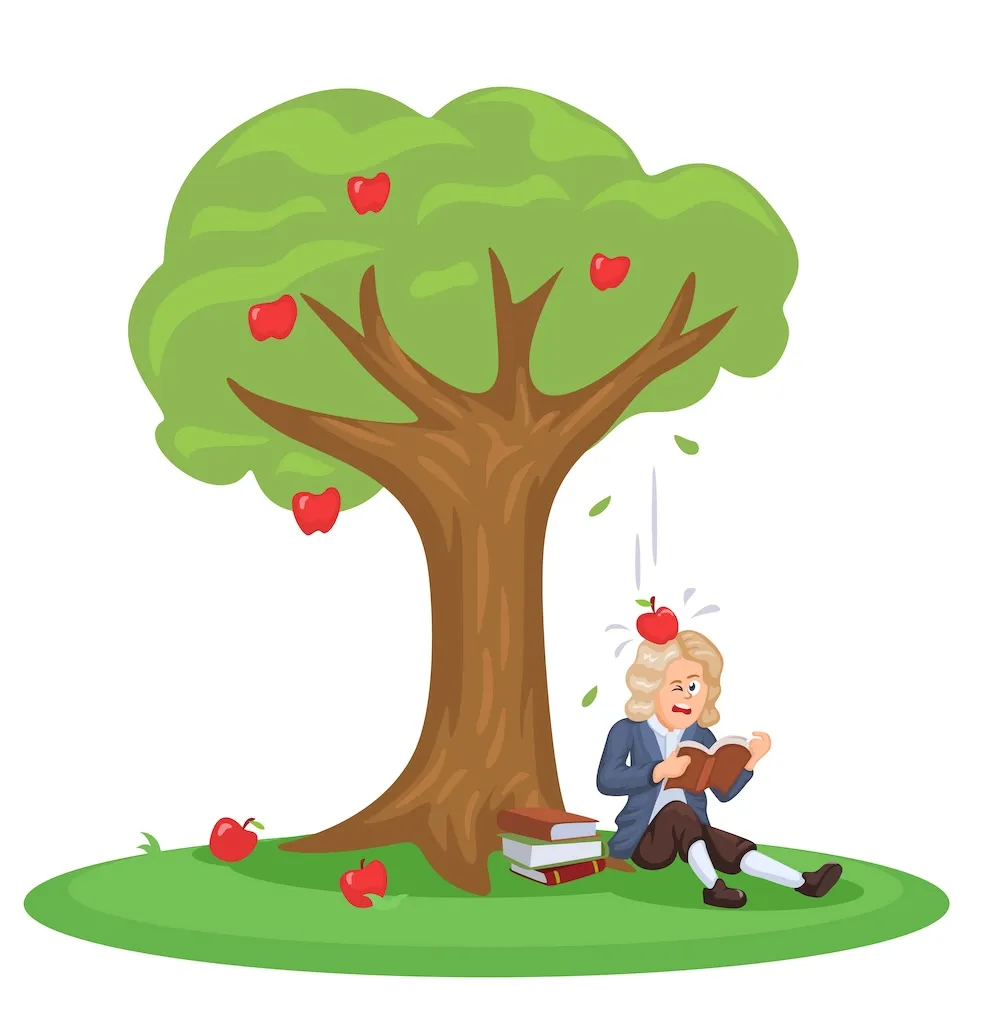
The story of an apple hitting Isaac Newton on the head is one of the most famous tales in science history. However, this dramatic version is folklore—a story that has been changed and exaggerated over time. The truth is different but just as interesting.
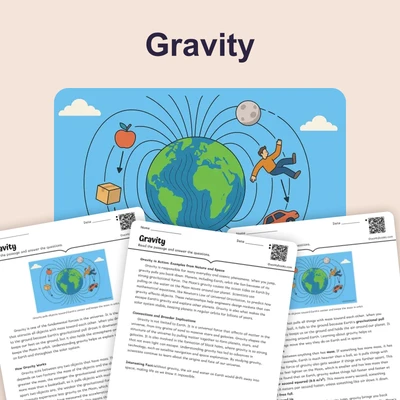
Newton did observe an apple fall from a tree in 1666. Evidence shows he was thinking about why objects fall straight down to Earth. This observation sparked his curiosity about gravitational force, the invisible pull between objects with mass. Newton wondered why the apple fell toward Earth instead of sideways or upward. He realized that Earth's mass creates a force that attracts other objects toward its center.
Scientists explain that Newton spent years developing his ideas through careful study and mathematics. He did not have a sudden revelation from being struck by fruit. Instead, he used evidence from many observations to build his theory of universal gravitation. This theory states that every object with mass pulls on every other object. The strength of this pull depends on the masses of the objects and the distance between them.
The apple story became more dramatic over time as people retold it. Newton himself mentioned the falling apple in conversations late in his life, but he never claimed it hit his head. Writers and storytellers added that detail to make the story more memorable and entertaining. This shows how historical accounts can become misconceptions when facts mix with fiction.
Understanding the real story matters because it shows how science actually works. Scientific discoveries come from careful observation, questioning, and testing ideas over time. Newton's work on gravity changed how we understand motion and forces in the universe. His laws help us predict how objects move on Earth and in space, from falling apples to orbiting satellites.
Interesting Fact: Newton's work on gravity also explained why the Moon orbits Earth instead of flying off into space. The same gravitational force that pulls an apple down keeps the Moon in its path around our planet.
Comprehension quiz (10 questions)
1. According to the passage, what really happened with Newton and the apple?
2. What year did Newton observe the falling apple?
3. What does the term 'folklore' mean in the passage?
4. What does 'gravitational force' refer to?
5. Why did the apple story become more dramatic over time?
6. What can we infer about how scientific discoveries are made based on Newton's work?
7. According to Newton's theory of universal gravitation, what affects the strength of gravitational pull between objects?
8. How could you apply Newton's understanding of gravity to explain why a basketball falls to the ground when you drop it?
9. True or False: Newton claimed that an apple hit him on the head.
10. True or False: The same gravitational force that pulls an apple down also keeps the Moon orbiting Earth.
Perfect for the way you teach
- Build comprehension skills
- Auto-graded quiz
- Differentiated reading
- Read together at home
- Improve fluency
- Quiet reading time
- Reading curriculum support
- Independent practice
- Track Lexile growth