Gravity
Interactive passage with audio narration, comprehension questions, and printable PDF.
By completing this purchase you agree to our Terms of Use and Privacy Policy. Your subscription renews automatically until you cancel. You can cancel anytime from your account settings. All sales are final and non-refundable. Digital content is available for download in your account immediately upon purchase.
What's included
Gravity preview and details
About this printable Gravity science reading passage, NGSS-aligned (Grades 5-8)
Sample passage and quiz from Gravity
Reading passage and comprehension quiz preview
Gravity
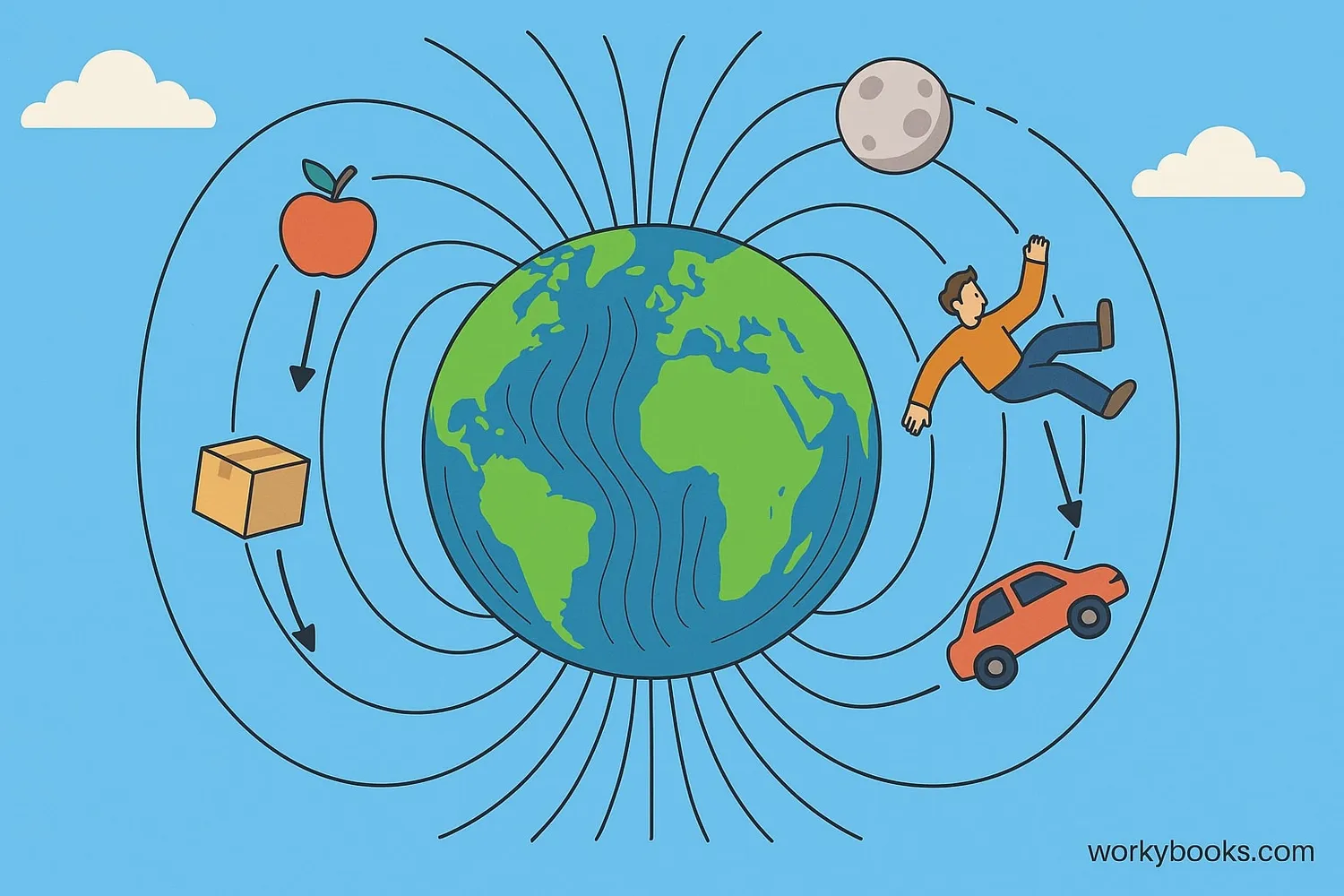
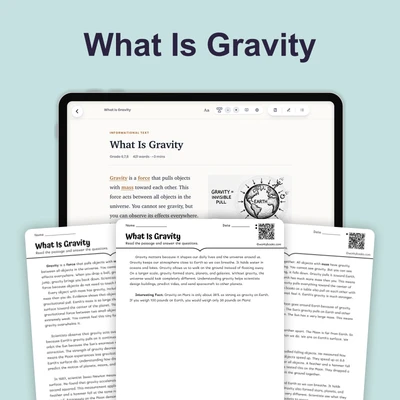
Gravity is one of the fundamental forces in the universe. It is the invisible force that attracts all objects with mass toward each other. When you drop a ball, it falls to the ground because Earth's gravitational pull draws it downward. Gravity not only keeps our feet on the ground, but it also holds the atmosphere around our planet and keeps the Moon in orbit. Understanding gravity helps us explain the motion of objects on Earth and throughout the solar system.
How Gravity Works
Gravity acts between any two objects that have mass. The strength of this force depends on two factors: the mass of the objects and the distance between them. The greater the mass, the stronger the gravitational attraction. For example, Earth has more mass than a basketball, so it pulls objects with much more force. The farther apart two objects are, the weaker the gravitational force between them. This is why astronauts experience less gravity on the Moon, which is smaller and less massive than Earth. Scientists have measured the acceleration due to Earth's gravity as 9.8 meters per second squared (9.8 m/s²). This means that if you drop an object, it speeds up by 9.8 meters per second for every second it falls, as long as no other force (like air resistance) is acting on it. This rapid increase in speed is called free fall.
Gravity in Action: Examples from Nature and Space
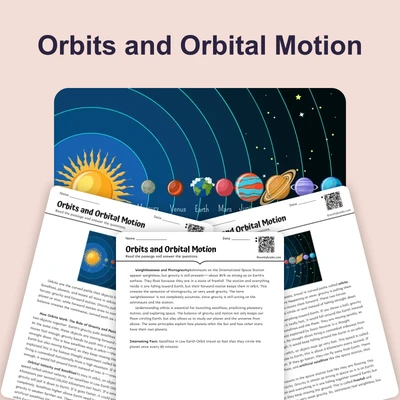
Gravity is responsible for many everyday and cosmic phenomena. When you jump, gravity pulls you back down. Planets, including Earth, orbit the Sun because of its strong gravitational force. The Moon's gravity causes the ocean tides on Earth by pulling on the water as the Moon moves around our planet. Scientists use mathematical equations, like Newton's Law of Universal Gravitation, to predict how gravity affects objects. These relationships help engineers design rockets that can escape Earth's gravity and explore other planets. Gravity is also what makes the solar system stable, keeping planets in regular orbits for billions of years.
Connections and Broader Implications
Gravity is not limited to Earth. It is a universal force that affects all matter in the universe, from tiny grains of sand to massive stars and galaxies. Gravity shapes the structure of the universe by pulling matter together to form planets, stars, and galaxies. It is also involved in the formation of black holes, where gravity is so strong that not even light can escape. Understanding gravity has led to advances in technology, such as satellite navigation and space exploration. By studying gravity, scientists continue to learn about the origins and fate of our universe.
Interesting Fact:
Without gravity, the air and water on Earth would drift away into space, making life as we know it impossible.
Comprehension quiz (10 questions)
1. What is gravity?
2. Which two factors affect the strength of gravitational force?
3. What is the acceleration due to gravity on Earth?
4. What causes ocean tides on Earth?
5. What is free fall?
6. In the passage, what does the term 'mass' mean?
7. Why do astronauts feel lighter on the Moon?
8. Which of the following is a result of gravity in space?
9. True or False: Gravity only exists on Earth.
10. True or False: Without gravity, the air and water on Earth would stay in place.
Perfect for the way you teach
- Build comprehension skills
- Auto-graded quiz
- Differentiated reading
- Read together at home
- Improve fluency
- Quiet reading time
- Reading curriculum support
- Independent practice
- Track Lexile growth