Mass vs Weight
Interactive passage with audio narration, comprehension questions, and printable PDF.
By completing this purchase you agree to our Terms of Use and Privacy Policy. Your subscription renews automatically until you cancel. You can cancel anytime from your account settings. All sales are final and non-refundable. Digital content is available for download in your account immediately upon purchase.
What's included
Mass vs Weight preview and details
About this printable Mass vs Weight science reading passage, NGSS-aligned (Grades 5-8)
Sample passage and quiz from Mass vs Weight
Reading passage and comprehension quiz preview
How Mass and Weight Differ
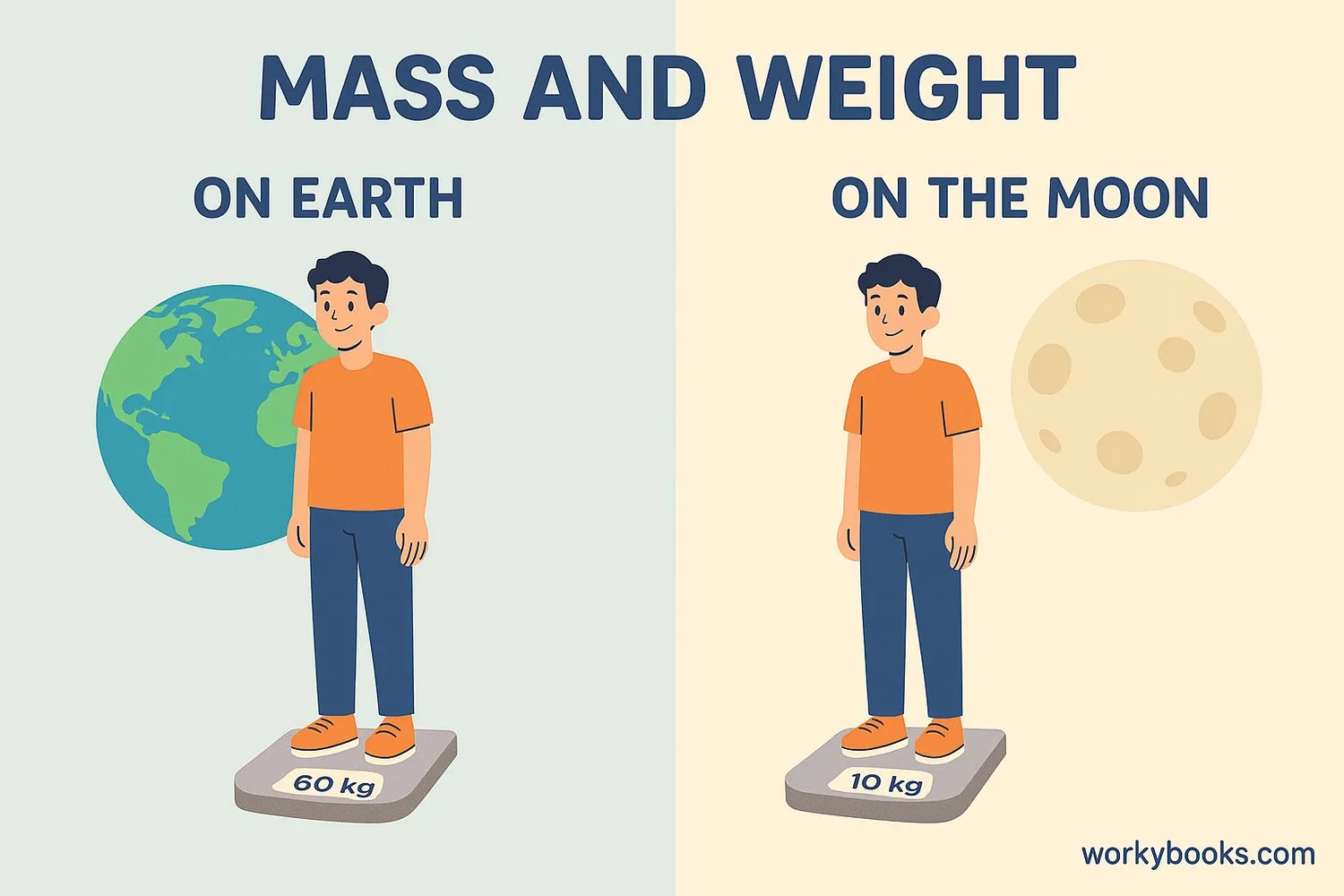
Mass and weight are two scientific concepts often confused, but they play different roles in understanding our universe. On Earth, a bathroom scale shows a number when you step on it, but does that number represent your mass or your weight? Scientists have found that, while related, mass and weight are not the same. Understanding the difference is vital for everything from space travel to everyday measurements in science.
How Mass and Weight Work
Mass is the amount of matter—the stuff that makes up an object. It remains constant no matter where you are in the universe. Mass is measured in kilograms (kg). Weight, however, is a force. It is the pull of gravity on an object's mass. The formula for weight is: weight = mass × gravity. On Earth, gravity is about 9.8 newtons per kilogram (N/kg). So, if you have a mass of 50 kg, your weight on Earth is 50 kg × 9.8 N/kg = 490 newtons (N). In this way, weight depends on both your mass and the strength of gravity where you are.
Examples from Earth, Moon, and Space
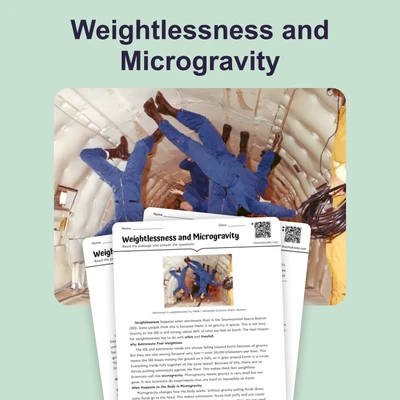
An astronaut's mass is the same everywhere—let’s say 80 kg. On Earth, the weight is 80 kg × 9.8 N/kg = 784 N. On the Moon, gravity is much weaker, about 1.6 N/kg. The astronaut’s weight there is 80 kg × 1.6 N/kg = 128 N. In deep space, far from planets, gravity is almost zero, so weight nearly disappears, but mass stays at 80 kg. This shows that mass stays the same but weight changes depending on gravity. Everyday objects show this, too: a rock has the same mass on Earth and Mars, but its weight will be less on Mars due to weaker gravity.
Common Misconceptions and Scientific Thinking
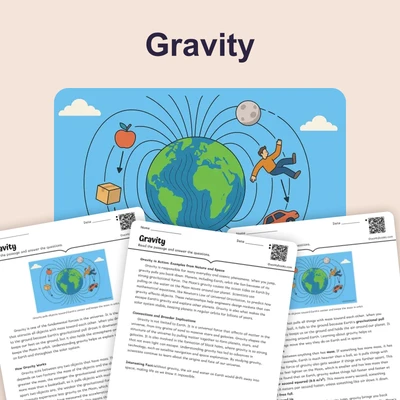
Many people believe weight and mass are the same, partly because we often use 'weight' to mean 'how heavy' something is. However, scientists carefully separate the two ideas. For instance, astronauts must know their true mass so they can calculate fuel needs, even when their weight is much less on the Moon or in space. This distinction is important in physics, chemistry, and engineering. Knowing the difference helps us predict how objects will move, design safe vehicles, and understand forces in nature. The law of universal gravitation explains that every mass pulls on every other mass, but the strength of that pull depends on mass and distance.
Understanding mass and weight shows how physical laws connect objects, forces, and motion throughout the universe. Whether on Earth, the Moon, or beyond, this distinction is crucial for science and technology.
Interesting Fact:
On Jupiter, your weight would be more than twice what it is on Earth, because Jupiter’s gravity is much stronger!
Comprehension quiz (10 questions)
1. Which of the following best describes mass?
2. What is the correct formula for calculating weight?
3. Which unit is used to measure weight in the metric system?
4. Why does an astronaut weigh less on the Moon than on Earth?
5. What happens to your mass if you travel from Earth to space?
6. In the passage, which word describes a push or pull on an object?
7. What does the law of universal gravitation state?
8. If a rock weighs less on Mars than on Earth, what stays the same?
9. True or False: Weight changes depending on the strength of gravity.
10. True or False: Scientists use the word 'weight' to mean 'mass' in physics.
Perfect for the way you teach
- Build comprehension skills
- Auto-graded quiz
- Differentiated reading
- Read together at home
- Improve fluency
- Quiet reading time
- Reading curriculum support
- Independent practice
- Track Lexile growth