Escape Velocity and Space Travel — Reading Comprehension
Rate this
Premium Resource
Present
Present in classroom. No work saved
Assign
Classroom with student accounts, Track progress
Quick Play
No student accounts, assign with a link
Grades
5
6
7
8
Standards
MS-ESS1-2
MS-PS2-4
PRINT+DIGITAL RESOURCE
This learning resource is available in interactive and printable formats. The interactive worksheet can be played online and assigned to students. The Printable PDF version can be downloaded and printed for completion by hand.
This middle school science passage introduces students to the concept of escape velocity—the minimum speed required to break free from a planet or star’s gravitational pull. Aligned with NGSS standards MS-ESS1-2 and MS-PS2-4, the text explains the underlying mechanisms of escape velocity, including the role of mass and radius, and offers real-world examples such as Earth, the Moon, Jupiter, and black holes. Students will learn how rockets achieve escape velocity to leave Earth, the difference between orbiting and escaping, and the innovative use of gravity assists in space exploration. The passage includes vocabulary support, differentiated content for struggling readers, Spanish translations, multiple-choice and writing activities, and graphic organizers. Audio integration is available for enhanced accessibility. This resource is ideal for teaching systems thinking and cause-and-effect relationships in space science.
CONTENT PREVIEW
Expand content preview
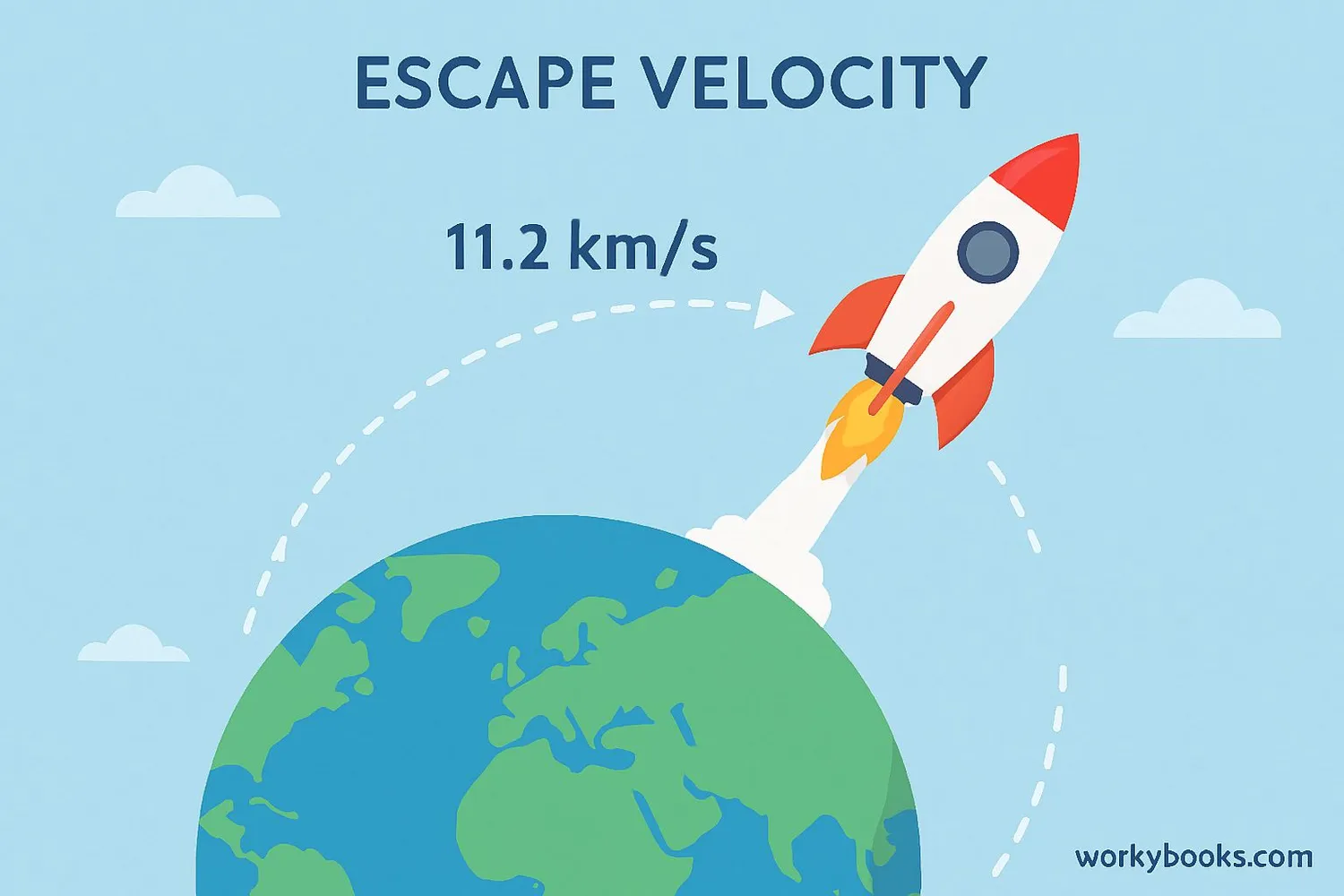
Visual representation of escape velocity concept
Escape velocity is a key concept in space science and engineering. Every planet, moon, or star has its own gravitational pull that keeps objects anchored to its surface. To travel beyond Earth's atmosphere and into space, rockets must reach a certain minimum speed. This speed is called escape velocity. Understanding escape velocity helps scientists design spacecraft capable of leaving Earth and exploring the rest of the solar system.
How Escape Velocity Works
Escape velocity is the minimum speed an object must reach to break free from a body's gravitational pull without using additional thrust after launch. For Earth, the escape velocity is about 11.2 kilometers per second (about 40,000 km/h). This means a rocket must travel at least this speed to leave Earth's gravity entirely. The value of escape velocity depends on two main factors: the mass of the planet or star, and its radius (distance from its center to the surface). The larger and more massive the body, the higher the escape velocity. For example, Jupiter's escape velocity is about 60 km/s, while the Moon's is just 2.4 km/s because it is smaller and has less mass. Surprisingly, the escape velocity does not depend on the mass of the object trying to escape—a pebble and a spaceship need the same speed to break free from Earth's gravity.
Applications and Related Concepts
Spacecraft must achieve escape velocity to leave Earth and travel to other planets. However, reaching such high speeds requires a lot of energy and fuel. To solve this problem, scientists use gravity assists, also called slingshot maneuvers. In a gravity assist, a spacecraft flies close to a planet and uses its gravity to increase speed without burning extra fuel. The famous Voyager missions used multiple gravity assists to gain enough speed to leave the solar system. There is a difference between orbital velocity—the speed needed to stay in orbit around a planet—and escape velocity. If a spacecraft moves at orbital velocity, it circles the planet. At escape velocity, it can leave the planet's gravity completely.
Extreme Examples: The Sun and Black Holes
The Sun has an escape velocity of about 618 km/s, much higher than any planet, because of its enormous mass. The most extreme case is a black hole. Its escape velocity is greater than the speed of light, which means nothing—not even light—can escape its gravity. This knowledge comes from both mathematical calculations and evidence from astronomical observations, such as the movement of stars near black holes.
Understanding escape velocity is crucial for planning space missions and helps explain the behavior of objects in our universe. It connects to broader ideas in science, such as the laws of motion and gravity described by Isaac Newton, and helps us understand the challenges and possibilities of space exploration.
Interesting Fact: If you could throw a baseball at Earth's escape velocity, it would leave the planet and never come back!
What is escape velocity?
The minimum speed needed to leave a planet's gravity without more thrustThe speed needed to orbit a planetThe maximum speed a rocket can reachThe speed of light in space
How does the mass of a planet affect its escape velocity?
A larger mass increases the escape velocityA larger mass decreases the escape velocityMass does not affect escape velocityOnly the object's mass matters
Which of the following has the highest escape velocity?
The MoonEarthJupiterThe Sun
What is a gravity assist?
Using a planet’s gravity to speed up a spacecraftSlowing down a spacecraft with gravityStaying in orbit around a moonLanding on a planet
Which best describes the difference between orbital velocity and escape velocity?
Orbital velocity keeps a spacecraft in orbit; escape velocity lets it leave the planetThey are exactly the same thingEscape velocity is only used on the MoonOrbital velocity is faster than escape velocity
Why can nothing escape from a black hole?
Because its escape velocity is greater than the speed of lightBecause it has no gravityBecause it is too smallBecause it spins too fast
What is NOT needed to calculate escape velocity?
The mass of the object trying to escapeThe mass of the planet or starThe radius of the planet or starGravity
True or False: A pebble and a spaceship both need the same escape velocity to leave Earth’s gravity.
TrueFalse
True or False: Gravity assists allow spacecraft to save fuel by increasing speed.
TrueFalse
What did the Voyager missions use to gain enough speed to leave the solar system?
Multiple gravity assistsOnly rocket fuelOrbiting the SunLanding on Jupiter
Perfect For:
👩🏫 Teachers
• Reading comprehension practice
• Auto-graded assessments
• Literacy skill development
👨👩👧👦 Parents
• Reading practice at home
• Comprehension improvement
• Educational reading time
🏠 Homeschoolers
• Reading curriculum support
• Independent reading practice
• Progress monitoring
Reading Features:
📖
Reading Passage
Engaging fiction or nonfiction text
❓
Comprehension Quiz
Auto-graded questions
📊
Instant Feedback
Immediate results and scoring
📄
Printable Version
Download for offline reading
🔊
Read Aloud
Voice-over with word highlighting
Reviews & Ratings
No reviews yet. Be the first to share your experience!
Related Content
Comets
This middle school science passage explores the fascinating world of comets, commonly known as 'dirty snowballs.' Studen...
MS-ESS1-2
Mercury: Closest to the Sun
This comprehensive, standards-aligned passage explores Mercury—the smallest and closest planet to the Sun. Students in g...
MS-ESS1-2MS-ESS1-3
Venus: Earth's Twin?
This comprehensive science passage for grades 6-8 examines Venus—often called Earth's twin—by exploring its similarities...
MS-ESS1-2MS-ESS1-3
Earth: Our Home Planet
This comprehensive science passage for grades 6-8 explores Earth’s unique characteristics and the interconnected systems...
MS-ESS1-2
Mars: The Red Planet
This middle school science passage explores Mars, the Red Planet, providing students in grades 6-8 with a comprehensive ...
MS-ESS1-2MS-ESS1-3
What Is Gravity?
This comprehensive middle school science reading passage explores the concept of gravity, aligning with NGSS standards M...
MS-ESS1-2MS-PS2-4
Kepler's Laws of Planetary Motion
This comprehensive middle school science passage explores Kepler's Laws of Planetary Motion, meeting NGSS Standard MS-ES...
MS-ESS1-2
Tides and Tidal Forces
This middle school science passage explores the mechanisms of tides and tidal forces, aligning with NGSS standards MS-ES...
MS-ESS1-1MS-ESS1-2
Weightlessness and Microgravity
This science reading passage for middle school students explores the phenomenon of weightlessness and microgravity. Alig...
MS-PS2-4MS-ESS1-2
Orbits and Orbital Motion
This middle school science passage, aligned with NGSS MS-ESS1-2 and MS-PS2-4, explores the science of orbits and orbital...
MS-ESS1-2MS-PS2-4
What Is the Solar System?
This passage provides a comprehensive overview of the solar system for grades 6-8, aligned with NGSS standards MS-ESS1-2...
MS-ESS1-2MS-ESS1-3
Structure of the Solar System
This comprehensive science reading passage introduces middle school students (grades 6-8) to the structure of the solar ...
MS-ESS1-2MS-ESS1-3
Moons of the Solar System
This comprehensive passage, designed for grades 6-8 and aligned to NGSS standard MS-ESS1-2, delves into the fascinating ...
MS-ESS1-2
Defining Life: What Are We Looking For?
This informational science passage for middle school students explores the question: What is life, and how do we define ...
MS-LS1-1MS-ESS1-2
Astronomy
This comprehensive reading passage introduces middle school students to the science of astronomy, which is the study of ...
MS-ESS1-2MS-ESS1-3MS-PS4-2MS-ETS1-1
The Solar System
This middle school science passage introduces students to the solar system, aligning with NGSS standards MS-ESS1-2 and M...
MS-ESS1-2MS-ESS1-3
Gravity and Orbits
This comprehensive passage for grades 6-8 explains the science of gravity and orbits, aligning with NGSS standard MS-ESS...
MS-ESS1-2
The Inner Planets
This comprehensive science passage for grades 6-8 explores the inner (terrestrial) planets of our solar system—Mercury, ...
MS-ESS1-2MS-ESS1-3
The Outer Planets
This engaging science passage for grades 6-8 introduces students to the outer planets—Jupiter, Saturn, Uranus, and Neptu...