This learning resource is available in interactive and printable formats. The interactive worksheet can be played online and assigned to students. The Printable PDF version can be downloaded and printed for completion by hand.
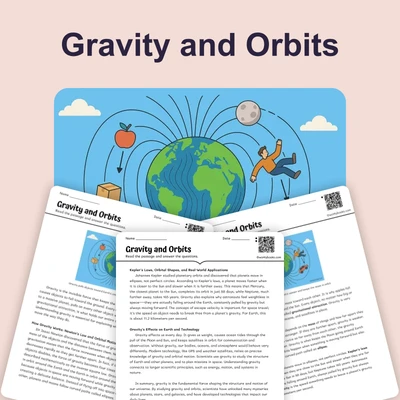
This middle school science passage, aligned with NGSS MS-ESS1-2 and MS-PS2-4, explores the science of orbits and orbital motion. Students will learn how gravity and forward motion create the curved paths of satellites, planets, and moons around larger bodies. The passage explains Newton's cannon thought experiment, the concept of orbital velocity, and why astronauts appear weightless in space. It distinguishes between natural and artificial satellites and connects these ideas to broader scientific principles of force, motion, and systems. With an accessible glossary, Spanish translation, a simplified version for struggling readers, comprehension quiz, writing prompts, and graphic organizers, this resource supports diverse learners. The passage is audio integrated and ideal for building foundational understanding of space science, gravity, and technology's role in observing and exploring our universe.
CONTENT PREVIEW
Expand content preview
Orbits are the curved paths that objects follow around other objects in space. Satellites, planets, and moons all move in orbits because of a balance between two forces: gravity and forward motion. Gravity pulls objects toward the center of a planet or star, while forward motion tries to carry them away in a straight line. This balance creates the continuous, curved path we call an orbit.
How Orbits Work: The Role of Gravity and Motion Gravity is the force that pulls two objects together. Earth's gravity pulls satellites and the Moon toward its center. At the same time, these objects are moving forward at high speeds. If an object moves fast enough, gravity bends its path into a curve instead of letting it fall straight down. This is how satellites stay in orbit—they are constantly falling toward Earth but also moving forward, so they keep missing the ground. Isaac Newton explained this in his famous thought experiment called Newton's cannon. He imagined firing a cannonball horizontally from a high mountain. If the cannonball traveled fast enough, it would fall around Earth instead of into it—creating a circular orbit.
Orbital Velocity and Satellites To stay in orbit, an object must reach a certain speed called orbital velocity. For satellites in Low Earth Orbit, this speed is about 8 kilometers per second (28,000 kilometers per hour). If a satellite goes slower, gravity will pull it down to Earth. If it goes faster, it could escape Earth's gravity completely. Satellites higher above Earth need less speed to stay in orbit because gravity is weaker farther out. There are natural satellites (like the Moon) and artificial satellites (like the International Space Station) that use these principles to orbit Earth.
Weightlessness and Microgravity Astronauts on the International Space Station appear weightless, but gravity is still present—about 90% as strong as on Earth's surface. They float because they are in a state of freefall. The station and everything inside it are falling toward Earth, but their forward motion keeps them in orbit. This creates the sensation of microgravity, or very weak gravity. The term 'weightlessness' is not completely accurate, since gravity is still acting on the astronauts and the station.
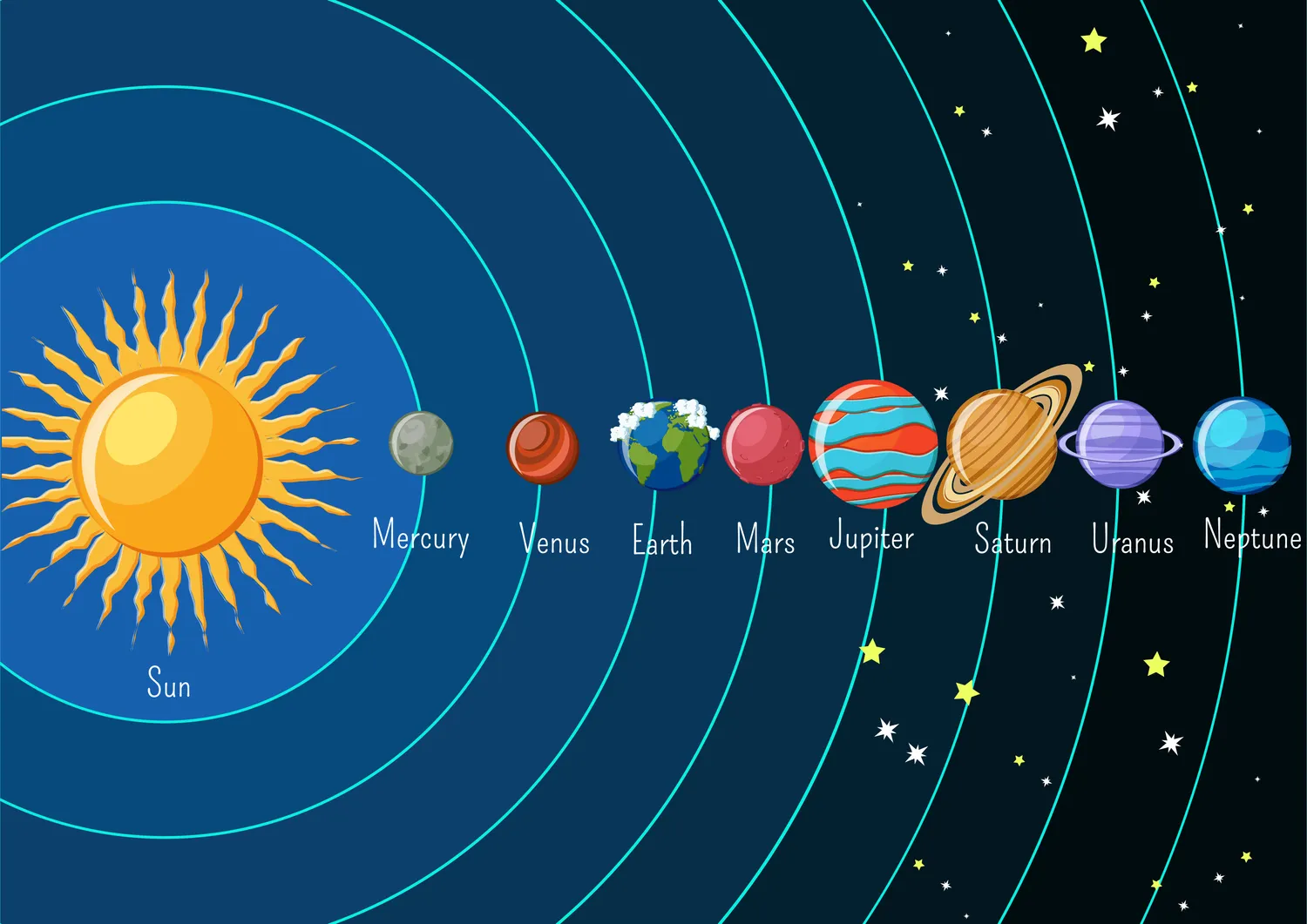
Understanding orbits is essential for launching satellites, predicting planetary motion, and exploring space. The balance of gravity and motion not only keeps our Moon circling Earth, but also allows us to study our planet and the universe from above. The same principles explain how planets orbit the Sun and how other stars have their own planets.
Interesting Fact: Satellites in Low Earth Orbit travel so fast that they circle the planet once every 90 minutes!
What two main forces combine to create an orbit?
Gravity and forward motionFriction and air pressureElectricity and magnetismLight and sound
According to the passage, what is orbital velocity?
The speed needed to stay in orbitThe force of gravity on an objectThe distance from Earth to the MoonThe weight of a satellite
How fast must a satellite in Low Earth Orbit travel to remain in orbit?
About 8 kilometers per secondAbout 1 kilometer per hourAbout 100 meters per secondAbout 28 kilometers per day
What does 'microgravity' mean as used in the passage?
Very weak gravityNo gravity at allStrong gravityGravity that only affects small objects
What is the main reason astronauts appear weightless in the International Space Station?
They are in freefall, falling together with the stationThere is no gravity in spaceThe station is moving away from EarthThey wear special suits that cancel gravity
Which of the following is an artificial satellite?
The International Space StationThe MoonMarsThe Sun
True or False: Gravity is completely absent for astronauts in orbit.
TrueFalse
True or False: A satellite moving faster than orbital velocity will escape Earth's gravity.
TrueFalse
If a satellite slows down while in orbit, what will most likely happen?
It will fall toward EarthIt will move to a higher orbitIt will remain in placeIt will become a natural satellite
Why do satellites in higher orbits need to move more slowly than those in low orbits?
Gravity is weaker farther from EarthThey are heavierThey are powered by the SunThere is more air resistance
Perfect For:
👩🏫 Teachers
• Reading comprehension practice
• Auto-graded assessments
• Literacy skill development
👨👩👧👦 Parents
• Reading practice at home
• Comprehension improvement
• Educational reading time
🏠 Homeschoolers
• Reading curriculum support
• Independent reading practice
• Progress monitoring
Reading Features:
📖
Reading Passage
Engaging fiction or nonfiction text
❓
Comprehension Quiz
Auto-graded questions
📊
Instant Feedback
Immediate results and scoring
📄
Printable Version
Download for offline reading
🔊
Read Aloud
Voice-over with word highlighting
Reviews & Ratings
No reviews yet. Be the first to share your experience!
Related Content
Comets
This middle school science passage explores the fascinating world of comets, commonly known as 'dirty snowballs.' Studen...
MS-ESS1-2
Mercury: Closest to the Sun
This comprehensive, standards-aligned passage explores Mercury—the smallest and closest planet to the Sun. Students in g...
MS-ESS1-2MS-ESS1-3
Venus: Earth's Twin?
This comprehensive science passage for grades 6-8 examines Venus—often called Earth's twin—by exploring its similarities...
MS-ESS1-2MS-ESS1-3
Earth: Our Home Planet
This comprehensive science passage for grades 6-8 explores Earth’s unique characteristics and the interconnected systems...
MS-ESS1-2
Mars: The Red Planet
This middle school science passage explores Mars, the Red Planet, providing students in grades 6-8 with a comprehensive ...
MS-ESS1-2MS-ESS1-3
What Is Gravity?
This comprehensive middle school science reading passage explores the concept of gravity, aligning with NGSS standards M...
MS-ESS1-2MS-PS2-4
Kepler's Laws of Planetary Motion
This comprehensive middle school science passage explores Kepler's Laws of Planetary Motion, meeting NGSS Standard MS-ES...
MS-ESS1-2
Tides and Tidal Forces
This middle school science passage explores the mechanisms of tides and tidal forces, aligning with NGSS standards MS-ES...
MS-ESS1-1MS-ESS1-2
Escape Velocity and Space Travel
This middle school science passage introduces students to the concept of escape velocity—the minimum speed required to b...
MS-ESS1-2MS-PS2-4
Weightlessness and Microgravity
This science reading passage for middle school students explores the phenomenon of weightlessness and microgravity. Alig...
MS-PS2-4MS-ESS1-2
What Is the Solar System?
This passage provides a comprehensive overview of the solar system for grades 6-8, aligned with NGSS standards MS-ESS1-2...
MS-ESS1-2MS-ESS1-3
Structure of the Solar System
This comprehensive science reading passage introduces middle school students (grades 6-8) to the structure of the solar ...
MS-ESS1-2MS-ESS1-3
Moons of the Solar System
This comprehensive passage, designed for grades 6-8 and aligned to NGSS standard MS-ESS1-2, delves into the fascinating ...
MS-ESS1-2
Defining Life: What Are We Looking For?
This informational science passage for middle school students explores the question: What is life, and how do we define ...
MS-LS1-1MS-ESS1-2
Astronomy
This comprehensive reading passage introduces middle school students to the science of astronomy, which is the study of ...
MS-ESS1-2MS-ESS1-3MS-PS4-2MS-ETS1-1
The Solar System
This middle school science passage introduces students to the solar system, aligning with NGSS standards MS-ESS1-2 and M...
MS-ESS1-2MS-ESS1-3
Gravity and Orbits
This comprehensive passage for grades 6-8 explains the science of gravity and orbits, aligning with NGSS standard MS-ESS...
MS-ESS1-2
The Inner Planets
This comprehensive science passage for grades 6-8 explores the inner (terrestrial) planets of our solar system—Mercury, ...
MS-ESS1-2MS-ESS1-3
The Outer Planets
This engaging science passage for grades 6-8 introduces students to the outer planets—Jupiter, Saturn, Uranus, and Neptu...