This learning resource is available in interactive and printable formats. The interactive worksheet can be played online and assigned to students. The Printable PDF version can be downloaded and printed for completion by hand.
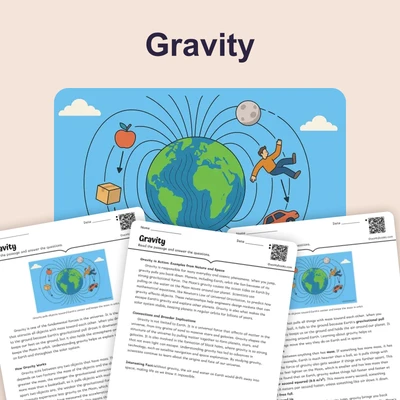
This comprehensive middle school science reading passage explores the concept of gravity, aligning with NGSS standards MS-ESS1-2 and MS-PS2-4. Students learn how gravity is the universal force of attraction between all objects with mass, how its strength depends on mass and distance, and how it affects everything from falling objects to planetary orbits. The passage explains Newton's law of universal gravitation and Einstein's theory of spacetime curvature in accessible language. Real-world examples, such as Earth's gravity holding us down and the Sun's gravity keeping the solar system together, are included. The resource features a glossary, Spanish translation, differentiated version, comprehension quiz, writing prompts, and graphic organizers to enhance understanding. Audio integration supports diverse learners. Ideal for grades 6-8 science classrooms.
CONTENT PREVIEW
Expand content preview
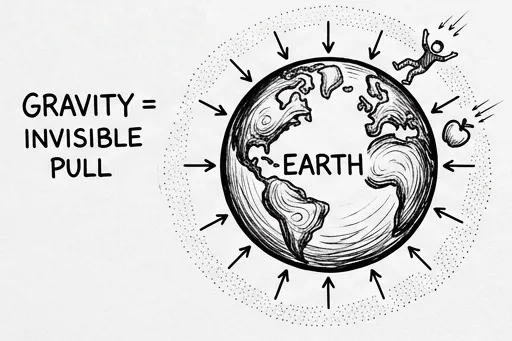
Gravity pulls objects toward Earth's center and keeps the moon in orbit
Gravity is a fundamental force that acts throughout the universe. Every object with mass experiences gravity, from tiny grains of sand to massive planets and stars. This force pulls objects toward each other and influences the structure and behavior of everything in the cosmos. Without gravity, there would be no planets, stars, or galaxies, and life as we know it would not exist.
The Universal Force of Attraction The scientist Isaac Newton first described gravity as a universal force of attraction between all objects with mass. According to Newton’s law of universal gravitation, every object attracts every other object in the universe. The strength of this force depends on two main factors: the mass of the objects and the distance between them. The greater the mass, the stronger the gravity. For example, Earth’s gravity is much stronger than the Moon’s because Earth is more massive. Distance also matters—a force called the inverse square law means that if you double the distance between two objects, the gravitational force becomes one-fourth as strong.
Gravity in Action: Everyday Life and the Universe Gravity affects us in everyday ways. It holds us on the ground and gives us weight. It also explains why objects fall toward the Earth when dropped. The Moon’s gravity is about one-sixth as strong as Earth’s, so astronauts can jump much higher there. The Sun’s gravity is so strong that it keeps the entire solar system—planets, comets, and asteroids—in their orbits. Planets stay in orbit because they move forward fast enough that, although the Sun’s gravity pulls them inward, they do not fall straight in. Instead, they travel in curved paths around the Sun. This balance of gravitational pull and forward motion creates orbits.
Modern Understanding: Einstein and Curved Spacetime Albert Einstein expanded our understanding of gravity with his theory of general relativity. He explained that gravity is not just a force but a bending, or curvature, of spacetime caused by mass. Massive objects like stars and planets create dents in the fabric of spacetime, and other objects move along these curves. This idea has been confirmed by many experiments, such as observing how light bends near the Sun during an eclipse. While Newton’s law works well for most everyday situations, Einstein’s theory is needed to explain extreme cases, like black holes and the motion of planets close to the Sun.
Gravity connects the entire universe, from tiny particles to enormous galaxies. It shapes the structure of the cosmos and the motions of everything within it. Scientists continue to study gravity to answer deep questions about the universe’s origin and future.
Interesting Fact: The International Space Station orbits Earth because it is moving fast enough that its fall toward Earth matches the curve of the planet’s surface, creating a state of continuous free-fall—what we call "microgravity."
What is gravity?
A force that pulls objects with mass toward each otherA type of energy created by the SunThe amount of matter in an objectA kind of light that travels through space
According to the passage, why does Earth’s gravity feel stronger than the Moon’s?
Earth is closer to the SunEarth has more mass than the MoonThe Moon is made of lighter materialsThe Sun’s gravity pushes Earth
What happens to the gravitational force if the distance between two objects doubles?
It becomes one-fourth as strongIt doublesIt stays the sameIt becomes twice as strong
What does the term "spacetime" mean in the passage?
A type of space travelThe fabric that combines space and time and is affected by gravityA measurement of how fast an object movesA place where planets are formed
Why do astronauts jump higher on the Moon than on Earth?
The Moon has less gravity than EarthThe Moon has more gravity than EarthThere is no air on the MoonThe Moon spins faster
What keeps planets in orbit around the Sun?
The balance of the Sun’s gravitational pull and the planet’s forward motionThe planet’s own gravityThe Sun’s lightThe pull of other planets
Which scientist explained gravity as the curvature of spacetime?
Isaac NewtonAlbert EinsteinGalileo GalileiNikola Tesla
True or False: Gravity only acts on Earth and not in space.
TrueFalse
True or False: The International Space Station is in continuous free-fall around Earth, which is called microgravity.
TrueFalse
What is the main reason scientists continue to study gravity?
To answer deep questions about the universe’s origin and futureTo find new planetsTo measure the weight of objectsTo make objects float
Perfect For:
👩🏫 Teachers
• Reading comprehension practice
• Auto-graded assessments
• Literacy skill development
👨👩👧👦 Parents
• Reading practice at home
• Comprehension improvement
• Educational reading time
🏠 Homeschoolers
• Reading curriculum support
• Independent reading practice
• Progress monitoring
Reading Features:
📖
Reading Passage
Engaging fiction or nonfiction text
❓
Comprehension Quiz
Auto-graded questions
📊
Instant Feedback
Immediate results and scoring
📄
Printable Version
Download for offline reading
🔊
Read Aloud
Voice-over with word highlighting
Reviews & Ratings
No reviews yet. Be the first to share your experience!
Related Content
Comets
This middle school science passage explores the fascinating world of comets, commonly known as 'dirty snowballs.' Studen...
MS-ESS1-2
Mercury: Closest to the Sun
This comprehensive, standards-aligned passage explores Mercury—the smallest and closest planet to the Sun. Students in g...
MS-ESS1-2MS-ESS1-3
Venus: Earth's Twin?
This comprehensive science passage for grades 6-8 examines Venus—often called Earth's twin—by exploring its similarities...
MS-ESS1-2MS-ESS1-3
Earth: Our Home Planet
This comprehensive science passage for grades 6-8 explores Earth’s unique characteristics and the interconnected systems...
MS-ESS1-2
Mars: The Red Planet
This middle school science passage explores Mars, the Red Planet, providing students in grades 6-8 with a comprehensive ...
MS-ESS1-2MS-ESS1-3
Kepler's Laws of Planetary Motion
This comprehensive middle school science passage explores Kepler's Laws of Planetary Motion, meeting NGSS Standard MS-ES...
MS-ESS1-2
Tides and Tidal Forces
This middle school science passage explores the mechanisms of tides and tidal forces, aligning with NGSS standards MS-ES...
MS-ESS1-1MS-ESS1-2
Escape Velocity and Space Travel
This middle school science passage introduces students to the concept of escape velocity—the minimum speed required to b...
MS-ESS1-2MS-PS2-4
Weightlessness and Microgravity
This science reading passage for middle school students explores the phenomenon of weightlessness and microgravity. Alig...
MS-PS2-4MS-ESS1-2
Orbits and Orbital Motion
This middle school science passage, aligned with NGSS MS-ESS1-2 and MS-PS2-4, explores the science of orbits and orbital...
MS-ESS1-2MS-PS2-4
What Is the Solar System?
This passage provides a comprehensive overview of the solar system for grades 6-8, aligned with NGSS standards MS-ESS1-2...
MS-ESS1-2MS-ESS1-3
Structure of the Solar System
This comprehensive science reading passage introduces middle school students (grades 6-8) to the structure of the solar ...
MS-ESS1-2MS-ESS1-3
Moons of the Solar System
This comprehensive passage, designed for grades 6-8 and aligned to NGSS standard MS-ESS1-2, delves into the fascinating ...
MS-ESS1-2
Defining Life: What Are We Looking For?
This informational science passage for middle school students explores the question: What is life, and how do we define ...
MS-LS1-1MS-ESS1-2
Astronomy
This comprehensive reading passage introduces middle school students to the science of astronomy, which is the study of ...
MS-ESS1-2MS-ESS1-3MS-PS4-2MS-ETS1-1
The Solar System
This middle school science passage introduces students to the solar system, aligning with NGSS standards MS-ESS1-2 and M...
MS-ESS1-2MS-ESS1-3
Gravity and Orbits
This comprehensive passage for grades 6-8 explains the science of gravity and orbits, aligning with NGSS standard MS-ESS...
MS-ESS1-2
The Inner Planets
This comprehensive science passage for grades 6-8 explores the inner (terrestrial) planets of our solar system—Mercury, ...
MS-ESS1-2MS-ESS1-3
The Outer Planets
This engaging science passage for grades 6-8 introduces students to the outer planets—Jupiter, Saturn, Uranus, and Neptu...