Challenges After the Civil War — Reading Comprehension
Rate this
Premium Resource
Present
Present in classroom. No work saved
Assign
Classroom with student accounts, Track progress
Quick Play
No student accounts, assign with a link
Grades
3
4
5
Standards
D2.HIS.1-6.3-5RI.4.3
RI.4.4
W.4.2
PRINT+DIGITAL RESOURCE
This learning resource is available in interactive and printable formats. The interactive worksheet can be played online and assigned to students. The Printable PDF version can be downloaded and printed for completion by hand.
This engaging history reading passage explores the key challenges Americans faced after the Civil War, such as rebuilding the South, helping freed slaves, and bringing the country back together. Students will learn about important figures like President Abraham Lincoln, and discover how communities worked to solve problems and heal the nation. The passage is written for young readers with clear language, a positive tone, and an easy-to-follow sequence of events. It aligns with the C3 Framework and Common Core standards. Included are multiple-choice and writing activities to test understanding, a glossary for key vocabulary, a timeline of major events, a public domain image, and a Spanish translation. This resource is ideal for teaching U.S. history and building literacy skills, with read aloud audio support and activities for deeper learning.
CONTENT PREVIEW
Expand content preview
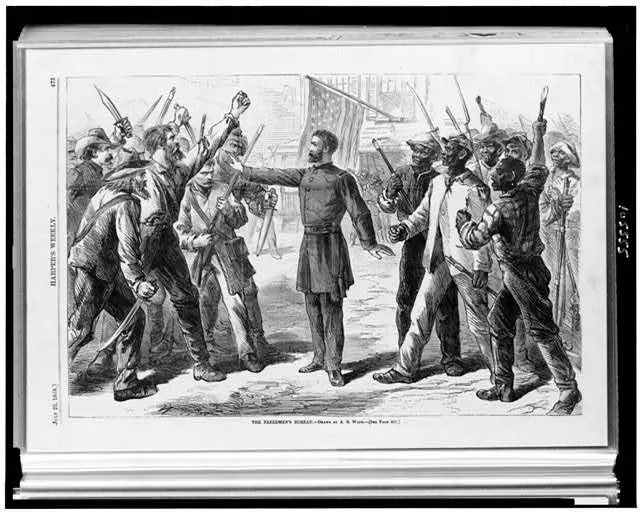
The Freedmen's Bureau Source: Library of Congress - Waud, Alfred R. (Alfred Rudolph), 1828-1891
The period after the Civil War is called Reconstruction. During this time, the United States tried to rebuild the South and help freed African Americans. The Civil War ended in 1865, but many problems remained.
One goal of Reconstruction was to give African Americans equal rights. The government passed new laws, like the 13th, 14th, and 15th Amendments. These laws ended slavery, gave citizenship, and allowed African American men to vote. Leaders such as Frederick Douglass and the Freedmen’s Bureau worked hard to support these changes.
However, there was strong opposition from many white Southerners. Some refused to accept African Americans as equals. They created groups like the Ku Klux Klan, which used violence and threats to scare African Americans. Many Black families lived in poverty and could not find good jobs or homes. Some states made unfair laws called Black Codes to keep African Americans from having power.
The government tried to stop this violence and protect rights, but it was very hard. Soldiers were sent to the South to keep peace, but many people still faced danger. Schools for Black children were opened, but some were burned down. Even with new rights, life was not easy for African Americans.
Over time, the support for Reconstruction weakened. In 1877, federal troops left the South, and many of the new rights were taken away. It would take almost one hundred more years before African Americans gained full equality during the Civil Rights Movement.
The Reconstruction period showed the bravery of those who fought for justice. It also reminds us that change can be slow and hard, but it is important to keep trying for fairness.
Interesting Fact: Some of the first African American members of Congress were elected during Reconstruction, showing that progress was possible, even during difficult times.
What was Reconstruction?
Time after the Civil WarTime before the Civil WarA new warA holiday
Who did the new laws help?
African AmericansAll AmericansOnly soldiersOnly children
What did the 13th Amendment do?
Ended slaveryStarted the Civil WarBuilt new schoolsCreated new states
Why did some schools burn down?
Because of violenceBad weatherToo many studentsOld buildings
What happened after 1877?
Many rights were lostNew states were madeSlavery returnedNo changes
Why was Reconstruction hard?
There was opposition and violenceEveryone agreedNo one needed helpThere were no problems
Reconstruction happened before the Civil War. True or false?
TrueFalse
What does 'poverty' mean?
Being very poorHaving many friendsOwning landBeing a leader
Perfect For:
👩🏫 Teachers
• Reading comprehension practice
• Auto-graded assessments
• Literacy skill development
👨👩👧👦 Parents
• Reading practice at home
• Comprehension improvement
• Educational reading time
🏠 Homeschoolers
• Reading curriculum support
• Independent reading practice
• Progress monitoring
Reading Features:
📖
Reading Passage
Engaging fiction or nonfiction text
❓
Comprehension Quiz
Auto-graded questions
📊
Instant Feedback
Immediate results and scoring
📄
Printable Version
Download for offline reading
🔊
Read Aloud
Voice-over with word highlighting
Reviews & Ratings
No reviews yet. Be the first to share your experience!
Related Content
Natural Disasters and Urban flooding
This reading comprehension worksheet focuses on the topic of natural disasters, specifically urban flooding. Following t...
RI.4.44-ESS3ESS3.B4-ESS3-1
The Formation of Fossils
L.4.2.DL.4.6RI.4.4
Climate and Water Cycle
W.4.2.ARI.4.4RI.4.1
Ocean Acidification
Download this reading comprehension worksheet about ocean acidification. The worksheet includes an informational text ab...
RI.4.4
Understanding Climate Action Context Clues
Understanding Climate Action" worksheet, aligned with CCS L.4.4.A and NGSS. This resource introduces key concepts such a...
L.4.4.ARI.4.1RI.4.4
Informational Text —The History of Toothpaste
RI.4.4RI.4.4
The Role of Pollinators in Nature
Learn about the fascinating world of pollinators and discover their crucial role in the reproductive process of flowerin...
RI.4.2RI.4.3RI.4.4RI.5.1
Pollination: A Crucial Ecosystem Service
Explore the vital role of pollination beyond plant reproduction, as it sustains ecosystems by ensuring food security, pr...
RI.4.2RI.4.3RI.4.4RI.5.1
Seed Dispersal: How Plants Travel
Plants may seem stationary, but their seeds have amazing ways to travel! Explore the fascinating world of seed dispersal...
RI.4.2RI.4.3RI.4.4RI.5.1
The States of Matter: Solid
Discover the differences between solids, liquids and gases by exploring how their particles are arranged and move. This ...
RI.4.2RI.4.3RI.4.4RI.5.1
What is a Simple Machine
Discover the power of simple machines! This informational text explores how basic tools like levers, pulleys and incline...
RI.4.2RI.4.3RI.4.4RI.5.1
The Life Cycle of a Salmon
Salmon have a remarkable life cycle that takes them from rivers to the ocean and back again. They hatch as alevin, grow ...
RI.3.1RI.4.4RI.4.2
Journey of a Sea Turtle
Sea turtles lay their eggs on beaches, and their hatchlings begin a dangerous journey to the ocean. After growing in the...
RI.3.1RI.4.4RI.4.2
Heroes for Freedom: Harriet Tubman
Harriet Tubman, born into slavery, became a hero who risked her life to lead others to freedom through the Underground R...
RI.3.1RI.4.4RI.4.2RI.5.2
Heroes for Freedom: Fannie Lou Hamer
Fannie Lou Hamer overcame racial segregation and poverty to become a powerful voice for civil rights. Her fight for voti...
RI.3.1RI.4.4RI.4.2RI.5.2
Sports: Lionel Messi
Lionel Messi, known for his unparalleled dribbling and passing, has broken records, won multiple FIFA Ballon d'Or awards...
RI.3.1RI.4.4RI.4.2RI.5.2
Natural Disaster: Droughts
Droughts are long periods with insufficient water, leading to crop failures and water shortages. Conserving water and pl...
RI.3.1RI.4.4RI.4.2RI.5.2
Natural Disaster: Blizzards
Blizzards are intense winter storms with strong winds and heavy snow. They can create dangerous conditions and require p...
RI.3.1RI.4.4RI.4.2RI.5.2
The Thorny Devil
The Thorny Devil is a fascinating desert lizard covered in sharp spines that protect it from predators. This unique rept...