Commensalism: A Relationship Helping One — Reading Comprehension
Rate this
Premium Resource
Present
Present in classroom. No work saved
Assign
Classroom with student accounts, Track progress
Quick Play
No student accounts, assign with a link
Grades
6
PRINT+DIGITAL RESOURCE
This learning resource is available in interactive and printable formats. The interactive worksheet can be played online and assigned to students. The Printable PDF version can be downloaded and printed for completion by hand.
This audio-integrated reading passage, 'Commensalism: A Relationship Helping One,' introduces students to a fascinating type of symbiotic relationship in ecosystems where one organism benefits and the other is neither helped nor harmed. Aligned with NGSS Standard LS2.A: Interdependent Relationships in Ecosystems, the passage defines key terms like commensalism and symbiosis, providing clear examples such as barnacles on whales and cattle egrets with livestock. Students will learn about diverse species interactions and how these relationships contribute to ecological balance. The passage is designed for a Grade 6 reading level, using simple language to explain complex scientific concepts and featuring relevant keywords like 'symbiotic relationship,' 'ecosystems,' and 'organism interactions.'
CONTENT PREVIEW
Expand content preview
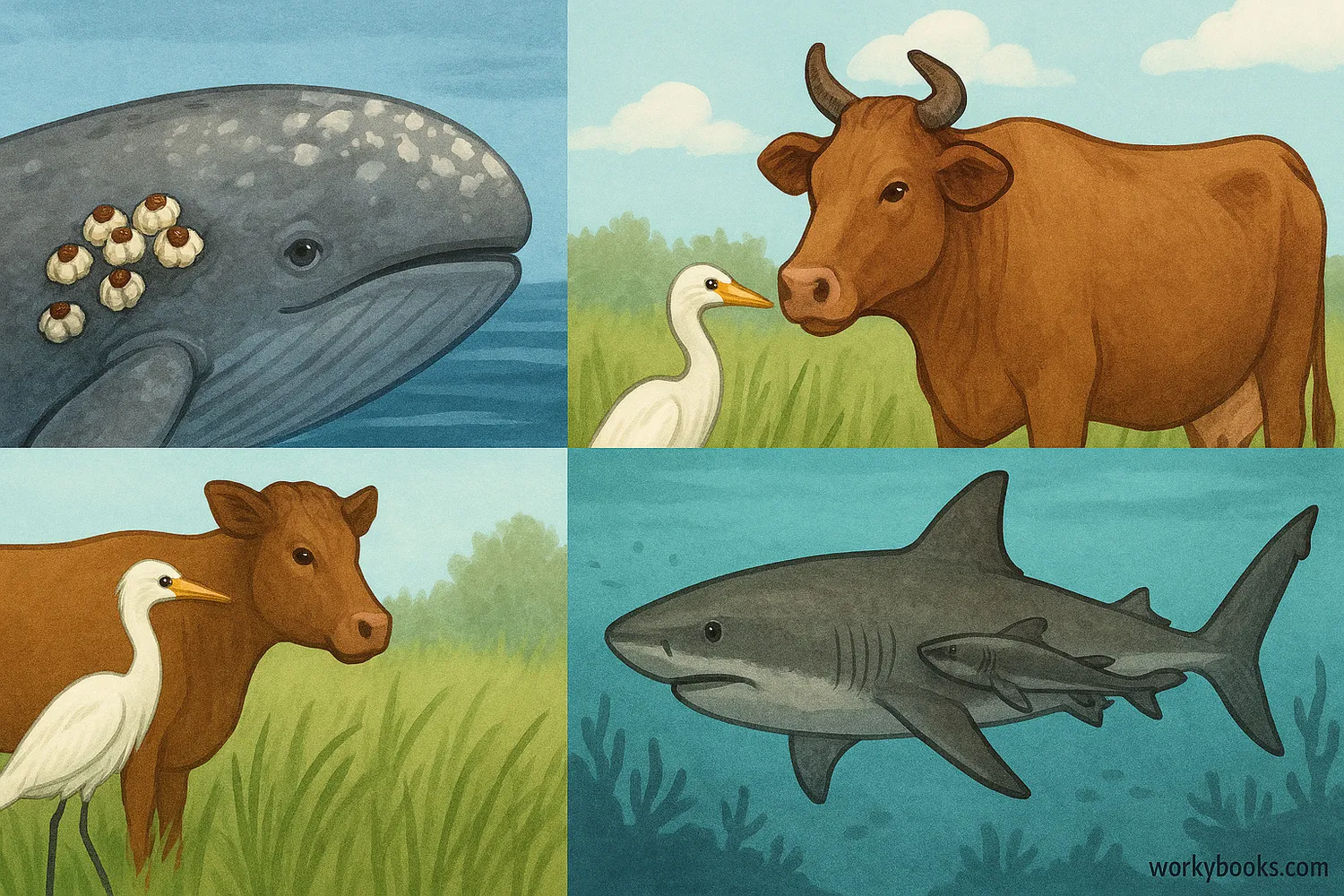
Commensalism: barnacles on whales, egrets with cattle, remoras riding sharks.
In nature, organisms have evolved intricate relationships that demonstrate the remarkable complexity of ecological interactions. Commensalism represents one of the most fascinating forms of symbiotic relationships, where two species live in close association but with distinctly different outcomes. In this biological arrangement, one organism derives clear benefits—such as shelter, transportation, or access to food—while the other species experiences no measurable positive or negative effects.
Let's look at some cool examples in various ecosystems. A classic case is the relationship between barnacles and whales. Barnacles are small crustaceans that attach themselves to the skin of whales. As the whale swims through the ocean, the barnacles get to travel to new areas with more food. The whale provides a home and transportation, but it doesn't even notice the barnacles. The barnacles benefit greatly by having a mobile home and access to nutrient-rich waters, while the whale remains completely unaffected.
Another interesting example involves cattle egrets and livestock. Cattle egrets are birds often seen walking alongside cows, horses, or other grazing animals. As these larger animals move through fields, they stir up insects from the grass. The egrets then easily catch and eat these disturbed insects. In this scenario, the egrets get an easy meal, a clear benefit. The cattle, however, don't get anything from the egrets' presence; they are neither helped nor harmed. This interaction is a perfect illustration of how one species thrives while the other is neutral.
Many types of creatures exhibit commensalism, from tiny mites living on insects to remoras, a type of fish that attaches to sharks. Remoras use their suction cups to stick to sharks, feeding on leftover food scraps from the shark's meals and gaining protection from predators. The shark, a powerful ocean predator, is usually not bothered by its small hitchhikers. These relationships are important for understanding the complex web of life and how organisms interact within their environments.
Understanding commensalism helps us see how diverse life forms find unique ways to survive and thrive. It highlights the intricate connections that exist in nature, where not all relationships are about mutual benefit or harm.
Interesting Fact: Some types of plants can also engage in commensalism, such as orchids that grow on trees, using the tree for support and sunlight without taking nutrients from it.
What is commensalism?
Both benefitOne benefits, one unaffectedOne benefits, one harmedBoth harmed
What do barnacles get from whales?
Nutrients from whaleTransportation and foodProtection from whalesWarmth from whale
Which word describes the whale in a barnacle-whale relationship?
BenefitedAffectedUnaffectedHarmful
Why do cattle egrets follow livestock?
For warmthTo eat parasitesTo catch disturbed insectsFor protection
What does 'unaffected' mean for an organism?
Greatly helpedGreatly harmedNeither helped nor harmedSlightly helped
Which animal provides protection to remoras?
WhalesCattleSharksEgrets
Commensalism is a type of symbiotic relationship.
TrueFalse
What term describes the large animal that an egret walks with?
PredatorPreyHostParasite
If a bird builds a nest in a tree branch without harming or helping the tree, what relationship is this?
MutualismParasitismCommensalismCompetition
Which relationship is most similar to barnacles on a whale?
Bee pollinating flowerMosquito biting humanSpider building web on houseDog playing with human
Perfect For:
👩🏫 Teachers
• Reading comprehension practice
• Auto-graded assessments
• Literacy skill development
👨👩👧👦 Parents
• Reading practice at home
• Comprehension improvement
• Educational reading time
🏠 Homeschoolers
• Reading curriculum support
• Independent reading practice
• Progress monitoring
Reading Features:
📖
Reading Passage
Engaging fiction or nonfiction text
❓
Comprehension Quiz
Auto-graded questions
📊
Instant Feedback
Immediate results and scoring
📄
Printable Version
Download for offline reading
🔊
Read Aloud
Voice-over with word highlighting
Reviews & Ratings
No reviews yet. Be the first to share your experience!
Related Content
The Nature of Life Science
This passage, aligned with NGSS MS-LS1-1, introduces students in grades 6-8 to the foundational concepts of life science...
MS-LS1-1
Science Vocabulary
This worksheet on domain-specific words will help students learn some science vocabulary. Students will be asked to matc...
L.3.6L.3.4.A
Citizen Science and Ecological Monitoring
This engaging passage for grades 6-8 introduces the concept of citizen science and its critical role in ecological monit...
MS-LS2-1
Ecosystem Services
This engaging middle school science passage introduces students to the concept of ecosystem services, the vital benefits...
MS-LS2-5MS-ESS3-3
Simple Machines Science Report
This science writing task requires students to clearly explain how three simple machines work using precise domain-speci...
W.5.4
Photosynthesis in Ecosystems
This comprehensive passage for grades 6-8 explores the fundamental role of photosynthesis in ecosystems, aligning with N...
MS-LS1-6MS-LS2-3
Biodiversity and Ecosystem Health
This comprehensive middle school science passage explores the relationship between biodiversity and ecosystem health, al...
MS-LS2-5
Desert Ecosystems
This informative writing worksheet on desert ecosystems supports CCSS.ELA-LITERACY.W.5.2.d on using precise language and...
W.5.2.D
Biomes: Aquatic Ecosystems
This middle school science passage, aligned with NGSS standard MS-LS2-1, introduces students to the key features and mec...
MS-LS2-1
Abiotic Factors in Ecosystems
This comprehensive informational reading passage is designed for middle school science students and aligns with NGSS sta...
MS-LS2-1
Biomes: Terrestrial Ecosystems
This NGSS-aligned science reading passage for grades 6-8 provides a comprehensive survey of Earth’s major terrestrial bi...
MS-LS2-1
Water in Ecosystems
This engaging passage for grades 6-8 explores the essential role of water in ecosystems, tracing its movement through va...
MS-LS2-3MS-ESS2-4
Producers: The Foundation of Ecosystems
This comprehensive science passage explains the critical role of producers, or autotrophs, in all ecosystems. Covering b...
MS-LS2-3MS-LS1-6
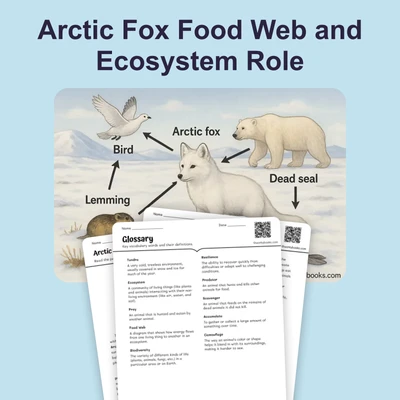
Arctic Fox Food Web and Ecosystem Role
This engaging audio-integrated passage, "Arctic Fox Food Web and Ecosystem Role," delves into the critical contributions...
What Is the Main Source of Carbon in an Ecosystem?
This NGSS-aligned science reading passage helps middle school students explore the main source of carbon in ecosystems: ...
MS-LS2-3
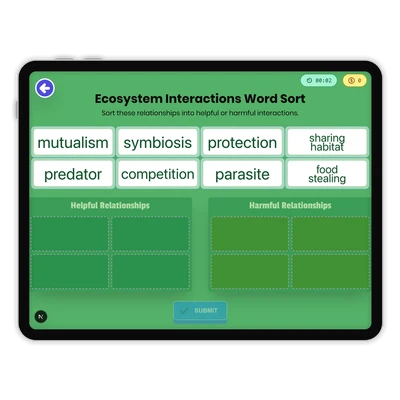
Ecosystem Interactions Word Sort
This word sort explores different types of relationships between organisms in ecosystems. Students categorize 12 differe...
The Pumpkin Life Cycle
This informational worksheet explores the pumpkin lifecycle, guiding students through procedural steps in a scientific t...
RI.2.3RI.2.10
What Is Earth Science?
This engaging middle school science passage introduces students to the field of Earth science, aligning with NGSS standa...
MS-ESS1MS-ESS2MS-ESS3SEP
Meadow Ecosystem
This reading passage, 'Life in the Meadow', is designed for elementary students to understand NGSS LS2.A: Interdependent...
2-LS2-1
Tools and Technology in Earth Science
This middle school science reading passage explores the wide range of tools and technologies used in Earth science, from...