This learning resource is available in interactive and printable formats. The interactive worksheet can be played online and assigned to students. The Printable PDF version can be downloaded and printed for completion by hand.
This reading passage, 'Life in the Meadow', is designed for elementary students to understand NGSS LS2.A: Interdependent Relationships in Ecosystems. It shifts focus from just plants to illustrate a simple food chain within a meadow, showing how grass depends on sunlight and water, rabbits depend on grass, and foxes depend on rabbits. The narrative emphasizes that if one part of this system is missing, it affects the others, clearly demonstrating the interconnectedness of living and non-living components in an ecosystem. This resource supports reading comprehension while teaching fundamental concepts of ecological relationships.
CONTENT PREVIEW
Expand content preview
Imagine a sunny meadow, buzzing with life! Here, every living thing depends on something else to survive. It's like a big team where everyone has a job and needs each other.
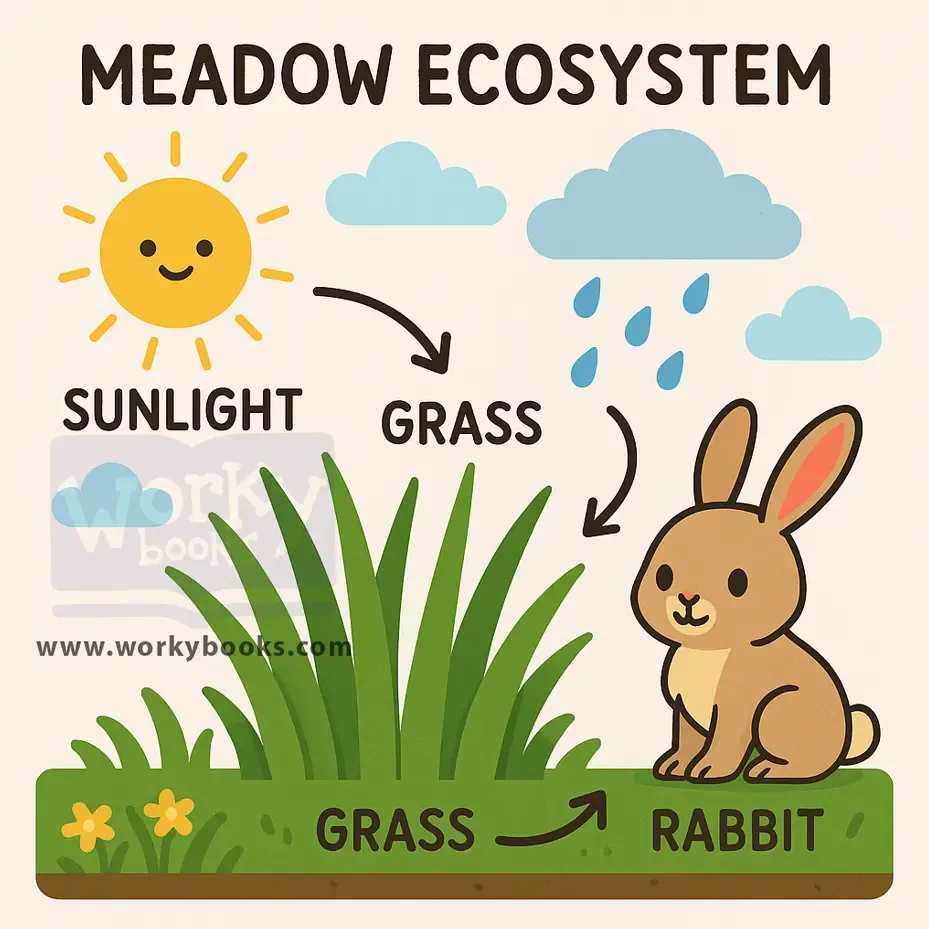
First, look at the tall green grass. The grass is a plant, so it needs the warm sunlight and cool water from the rain to grow big and strong. Without the sun and rain, the grass would wither and disappear.
Now, a little brown
hops into view. What does the rabbit eat? The green grass! The rabbit depends on the grass for its food and energy. If there wasn't any grass, the rabbit would go hungry.
Suddenly, a quick fox peeks out from the trees. The fox is looking for its dinner. What does the fox like to eat? Rabbits! So, the fox depends on the rabbit for its food.
This is how an ecosystem works. The grass depends on the sun and water. The rabbit depends on the grass. The fox depends on the rabbit. If one part of this team is missing, like if there's no rain for the grass, then the grass won't grow, the rabbit won't have food, and the fox won't have a rabbit to hunt. All these connections show interdependent relationships – living things needing each other and their non-living environment to live and thrive.
What is the setting of this story?
A big cityA sunny meadowA deep oceanA tall mountain
What two things does the grass need to grow?
Rabbits and foxesSunlight and waterTrees and flowersSoil and air
What animal eats the green grass?
A foxA birdA rabbitA deer
What animal does the fox depend on for food?
The grassThe rabbitThe sunThe rain
What would happen if there was no rain for the grass?
The grass would grow tallerThe grass would disappearThe rabbits would eat moreThe foxes would find more food
What is the main idea of this passage?
How animals huntWhy grass is greenHow living things in a meadow depend on each otherThe different types of animals
What does "interdependent relationships" mean in this story?
Animals that live alone. When things need each other to survive. Plants that only need sunlight.Animals that eat only one type of food.
Which of these is an example of an interdependent relationship from the passage?
The sun shining brightly.A rabbit eating grass.A fox running fast.Grass growing tall.
Perfect For:
👩🏫 Teachers
• Reading comprehension practice
• Auto-graded assessments
• Literacy skill development
👨👩👧👦 Parents
• Reading practice at home
• Comprehension improvement
• Educational reading time
🏠 Homeschoolers
• Reading curriculum support
• Independent reading practice
• Progress monitoring
Reading Features:
📖
Reading Passage
Engaging fiction or nonfiction text
❓
Comprehension Quiz
Auto-graded questions
📊
Instant Feedback
Immediate results and scoring
📄
Printable Version
Download for offline reading
🔊
Read Aloud
Voice-over with word highlighting
Reviews & Ratings
No reviews yet. Be the first to share your experience!
Related Content
The Tiny Seed
This reading passage, 'The Sun, the Rain, and the Tiny Seed', is designed to illustrate the core concepts of NGSS LS2.A:...
2-LS2-1
Where Does My Food Come From?
This reading passage, 'Where Does My Food Come From?', aligns with NGSS LS2.A: Interdependent Relationships in Ecosystem...
2-LS2-1
What do Tadpoles Eat?
This reading passage, 'The Pond's Busy Life', vividly describes a pond ecosystem to illustrate NGSS LS2.A: Interdependen...
2-LS2-1
What do Plants Need to Thrive?
This science passage, 'Growing Green!', is designed for second-grade students and aligns with the NGSS standard 2-LS2-1....
2-LS2-1
The Bean Plant
This reading passage, 'The Mystery of the Green Bean Plant', is designed for second-grade students to understand cause a...
2-LS2-1
Robin's Nest
This NGSS passage, 'The Mystery of the Chirping Robin', is designed for second-grade students to explore cause and effec...
2-LS2-1
Butterfly Food
This science passage, 'The Butterfly's Busy Day', is crafted for second-grade students to understand cause and effect re...
2-LS2-1
The Amazing Axolotl
This science reading passage, titled "The Amazing Axolotl," introduces young learners to one of Earth's most fascinating...
2-LS2-1
The Beaver Creek
This science reading passage, 'The Beaver's Big Build', explores cause and effect relationships in animal behavior for s...
2-LS2-1
Seed Germination Experiment
This reading passage, 'The Sleepy Seed's Big Surprise', targets second-grade students and reinforces NGSS 2-LS2-1 by foc...
2-LS2-1
Squirrel Nuts
This science passage, 'Why Did the Squirrel Bury the Nut?', introduces second-grade students to cause and effect relatio...