Arctic Fox Food Web and Ecosystem Role — Reading Comprehension
Rate this
Premium Resource
Present
Present in classroom. No work saved
Assign
Classroom with student accounts, Track progress
Quick Play
No student accounts, assign with a link
Grades
6
PRINT+DIGITAL RESOURCE
This learning resource is available in interactive and printable formats. The interactive worksheet can be played online and assigned to students. The Printable PDF version can be downloaded and printed for completion by hand.
This engaging audio-integrated passage, "Arctic Fox Food Web and Ecosystem Role," delves into the critical contributions of the Arctic fox within its harsh environment. Students will learn about the Arctic fox's various roles as a predator of small animals and an efficient scavenger, highlighting how these actions directly influence the energy flow through the tundra ecosystem. The passage defines key terms like predator, scavenger, food web, and ecosystem, making complex scientific concepts accessible. Aligned with NGSS LS2.A: Interdependent Relationships in Ecosystems, this resource helps Grade 6 students understand how one species can significantly impact its entire habitat, offering a fascinating look into arctic biodiversity. It's perfect for enhancing comprehension and sparking scientific curiosity.
CONTENT PREVIEW
Expand content preview
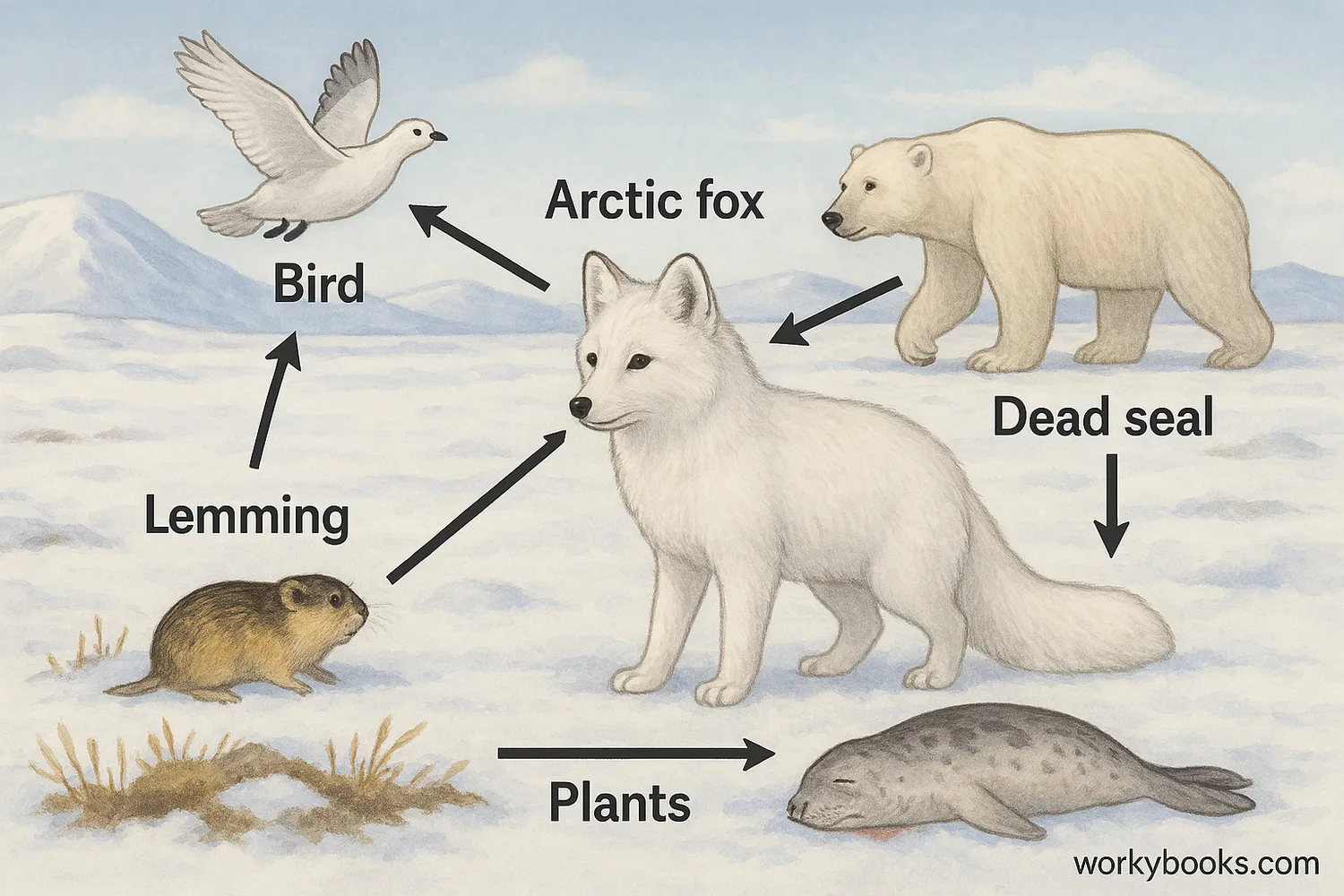
Arctic fox hunting and scavenging in tundra, highlighting its role in the food web.
The tundra is an environment dominated by snow and ice for most of the year, with temperatures that plunge far below freezing. In this harsh landscape lives the Arctic fox, a highly adapted animal known for its resilience. The Arctic fox not only survives in these extreme conditions but also plays a vital role in maintaining the balance of its ecosystem—a community of living organisms interacting with their physical environment.
The Arctic fox (Vulpes lagopus) is a master of survival, and its role as both a predator and a scavenger is vital. As a predator, the Arctic fox actively hunts other animals for food. Its main prey are small rodents like lemmings and voles, which burrow under the snow. When lemming populations are high, the Arctic fox thrives, having plenty to eat. They also hunt birds, eggs, and even young seals when opportunities arise. This hunting helps control the populations of these prey animals, preventing them from overpopulating and consuming too much vegetation.
But the Arctic fox doesn't just hunt; it's also an incredibly efficient scavenger. A scavenger is an animal that feeds on the remains of dead animals it did not kill. In the Arctic, this often means following polar bears or wolves and eating the leftovers from their hunts. This behavior is very important because it helps clean up the environment and ensures that no energy from dead animals goes to waste. It's a key part of the food web, which shows how energy flows from one living thing to another in an ecosystem.
The Arctic fox's diverse diet and adaptable feeding habits are crucial for the flow of energy in the Arctic tundra. Energy enters the food web when plants create their own food using sunlight. This energy then moves up the chain when lemmings eat plants, and then again when the Arctic fox eats lemmings. By preying on some animals and scavenging others, the Arctic fox helps to distribute energy throughout the ecosystem. Without the Arctic fox, populations of its prey could grow too large, or dead animal remains might accumulate, affecting the health and balance of the entire Arctic environment. Its presence supports the biodiversity, or variety of life, in this unique habitat.
Interesting Fact: Arctic foxes have a thick coat of fur that changes color with the seasons, from white in winter to brown or gray in summer, providing excellent camouflage.
What is the Arctic fox's primary habitat?
DesertTundraForestOcean
What do Arctic foxes mainly hunt?
Large deerSmall rodentsFishInsects
The Arctic fox is important as both a predator and a scavenger. True or False?
TrueFalse
What is the definition of a 'predator' as used in the passage?
Eats only plantsHunts other animalsFeeds on dead animalsLives in the ocean
How does the Arctic fox being a predator help the ecosystem?
Controls plant growthIncreases prey populationControls prey populationsMakes the tundra warmer
Why is scavenging an important role for the Arctic fox?
It helps grow plantsIt keeps the environment cleanIt warms the ecosystemIt provides shelter
What happens if lemming populations grow too large?
More arctic foxesLess vegetationColder temperaturesMore large predators
How does the Arctic fox affect energy flow?
Generates electricityTraps energy in snowDistributes energy by eatingCreates new energy
If a new predator, like a large bird, started eating lemmings, what might happen to the Arctic fox population?
It would increaseIt would stay the sameIt would likely decreaseIt would move away
A factory pollutes the tundra, killing many lemmings. How might this affect the Arctic fox and the ecosystem?
Foxes would eat more plantsFox population might declineEcosystem becomes healthierMore birds would appear
Perfect For:
👩🏫 Teachers
• Reading comprehension practice
• Auto-graded assessments
• Literacy skill development
👨👩👧👦 Parents
• Reading practice at home
• Comprehension improvement
• Educational reading time
🏠 Homeschoolers
• Reading curriculum support
• Independent reading practice
• Progress monitoring
Reading Features:
📖
Reading Passage
Engaging fiction or nonfiction text
❓
Comprehension Quiz
Auto-graded questions
📊
Instant Feedback
Immediate results and scoring
📄
Printable Version
Download for offline reading
🔊
Read Aloud
Voice-over with word highlighting
Reviews & Ratings
No reviews yet. Be the first to share your experience!
Related Content
The Nature of Life Science
This passage, aligned with NGSS MS-LS1-1, introduces students in grades 6-8 to the foundational concepts of life science...
MS-LS1-1
Science Vocabulary
This worksheet on domain-specific words will help students learn some science vocabulary. Students will be asked to matc...
L.3.6L.3.4.A
Citizen Science and Ecological Monitoring
This engaging passage for grades 6-8 introduces the concept of citizen science and its critical role in ecological monit...
MS-LS2-1
Ecosystem Services
This engaging middle school science passage introduces students to the concept of ecosystem services, the vital benefits...
MS-LS2-5MS-ESS3-3
Simple Machines Science Report
This science writing task requires students to clearly explain how three simple machines work using precise domain-speci...
W.5.4
Photosynthesis in Ecosystems
This comprehensive passage for grades 6-8 explores the fundamental role of photosynthesis in ecosystems, aligning with N...
MS-LS1-6MS-LS2-3
Biodiversity and Ecosystem Health
This comprehensive middle school science passage explores the relationship between biodiversity and ecosystem health, al...
MS-LS2-5
Desert Ecosystems
This informative writing worksheet on desert ecosystems supports CCSS.ELA-LITERACY.W.5.2.d on using precise language and...
W.5.2.D
Biomes: Aquatic Ecosystems
This middle school science passage, aligned with NGSS standard MS-LS2-1, introduces students to the key features and mec...
MS-LS2-1
Abiotic Factors in Ecosystems
This comprehensive informational reading passage is designed for middle school science students and aligns with NGSS sta...
MS-LS2-1
Biomes: Terrestrial Ecosystems
This NGSS-aligned science reading passage for grades 6-8 provides a comprehensive survey of Earth’s major terrestrial bi...
MS-LS2-1
Water in Ecosystems
This engaging passage for grades 6-8 explores the essential role of water in ecosystems, tracing its movement through va...
MS-LS2-3MS-ESS2-4
Producers: The Foundation of Ecosystems
This comprehensive science passage explains the critical role of producers, or autotrophs, in all ecosystems. Covering b...
MS-LS2-3MS-LS1-6
What Is the Main Source of Carbon in an Ecosystem?
This NGSS-aligned science reading passage helps middle school students explore the main source of carbon in ecosystems: ...
MS-LS2-3
The Pumpkin Life Cycle
This informational worksheet explores the pumpkin lifecycle, guiding students through procedural steps in a scientific t...
RI.2.3RI.2.10
Ecosystem Interactions Word Sort
This word sort explores different types of relationships between organisms in ecosystems. Students categorize 12 differe...
What Is Earth Science?
This engaging middle school science passage introduces students to the field of Earth science, aligning with NGSS standa...
MS-ESS1MS-ESS2MS-ESS3SEP
Meadow Ecosystem
This reading passage, 'Life in the Meadow', is designed for elementary students to understand NGSS LS2.A: Interdependent...
2-LS2-1
Tools and Technology in Earth Science
This middle school science reading passage explores the wide range of tools and technologies used in Earth science, from...