This learning resource is available in interactive and printable formats. The interactive worksheet can be played online and assigned to students. The Printable PDF version can be downloaded and printed for completion by hand.
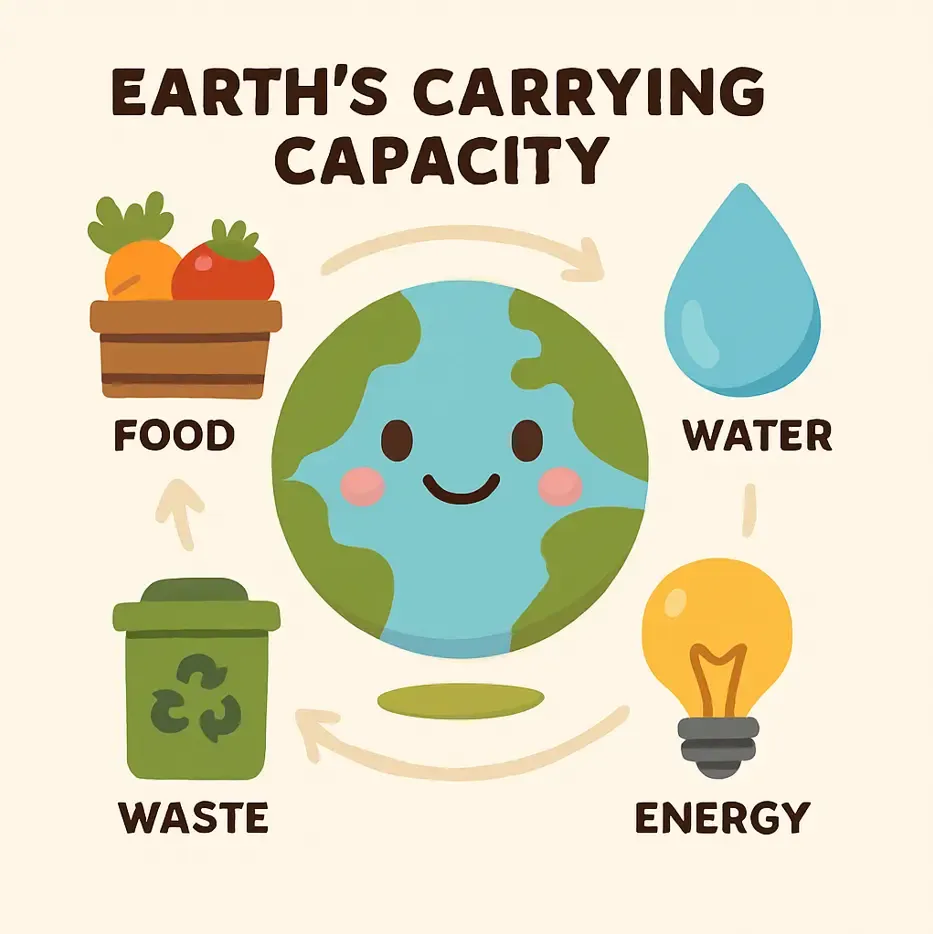
Earth's carrying capacity refers to the maximum number of people the planet can support sustainably. This depends on factors like food production, water availability, energy use, and waste management. Scientists estimate that current agricultural practices can feed about 10 billion people, but this relies on efficient resource use. Freshwater scarcity, climate change, and pollution further challenge Earth's capacity. Sustainable solutions like vertical farming, renewable energy, and waste reduction can help increase this limit. Lifestyle choices, such as eating less meat and using public transportation, also play a role. Understanding Earth's carrying capacity is crucial for ensuring a sustainable future for all.
CONTENT PREVIEW
Expand content preview
The carrying capacity of Earth refers to the maximum number of people our planet can support without harming the environment. Determining this number is complex because it depends on many factors, including resource availability, technology, and lifestyle choices.
One key factor is food production. Earth has a limited amount of arable land for farming. Scientists estimate that current agricultural practices can feed about 10 billion people. However, this depends on how efficiently we use resources like water and fertilizers. For example, vertical farming and genetically modified crops could increase food production, but they also require energy and technology.
Another factor is water availability. Freshwater is essential for drinking, farming, and industry, but only 2.5% of Earth’s water is fresh. Climate change and pollution are making clean water even scarcer. If we don’t manage water wisely, Earth’s carrying capacity could drop significantly.
Energy use also plays a role. Fossil fuels like coal and oil are limited and harm the environment. Switching to renewable energy sources like solar and wind could support more people sustainably. However, this requires investment in infrastructure and technology.
Waste management is another challenge. Humans produce billions of tons of waste each year, polluting land, water, and air. Recycling and reducing waste could help increase Earth’s carrying capacity.
Finally, lifestyle choices matter. If everyone lived like the average American, Earth could only support about 1.5 billion people. But if we adopt more sustainable habits, like eating less meat and using public transportation, the planet could support more people.
Fun fact: If everyone on Earth lived in a city as dense as New York, the entire global population could fit into an area the size of Texas!
What does "carrying capacity" mean in the passage?
The weight Earth can holdThe maximum number of people Earth can supportThe amount of water on EarthThe number of countries on Earth
What is one factor that affects Earth’s carrying capacity?
The number of cars on the roadFood productionThe popularity of social mediaThe number of languages spoken
How could vertical farming help increase Earth’s carrying capacity?
By reducing the need for waterBy increasing food production in small spacesBy using more fossil fuelsBy creating more waste
What percentage of Earth’s water is fresh, according to the passage?
10%25%2.5%50%
What is one way to manage Earth’s resources more sustainably?
Using more fossil fuelsSwitching to renewable energyIncreasing waste productionCutting down more trees
How does waste management affect Earth’s carrying capacity?
It has no effectPoor waste management reduces carrying capacityWaste increases food productionWaste makes water cleaner
What is one lifestyle choice that could help increase Earth’s carrying capacity?
Eating more meatDriving more oftenUsing public transportationWasting more food
What is the fun fact mentioned in the passage?
Earth’s population could fit into an area the size of TexasEveryone on Earth could live in one cityNew York is the most sustainable cityTexas has the most arable land
Perfect For:
👩🏫 Teachers
• Reading comprehension practice
• Auto-graded assessments
• Literacy skill development
👨👩👧👦 Parents
• Reading practice at home
• Comprehension improvement
• Educational reading time
🏠 Homeschoolers
• Reading curriculum support
• Independent reading practice
• Progress monitoring
Reading Features:
📖
Reading Passage
Engaging fiction or nonfiction text
❓
Comprehension Quiz
Auto-graded questions
📊
Instant Feedback
Immediate results and scoring
📄
Printable Version
Download for offline reading
🔊
Read Aloud
Voice-over with word highlighting
Reviews & Ratings
No reviews yet. Be the first to share your experience!
Related Content
Tools and Technology in Earth Science
This middle school science reading passage explores the wide range of tools and technologies used in Earth science, from...
MS-ESS2-2MS-ESS3-2MS-ETS1-1MS-PS4-3
Interpreting visual information on Layers of the Earth
This informational text on the layers of the earth is a great way to practice using images during reading. Students will...
RI.1.7RI.10RF.1.4.ARF.1.4
What Is Earth Science?
This engaging middle school science passage introduces students to the field of Earth science, aligning with NGSS standa...
MS-ESS1MS-ESS2MS-ESS3SEP
Reading Comprehension— Storms
Practie summarizing paragraphs with this fun science informational text on storms! Students will give the main idea of t...
RI.2.2RF.2.4.ARF.2.4RI.2.10
Scientific Inquiry in Earth Science
This passage explores scientific inquiry in Earth science for grades 6-8, aligned with NGSS standards MS-ESS1-4, MS-ESS2...
MS-ESS1-4MS-ESS2-1MS-ESS3-5SEP
Reading Comprehension: The Grand Canyon
This informational text on the Grand Canyon will teach your students all about this incredible wonder of the world! Free...
RI.3.1RI.3.10RI.3.4RF.3.4
What Is Space Weather and How Does It Affect the Earth?
This NGSS-aligned science passage for middle school explains what space weather is and how it affects Earth. Students le...
MS-ESS2-2
Reading Comprehension - Science and Social Studies
RI.2.10RI.2.1RI.2.2RI.2.4
Earth: Our Home in Space
This engaging Grade 4-5 science passage, aligned to NGSS, introduces students to Earth's special place in the solar syst...
The Solar System—Informational Text
This informational text is a great way for early readers to practice their comprehension skills. Students will read the ...
RI.K.7
Informational Text — Habitats
This short informational text on habitats will teach your students what a habitat is, as well as provide some examples o...
RF.3.4.A
Earth's Spheres
This middle school science passage introduces students to Earth's four major spheres: the geosphere, hydrosphere, atmosp...
MS-ESS2-4MS-ESS2-6
Informational Text —Bioluminescence
This informational text on bioluminescence will teach your students about this phenomenon. Examples in nature are provid...
RI.3.10RF.3.4RF.3.4.ARI.3.1
Informational Text — Penguins
This informational text on penguins is a great way to practice reading comprehension. Students will read the short passa...
RI.2.1RI.2.10
Informational Text — Armadillos
This informational text on armadillos is a great way to practice reading comprehension. Students will read the short pas...
RI.2.1RI.2.10
Informational Text — Astronauts
Practice this second grade context clues worksheet with this informational text on astronauts. Students will read the te...
RI.2.4RI.2.10RI.3.4RI.3.10
Informational Text —Snowflakes
This informational text on snowflakes will teach your students how snowflakes are formed. Images of several different fl...
RI.3.10RF.3.4RF.3.4.ARI.3.1
Informational Text—Tardigrades
This informational text on tardigrades will teach your students all about this strange animal! Free response comprehensi...
RI.2.1RI.2.10RI.3.1RI.3.10
Informational Text —Importance of Sound
This Reading Informational Text Common Core standards calls for 4th graders to be able to effectively describe and analy...
RI.4.5
Facts About Earth
This engaging science reading passage introduces Grade 4 and 5 students to Earth, our home planet. Aligned with NGSS sta...