This learning resource is available in interactive and printable formats. The interactive worksheet can be played online and assigned to students. The Printable PDF version can be downloaded and printed for completion by hand.
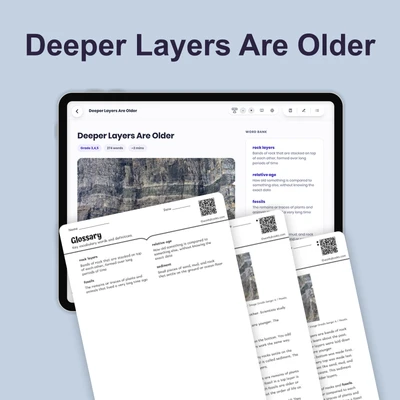
This 250-word reading passage introduces fourth-grade students to the concept of fossils in rock layers, aligned with NGSS standard 4-ESS1-1 and the Disciplinary Core Idea ESS1.C: The History of Planet Earth. Students discover how fossils are preserved in specific rock layers and learn that the position of a fossil layer indicates when that organism lived. The passage explains that deeper layers contain older fossils of simpler organisms, while higher layers reveal younger fossils of more complex life forms. Using the analogy of a history book with pages and illustrations, students understand how scientists read Earth's story through rock layers. The passage includes audio integration for accessibility and engagement. This foundational knowledge prepares students for hands-on investigations and discussions about Earth's history and the evolution of life over time. Key vocabulary terms including fossils, rock layers, organisms, and sedimentary rocks are introduced and defined in context. The passage avoids overwhelming students with complex terminology while building essential background knowledge needed for deeper NGSS-aligned learning experiences in earth science and paleontology.
CONTENT PREVIEW
Expand content preview
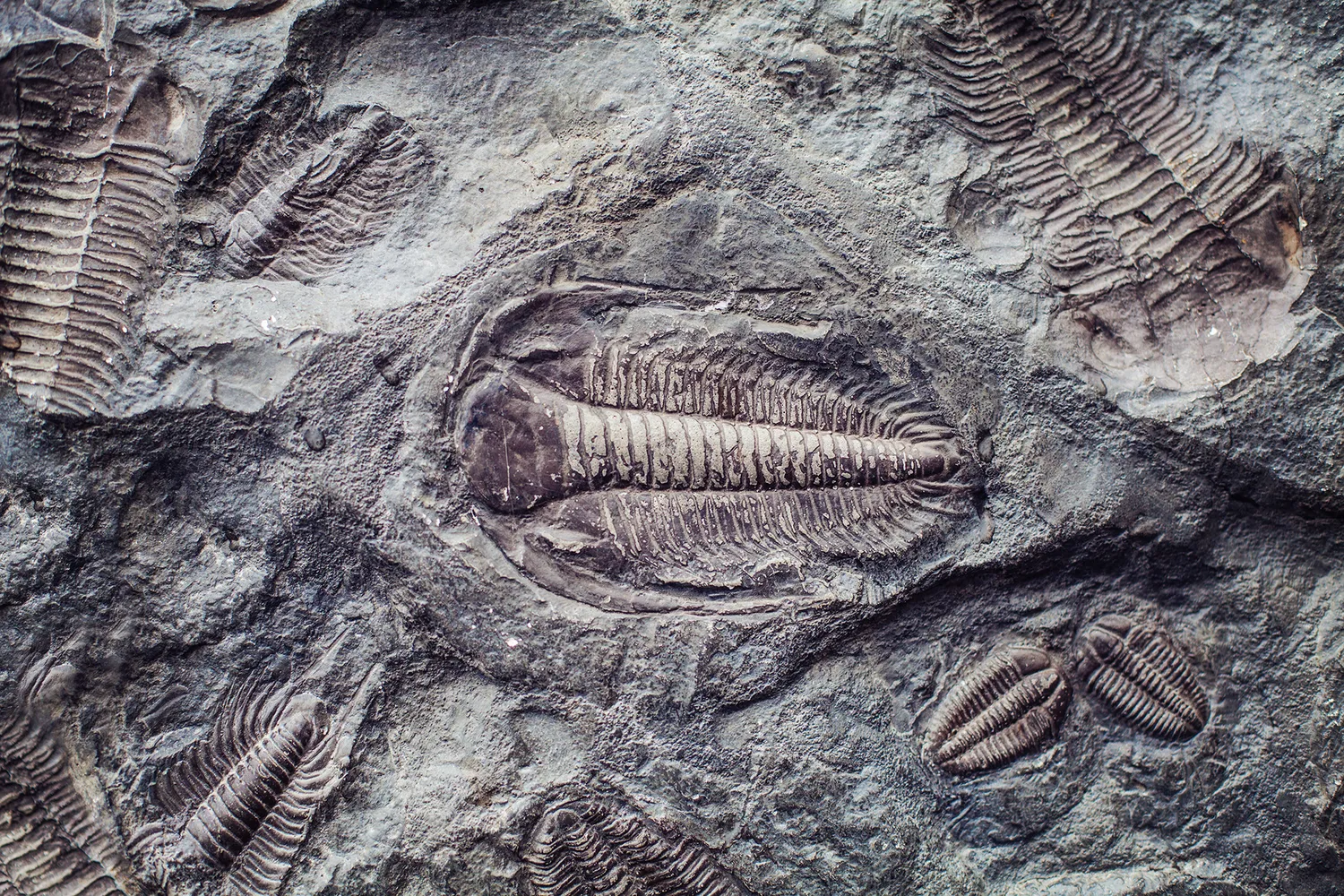
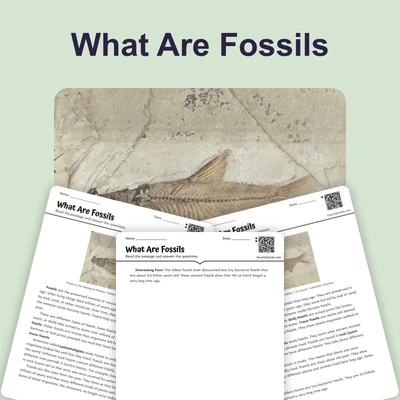
The imprint of the ancient trilobites in a stone trilobites a fossil group of extinct marine arachnomorph arthropods class trilobita
Fossils are the remains or traces of plants and animals that lived long ago. Scientists find fossils inside rock layers, which are like stacked sheets of rock that formed over millions of years. These rock layers help scientists understand Earth's history because they show when different organisms, or living things, existed on our planet.
The position of a fossil in rock layers tells us its age. Sedimentary rocks form when tiny pieces of sand, mud, and other materials settle in layers, one on top of another. The bottom layers are the oldest because they formed first. The top layers are the youngest because they formed most recently. When a fossil is found in a deep layer, it means that organism lived a very long time ago. Fossils in higher layers are younger because those organisms lived more recently.
By studying fossils layer by layer, scientists discover how life changed over time. The deepest, oldest layers contain fossils of simple organisms like tiny sea creatures. Higher, younger layers show fossils of more complex organisms like fish, then reptiles, and eventually mammals. Each rock layer is like a page in a history book, and the fossils are the illustrations showing what was alive at that time.
Interesting Fact: The oldest fossils ever found are about 3.5 billion years old and show tiny bacteria-like organisms that lived in ancient oceans!
What are fossils?
Remains of plants and animals from long agoPieces of sand and mudNew rocks that just formedTools that scientists use
Which rock layers are the oldest?
The top layersThe bottom layersThe middle layersAll layers are the same age
What do sedimentary rocks form from?
Melted lava from volcanoesCrystals that grow undergroundSand, mud, and materials settling in layersFossils pressed together tightly
Why do deeper layers have simpler organisms?
Simple organisms liked living undergroundComplex organisms destroyed the simple onesSimple organisms lived earlier in Earth's historyScientists only look for simple fossils
How do scientists learn about life changes?
By studying fossils layer by layerBy watching animals in zoosBy reading old booksBy looking at modern plants
What does the passage compare to pages?
Fossils in museumsDifferent types of organismsRock layersScientists' notebooks
Fossils in higher layers are younger than deeper ones.
TrueFalse
What does 'organism' mean in this passage?
A type of rockA living thingA layer of sedimentA scientific tool
Perfect For:
👩🏫 Teachers
• Reading comprehension practice
• Auto-graded assessments
• Literacy skill development
👨👩👧👦 Parents
• Reading practice at home
• Comprehension improvement
• Educational reading time
🏠 Homeschoolers
• Reading curriculum support
• Independent reading practice
• Progress monitoring
Reading Features:
📖
Reading Passage
Engaging fiction or nonfiction text
❓
Comprehension Quiz
Auto-graded questions
📊
Instant Feedback
Immediate results and scoring
📄
Printable Version
Download for offline reading
🔊
Read Aloud
Voice-over with word highlighting
Reviews & Ratings
No reviews yet. Be the first to share your experience!
Related Content
Understanding the Movement of Tectonic Plates
W.4.94-ESS1-1ESS1.C
Types of Volcanoes
W.4.94-ESS1-1ESS1.C
Types of Fossils
This engaging 250-word reading passage introduces fourth-grade students to the four main types of fossils and how each f...
NGSS 4-ESS1-1ESS1.C
Deeper Layers Are Older
This engaging 250-word reading passage introduces fourth-grade students to the fundamental geological principle that dee...
NGSS 4-ESS1-1ESS1.C
Core Samples
This engaging 350-word science passage introduces elementary students to core samples and how scientists use them to stu...
NGSS 4-ESS1-1
Plant Fossil
This engaging 350-word science reading passage for grades 4-5 explores how plant fossils provide clues about Earth's anc...
NGSS 4-ESS1-1
Fossil Patterns
This engaging science reading passage explores how scientists use fossil patterns to understand Earth's history, perfect...
NGSS 4-ESS1-1
What Are Fossils
This engaging 250-word reading passage introduces fourth-grade students to the concept of fossils as preserved remains o...
NGSS 4-ESS1-1
What Do Paleontologists Do
This engaging 250-word reading passage introduces fourth-grade students to the work of paleontologists and how they stud...