This reading passage offers a detailed look at the Rosa Parks Bus Boycott, an important moment in U.S. history and the Civil Rights Movement. Students will discover how Rosa Parks' refusal to give up her seat led to a 381-day boycott of Montgomery buses, uniting Black citizens in peaceful resistance. The resource uses simple language and a clear sequence of events to help students understand cause and effect, key figures like Rosa Parks and Dr. Martin Luther King Jr., and the broader impact of the boycott. Activities include a glossary, multiple-choice quiz, writing prompts, graphic organizers, a timeline, and Spanish translation to support comprehension. Aligned with HSS 5.10.5 and RI.4.4 standards, this passage can be used in history or literacy instruction. It also features a read aloud audio and a public domain image. Keywords: Rosa Parks, bus boycott, segregation, Montgomery, civil rights, protest.
Written by Workybooks TeamPublished by Workybooks
Preview
Sample passage and quiz content
CONTENT PREVIEW
Expand content preview
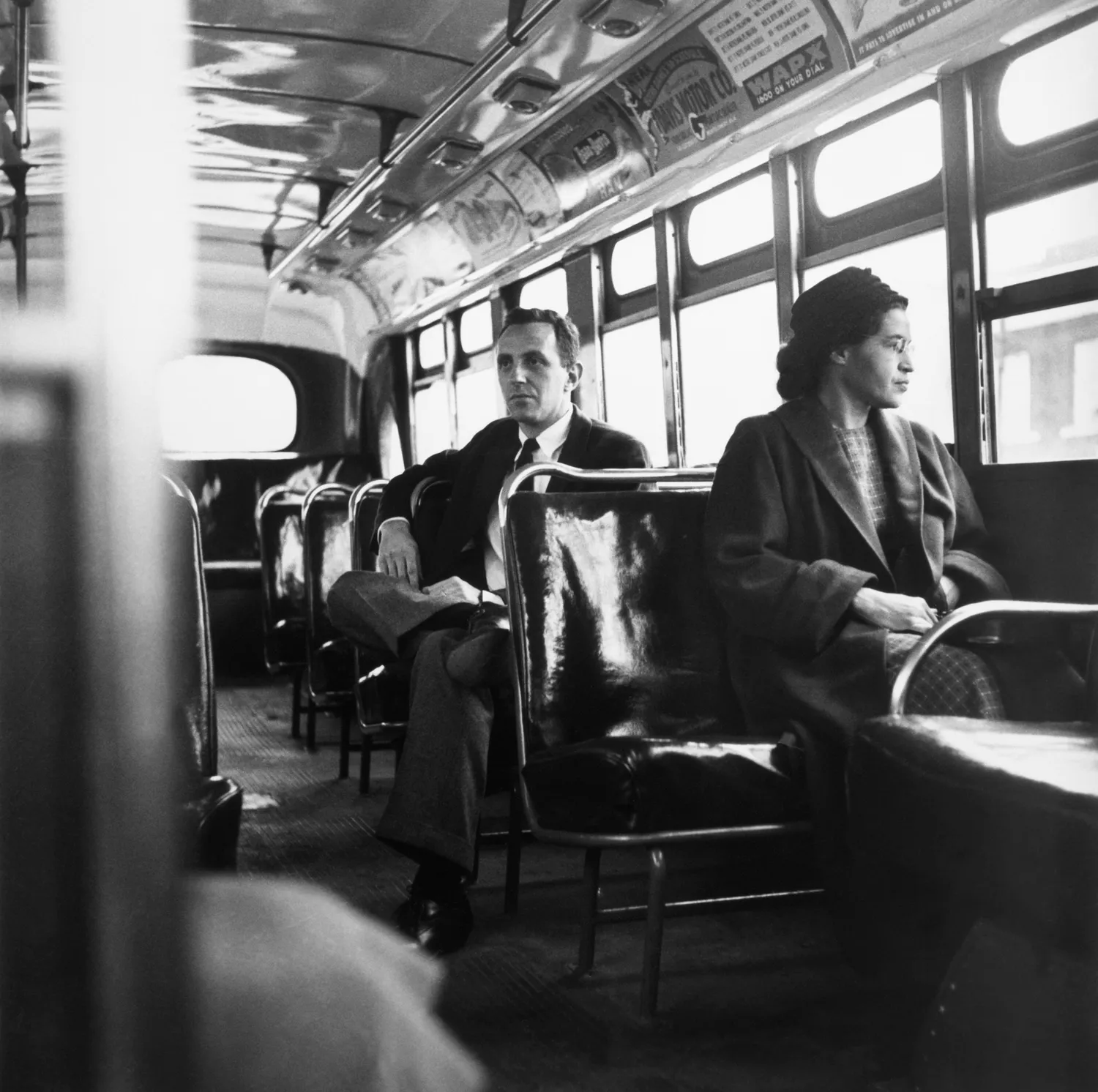
EnglishAmerican civil rights activist Rosa Parks sits in the front of a bus in Montgomery, Alabama, after the Supreme Court ruled segregation illegal on the city bus system on December 21st, 1956 by UPI / Wikimedia Commons
On December 1, 1955, in Montgomery, Alabama, a woman named Rosa Parks did something that would change history. She was tired after a long day at work. Rosa took a seat on a city bus. When the bus filled up, the driver told her to give up her seat to a white passenger. Rosa quietly refused. She was arrested for breaking the city’s segregation laws, which kept Black and white people apart in public places.
Many people in the Black community were upset. They wanted to show that these laws were unfair. Leaders in Montgomery, like Dr. Martin Luther King Jr., asked everyone to stop riding the buses. This was called the Montgomery Bus boycott. For 381 days, Black citizens walked, shared rides, or found other ways to get to work and school. They wanted to send a message that segregation on buses was wrong.
The boycott was a form of peaceful protest. People did not use violence. Instead, they worked together and supported each other. The boycott brought the Black community closer. It also showed the country how strong they were when they stood together.
The city lost lots of money because so many people stopped riding the buses. After more than a year, the U.S. Supreme Court decided that segregation on city buses was illegal. The law changed. Black and white people could sit anywhere they wanted on Montgomery’s buses.
Rosa Parks’ brave action and the boycott helped start the Civil Rights Movement. This movement fought to end unfair laws and gain equal rights for all Americans. Rosa Parks became a symbol of courage and hope. The Montgomery Bus Boycott showed that peaceful resistance could bring about important changes.
Interesting Fact: Rosa Parks was not the first person to refuse to move on a bus, but her story inspired millions and helped change America.
Who refused to give up her bus seat?
Rosa ParksHarriet TubmanSusan B. AnthonyEleanor Roosevelt
Where did the bus boycott happen?
MontgomeryAtlantaNew YorkChicago
How long did the boycott last?
381 days50 days1 week2 years
Why did people boycott the buses?
To fight unfair lawsFor cheaper ticketsTo get new busesFor more drivers
What happened after the boycott?
Segregation on buses endedBuses stopped runningTickets got expensiveRosa moved away
How did people protest during the boycott?
Peaceful protestViolenceShoutingNone
Rosa Parks was arrested for refusing to move. True or false?
TrueFalse
What is a boycott?
Stopping use as protestBuying more thingsAsking for helpWriting a letter
Curriculum
Common Core standards covered
RI.4.4
Determine the meaning of general academic and domain-specific words or phrases in a text relevant to a grade 4 topic or subject area.
Who it's for
Perfect for the way you teach
Teachers
Build comprehension skills
Auto-graded quiz
Differentiated reading
Parents
Read together at home
Improve fluency
Quiet reading time
Homeschoolers
Reading curriculum support
Independent practice
Track Lexile growth
Topics
Rosa Parksbus boycottMontgomerycivil rightssegregationpeaceful protestU.S. history
Reviews & Ratings
No reviews yet. Be the first to share your experience!
More reading you might love
19 more
Cesar Chavez and Farm Workers
This educational reading passage explores Cesar Chavez and the struggle for farm workers' rights in U.S. history. Studen...
HSS 5.10.5RI.4.2
Natural Disasters and Urban flooding
This reading comprehension worksheet focuses on the topic of natural disasters, specifically urban flooding. Following t...
RI.4.44-ESS3ESS3.B4-ESS3-1
The Formation of Fossils
L.4.2.DL.4.6RI.4.4
Climate and Water Cycle
W.4.2.ARI.4.4RI.4.1
Ocean Acidification
Download this reading comprehension worksheet about ocean acidification. The worksheet includes an informational text ab...
RI.4.4
Informational Text —The History of Toothpaste
RI.4.4RI.4.4
Understanding Climate Action Context Clues
Understanding Climate Action" worksheet, aligned with CCS L.4.4.A and NGSS. This resource introduces key concepts such a...
L.4.4.ARI.4.1RI.4.4
Pollination: A Crucial Ecosystem Service
Explore the vital role of pollination beyond plant reproduction, as it sustains ecosystems by ensuring food security, pr...
RI.4.2RI.4.3RI.4.4RI.5.1
The States of Matter: Solid
Discover the differences between solids, liquids and gases by exploring how their particles are arranged and move. This ...
RI.4.2RI.4.3RI.4.4RI.5.1
What is a Simple Machine
Discover the power of simple machines! This informational text explores how basic tools like levers, pulleys and incline...
RI.4.2RI.4.3RI.4.4RI.5.1
The Role of Pollinators in Nature
Learn about the fascinating world of pollinators and discover their crucial role in the reproductive process of flowerin...
RI.4.2RI.4.3RI.4.4RI.5.1
Seed Dispersal: How Plants Travel
Plants may seem stationary, but their seeds have amazing ways to travel! Explore the fascinating world of seed dispersal...
RI.4.2RI.4.3RI.4.4RI.5.1
Sunspots and Solar Flares
This quiz is designed to test your understanding of the fascinating phenomena of sunspots and solar flares, as described...
RI.4.1RI.4.4RI.5.1ESS1.A
Exploring Space: Rockets and Spacecraft
Space exploration has been one of humanity's greatest achievements, made possible by rockets and spacecraft. Rockets act...
RI.4.4RI.4.2
The Water Cycle
The water cycle describes how water continuously moves through our planet via evaporation, condensation, precipitation, ...
RI.4.4RI.4.2
The Nitrogen Cycle
The nitrogen cycle describes how nitrogen moves through the air, soil, and living organisms. It involves processes like ...
RI.4.4RI.4.2
The Life Cycle of a Frog
The frog's life cycle takes it from water to land in amazing stages. Starting as eggs, they hatch into tadpoles, grow le...
RI.3.1RI.4.4RI.4.2
The Life Cycle of a Salmon
Salmon have a remarkable life cycle that takes them from rivers to the ocean and back again. They hatch as alevin, grow ...
RI.3.1RI.4.4RI.4.2
The Life Cycle of a Plant
The life cycle of a plant begins with seed germination, followed by growth, leaf development, and photosynthesis. The pl...