The Life Cycle of a Sea Turtle
Interactive passage with audio narration, comprehension questions, and printable PDF.
What's included
The Life Cycle of a Sea Turtle preview and details
About this printable The Life Cycle of a Sea Turtle science reading passage, NGSS-aligned (Grades 4-5)
Sample passage and quiz from The Life Cycle of a Sea Turtle
Reading passage and comprehension quiz preview
The Life Cycle of a Sea Turtle
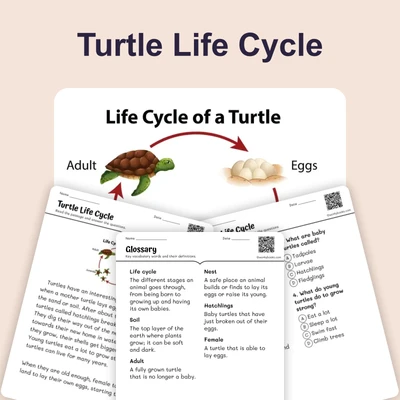
Sea turtles have an amazing life cycle that starts on land but mostly takes place in the ocean. The cycle begins when a female sea turtle comes ashore to lay her eggs. She uses her flippers to dig a deep hole in the sand, called a nest. Then, she lays about 100 soft-shelled eggs, each about the size of a ping-pong ball. After covering the nest with sand, she returns to the sea.
The eggs stay buried in the warm sand for about two months. The temperature of the sand determines whether the baby turtles will be male or female. Warmer temperatures produce more females, while cooler temperatures result in more males.
When the baby turtles are ready to hatch, they break out of their eggs using a special tooth called an egg tooth. It takes them several days to dig their way out of the nest. Once they reach the surface, they immediately head towards the brightest horizon, which is usually the ocean reflecting moonlight or starlight.
This journey from nest to sea is very dangerous for the baby turtles, also called hatchlings. Many are eaten by birds, crabs, or other predators. Those that make it to the water face new challenges from fish and other sea creatures.
The young turtles that survive spend their first few years in the open ocean. As they grow, they move to coastal areas where they can find plenty of food. Depending on the species, sea turtles take anywhere from 10 to 50 years to become adults.
Adult sea turtles spend most of their lives in the ocean, coming to the surface only to breathe and bask in the sun. When it's time to lay eggs, female turtles return to the beach – often the very same beach where they were born. This amazing journey completes the cycle, and it starts all over again.
Comprehension quiz (8 questions)
1. A female sea turtle lays her eggs in a ____________ dug in the sand.
2. The ____________ of the sand determines whether baby turtles will be male or female.
3. Baby turtles use a special ____________ to break out of their eggs.
4. When leaving the nest, baby turtles head towards the ____________ horizon.
5. Young sea turtles are also called ____________.
6. Adult sea turtles come to the surface to ____________ and bask in the sun.
7. It can take between ____________ to ____________ years for a sea turtle to become an adult.
8. Female turtles often return to the same ____________ where they were born to lay their eggs.
Perfect for the way you teach
- Build comprehension skills
- Auto-graded quiz
- Differentiated reading
- Read together at home
- Improve fluency
- Quiet reading time
- Reading curriculum support
- Independent practice
- Track Lexile growth