The Life Cycle of an Angiosperm — Reading Comprehension
Rate this
Premium Resource
Present
Present in classroom. No work saved
Assign
Classroom with student accounts, Track progress
Quick Play
No student accounts, assign with a link
Grades
6
PRINT+DIGITAL RESOURCE
This learning resource is available in interactive and printable formats. The interactive worksheet can be played online and assigned to students. The Printable PDF version can be downloaded and printed for completion by hand.
This educational content package delves into the intriguing world of angiosperms and their complex life cycles, perfectly aligned with the NGSS standard LS1.B: Growth and Development of Organisms. Students will explore how plants reproduce, grow, develop, and continue their species through a captivating reading passage. Key terms like pollination, fertilization, and seed dispersal are explained in simple language, making the content accessible for Grade 6 learners. The package includes a reading passage, multiple-choice questions, short answer questions, and a glossary to reinforce learning. All components are audio-integrated for enhanced accessibility.
CONTENT PREVIEW
Expand content preview
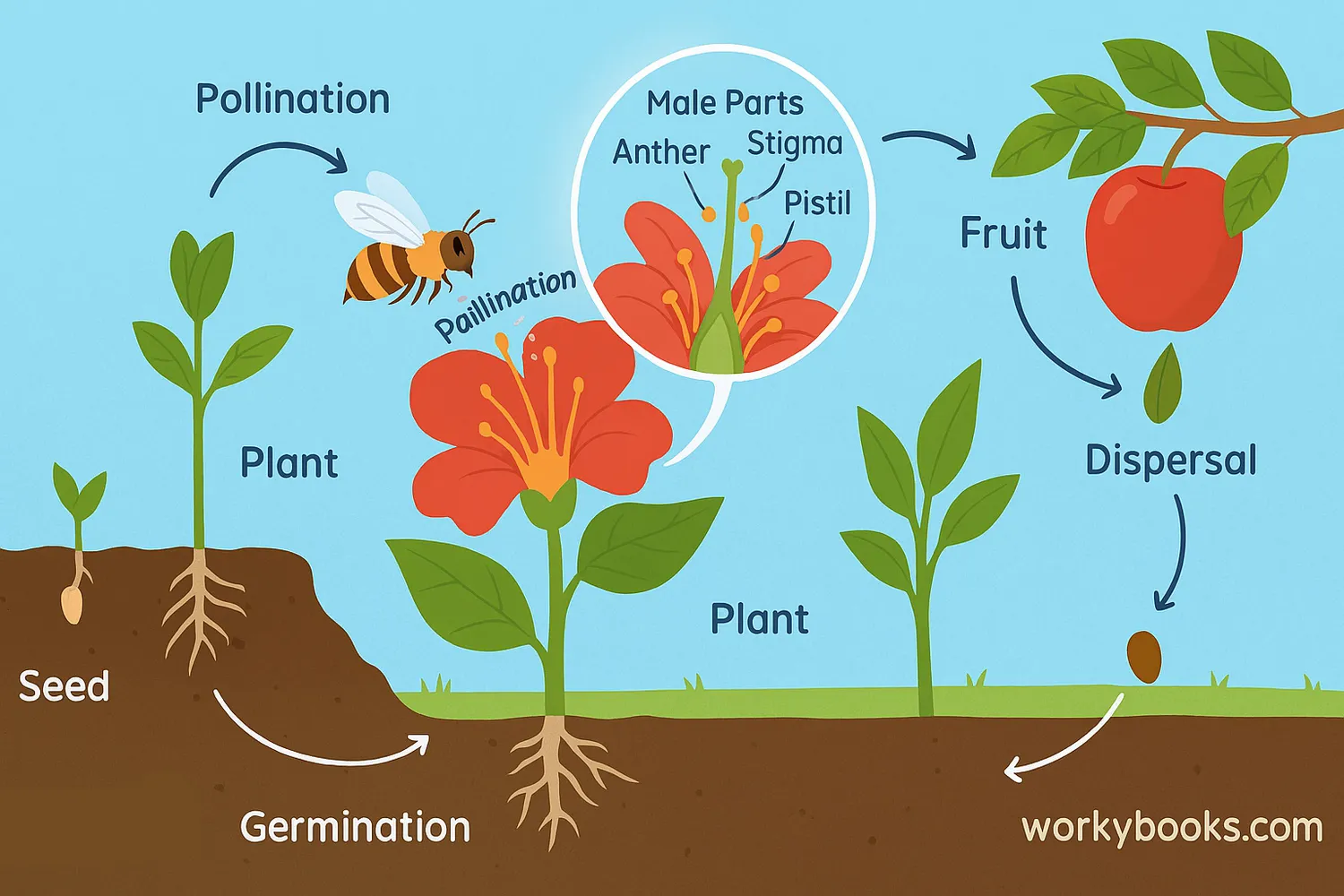
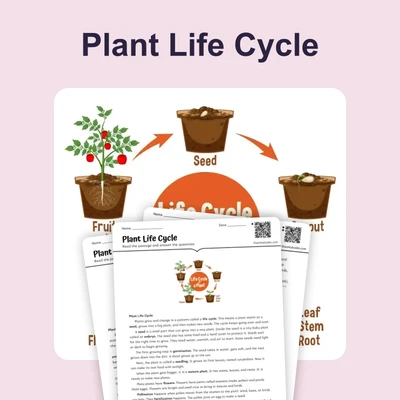
Angiosperm life cycle: seed, germination, flower, pollination, fertilization, fruit, and seed dispersal.
Imagine a world without colorful flowers, delicious fruits, or the fresh air provided by many plants. Much of this beauty and vital function comes from a special group of plants called angiosperms, also known as flowering plants. Angiosperms have a fascinating life cycle that allows them to reproduce and thrive across almost every environment on Earth. Understanding this cycle helps us appreciate the intricate processes of nature, from tiny seeds to towering trees.
The journey of an angiosperm typically begins as a seed. A seed is like a tiny package containing a young plant, or embryo, along with food storage. When conditions are right – enough water, warmth, and light – the seed will sprout, a process called germination. The embryo grows roots downwards and a shoot upwards, developing into a seedling and then a mature plant. This plant will then produce flowers, which are the reproductive organs of the angiosperm.
Inside the flower, there are male and female parts. The male parts produce pollen, which contains the male reproductive cells. The female part, called the pistil, contains the ovules, which hold the female reproductive cells. For reproduction to occur, pollen must be transferred from the male part to the female part. This transfer is called pollination. Pollination often happens with the help of wind, water, or animals like bees, butterflies, and even bats!
Once pollen lands on the correct part of the pistil, it grows a tube down to an ovule. The male reproductive cell then joins with the female reproductive cell in a process called fertilization. After fertilization, the ovule develops into a new seed, and the flower's ovary often develops into a fruit. Fruits are specifically designed to protect the seeds and aid in their dispersal, meaning they help spread the seeds away from the parent plant. Animals eat the fruit and carry the seeds elsewhere, or wind and water might transport them. Once dispersed, these new seeds can germinate, starting the entire life cycle over again.
Interesting Fact: The smallest flowering plant in the world is Wolffia globosa, which is smaller than a grain of rice and has the smallest flower.
What is another name for angiosperms?
Flowering plantsSeed plantsFernsMosses
What is the process of a seed sprouting called?
PollinationFertilizationGerminationDispersal
True or False: Fruits help protect and disperse seeds.
TrueFalse
Which of these is NOT typically involved in pollination?
WindAnimalsSunlightWater
How is a seed different from an embryo?
Seed is an older plantEmbryo is inside seedSeed is female partEmbryo is pollen
What is the main purpose of a flower in the angiosperm life cycle?
Attract insectsPhotosynthesisReproductionStore water
Why is seed dispersal important for plants?
To make fruitTo find matesTo spread speciesTo grow taller
What process happens after pollination but before the seed develops?
GerminationFertilizationDispersalGrowth
If a plant's flowers were removed, what stage of its life cycle would be prevented?
GerminationSeed growthPollinationEmbryo development
What does the word 'pollination' mean in this passage?
Pollen making foodPollen movingPollen becoming seedPollen getting water
Perfect For:
👩🏫 Teachers
• Reading comprehension practice
• Auto-graded assessments
• Literacy skill development
👨👩👧👦 Parents
• Reading practice at home
• Comprehension improvement
• Educational reading time
🏠 Homeschoolers
• Reading curriculum support
• Independent reading practice
• Progress monitoring
Reading Features:
📖
Reading Passage
Engaging fiction or nonfiction text
❓
Comprehension Quiz
Auto-graded questions
📊
Instant Feedback
Immediate results and scoring
📄
Printable Version
Download for offline reading
🔊
Read Aloud
Voice-over with word highlighting
Reviews & Ratings
No reviews yet. Be the first to share your experience!
Related Content
Understanding Biological Evolution and Diversity
This passage addresses the NGSS standard 3-LS4-2 focusing on biological evolution and the unity and diversity of life. T...
RI.3.3RI.4.3RI.5.33-LS4-2
Theory of Evolution
This middle school science passage explains the theory of evolution and the concept of common ancestry, aligning with NG...
MS-LS4-1MS-LS4-2
Evidence for Evolution: Comparative Anatomy
This middle school science reading passage explores the evidence for evolution through comparative anatomy, aligning wit...
MS-LS4-2MS-LS4-3
The Nature of Life Science
This passage, aligned with NGSS MS-LS1-1, introduces students in grades 6-8 to the foundational concepts of life science...
MS-LS1-1
Human Evolution
This middle school science passage explains the scientific evidence for human evolution, aligning with NGSS standards MS...
MS-LS4-1MS-LS4-2
The Giant Isopod: Biological Evolution
This NGSS passage examines how giant isopods evolved for deep-sea survival, including slow metabolism for food scarcity,...
MS-LS4-4RI.6.3RI.7.3RI.8.8
Science Vocabulary
This worksheet on domain-specific words will help students learn some science vocabulary. Students will be asked to matc...
L.3.6L.3.4.A
Evidence for Evolution: The Fossil Record
This middle school science passage explains the importance of fossils as preserved evidence of ancient life and their ro...
MS-LS4-1
Simple Machines Science Report
This science writing task requires students to clearly explain how three simple machines work using precise domain-speci...
W.5.4
The Science of Hibernation
This educational module, featuring an audio-integrated reading passage titled 'The Science of Hibernation,' is designed ...
What is an amphibian
This audio-integrated reading passage, "The Life of Amphibians," is designed for 4th-grade students to explore the fasci...
The Levels of Australopithecus
This educational content offers an engaging, audio-integrated reading passage titled 'The Levels of Biological Classific...
The Nature of Science
This passage explores the nature of science for middle school students, aligning with NGSS standards MS-ETS1-4, MS-PS1-1...
MS-ETS1-4MS-PS1-1MS-LS1-1
The Pumpkin Life Cycle
This informational worksheet explores the pumpkin lifecycle, guiding students through procedural steps in a scientific t...
RI.2.3RI.2.10
What Is Earth Science?
This engaging middle school science passage introduces students to the field of Earth science, aligning with NGSS standa...
MS-ESS1MS-ESS2MS-ESS3SEP
Citizen Science and Ecological Monitoring
This engaging passage for grades 6-8 introduces the concept of citizen science and its critical role in ecological monit...
MS-LS2-1
Tools and Technology in Earth Science
This middle school science reading passage explores the wide range of tools and technologies used in Earth science, from...
MS-ESS2-2MS-ESS3-2MS-ETS1-1MS-PS4-3
Barnacle Life Cycle
This audio-integrated reading passage, "Barnacle Life Cycle," delves into the intriguing growth and development of barna...
History of Life on Earth
This comprehensive middle school science reading passage provides an engaging overview of the history of life on Earth, ...