This learning resource is available in interactive and printable formats. The interactive worksheet can be played online and assigned to students. The Printable PDF version can be downloaded and printed for completion by hand.
This audio-integrated reading passage, "Barnacle Life Cycle," delves into the intriguing growth and development of barnacles, marine invertebrates commonly found in ocean ecosystems. Aligned with NGSS Standard LS1.B: Growth and Development of Organisms, the passage describes the unique stages of a barnacle's life, from its free-swimming larval forms—the nauplius and cyprid—to its adult, sessile existence. Students will learn about barnacle reproduction, their remarkable ability to attach to surfaces, and how they adapt to their environment. Key terms like 'sessile,' 'larva,' and 'metamorphosis' are explained to enhance comprehension of this fascinating creature's journey. This passage is perfect for understanding diverse life cycles.
CONTENT PREVIEW
Expand content preview
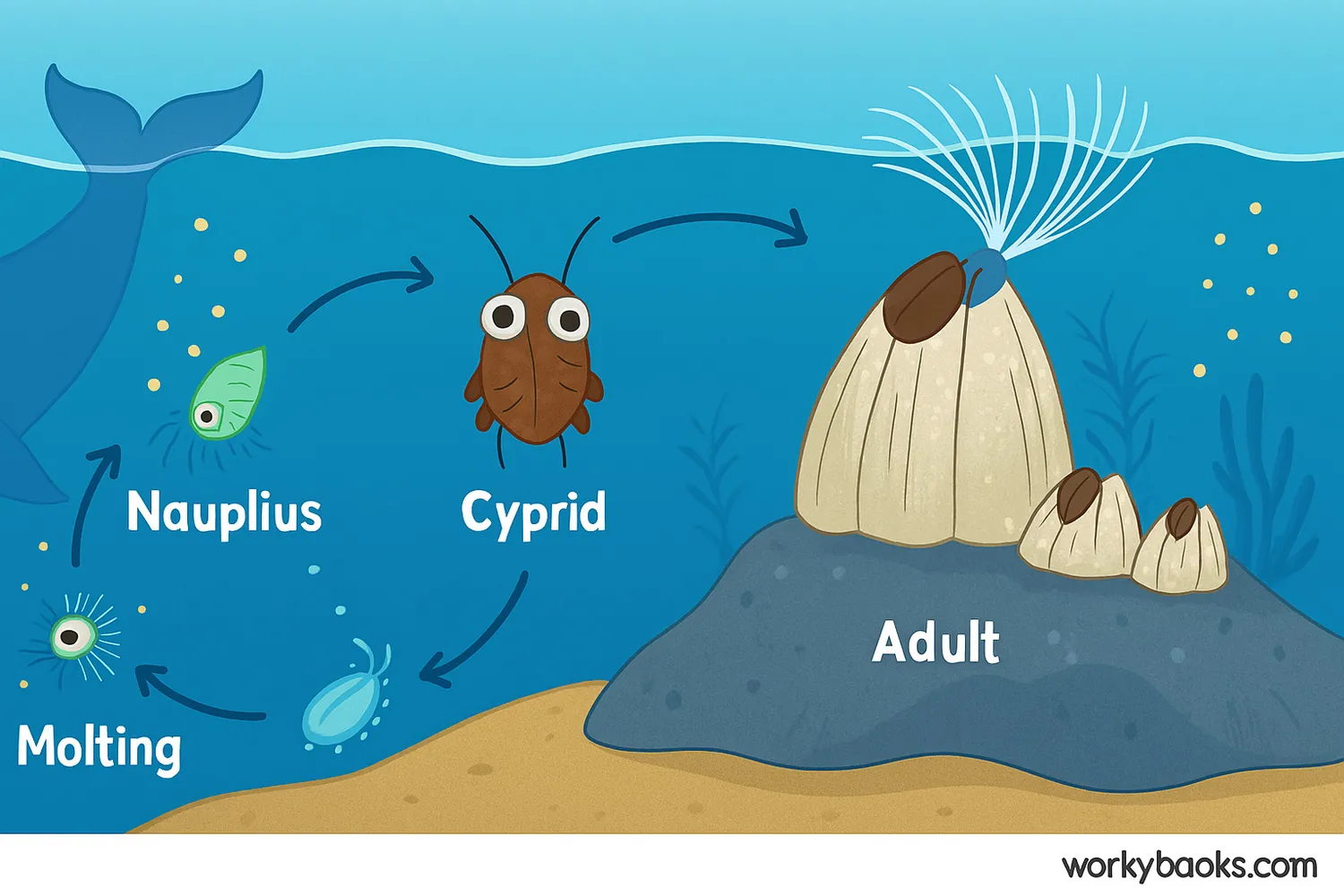
Barnacle grows from drifting larva to glued adult with cirri filtering food from ocean water.
Imagine a creature that spends its youth swimming freely, only to glue itself headfirst to a rock for the rest of its life. This fascinating journey belongs to the barnacle, a common marine invertebrate found clinging to rocks, ship hulls, and even whales around the world. Understanding the barnacle life cycle reveals an incredible story of growth, adaptation, and survival in the ocean.
The life of a barnacle begins as a tiny, free-swimming larva called a nauplius. This microscopic stage looks very different from an adult barnacle, resembling a small, oval-shaped creature with three pairs of legs and a single eye. The nauplius drifts in the ocean currents, feeding on plankton and growing. It undergoes several molts, shedding its outer skin as it gets larger. This period of growth is crucial for the barnacle to gather enough energy for its next transformation.
After several nauplius stages, the larva transforms into a second larval stage called a cyprid. The cyprid is still free-swimming but its main goal is no longer just eating; it's looking for a permanent home. It has complex antennae that it uses to explore surfaces, searching for the perfect spot to settle. These antennae are sensitive to chemical signals left by other barnacles, which helps them find safe and suitable places to attach. Once a good spot is found, the cyprid uses special glands in its antennae to produce a super-strong, natural biological glue.
With its glue applied, the cyprid attaches itself headfirst to the chosen surface. This is a critical moment of metamorphosis. Once attached, it will never move again, becoming sessile. Over the next few days, the cyprid transforms into its adult form. Its outer shell hardens into protective plates, and its feathery feeding legs, called cirri, emerge. These cirri sweep through the water, filtering out tiny food particles.
Barnacles are hermaphrodites, meaning each individual barnacle has both male and female reproductive organs. This allows them to reproduce even when isolated, though they usually cross-fertilize with neighbors. They release their fertilized eggs into the water, and the cycle begins anew with the hatching of new nauplius larvae. From a tiny swimmer to a firmly attached filter-feeder, the barnacle life cycle is a remarkable example of adaptation in marine environments. Interesting Fact: Some barnacle species can live for over 10 years, continuously filtering food from the ocean currents.
What is the first free-swimming larval stage of a barnacle called?
NaupliusCypridAdultHermaphrodite
What does a barnacle cyprid use to explore surfaces?
LegsEyesAntennaeShell
Why is the cyprid stage crucial for barnacles?
Eating planktonFinding a homeGrowing largerShedding skin
What does 'sessile' mean for an adult barnacle?
Can swim freelyAttached permanentlyEats only plantsChanges color
How do adult barnacles typically feed?
By hunting fishSweeping waterEating seaweedDigging in sand
What advantage do barnacles gain from being hermaphrodites?
Swim fasterEat more foodReproduce aloneChange color
A barnacle's ability to stick to surfaces is an example of what?
PredationMigrationAdaptationCompetition
If a cyprid settled on a surface with no other barnacles, could it still reproduce?
Yes, it's hermaphroditeNo, it needs partner
Which term describes the change from cyprid to adult barnacle?
MoltingFeedingMetamorphosisDrifting
Why is it important for a nauplius to gather enough energy?
To swim fasterFor transformationTo attract matesTo hide better
Perfect For:
👩🏫 Teachers
• Reading comprehension practice
• Auto-graded assessments
• Literacy skill development
👨👩👧👦 Parents
• Reading practice at home
• Comprehension improvement
• Educational reading time
🏠 Homeschoolers
• Reading curriculum support
• Independent reading practice
• Progress monitoring
Reading Features:
📖
Reading Passage
Engaging fiction or nonfiction text
❓
Comprehension Quiz
Auto-graded questions
📊
Instant Feedback
Immediate results and scoring
📄
Printable Version
Download for offline reading
🔊
Read Aloud
Voice-over with word highlighting
Reviews & Ratings
No reviews yet. Be the first to share your experience!
Related Content
Understanding Biological Evolution and Diversity
This passage addresses the NGSS standard 3-LS4-2 focusing on biological evolution and the unity and diversity of life. T...
RI.3.3RI.4.3RI.5.33-LS4-2
Theory of Evolution
This middle school science passage explains the theory of evolution and the concept of common ancestry, aligning with NG...
MS-LS4-1MS-LS4-2
Evidence for Evolution: Comparative Anatomy
This middle school science reading passage explores the evidence for evolution through comparative anatomy, aligning wit...
MS-LS4-2MS-LS4-3
The Nature of Life Science
This passage, aligned with NGSS MS-LS1-1, introduces students in grades 6-8 to the foundational concepts of life science...
MS-LS1-1
Human Evolution
This middle school science passage explains the scientific evidence for human evolution, aligning with NGSS standards MS...
MS-LS4-1MS-LS4-2
The Giant Isopod: Biological Evolution
This NGSS passage examines how giant isopods evolved for deep-sea survival, including slow metabolism for food scarcity,...
MS-LS4-4RI.6.3RI.7.3RI.8.8
Evidence for Evolution: The Fossil Record
This middle school science passage explains the importance of fossils as preserved evidence of ancient life and their ro...
MS-LS4-1
Science Vocabulary
This worksheet on domain-specific words will help students learn some science vocabulary. Students will be asked to matc...
L.3.6L.3.4.A
Simple Machines Science Report
This science writing task requires students to clearly explain how three simple machines work using precise domain-speci...
W.5.4
The Science of Hibernation
This educational module, featuring an audio-integrated reading passage titled 'The Science of Hibernation,' is designed ...
What is an amphibian
This audio-integrated reading passage, "The Life of Amphibians," is designed for 4th-grade students to explore the fasci...
The Levels of Australopithecus
This educational content offers an engaging, audio-integrated reading passage titled 'The Levels of Biological Classific...
The Pumpkin Life Cycle
This informational worksheet explores the pumpkin lifecycle, guiding students through procedural steps in a scientific t...
RI.2.3RI.2.10
The Nature of Science
This passage explores the nature of science for middle school students, aligning with NGSS standards MS-ETS1-4, MS-PS1-1...
MS-ETS1-4MS-PS1-1MS-LS1-1
What Is Earth Science?
This engaging middle school science passage introduces students to the field of Earth science, aligning with NGSS standa...
MS-ESS1MS-ESS2MS-ESS3SEP
The Life Cycle of an Angiosperm
This educational content package delves into the intriguing world of angiosperms and their complex life cycles, perfectl...
Citizen Science and Ecological Monitoring
This engaging passage for grades 6-8 introduces the concept of citizen science and its critical role in ecological monit...
MS-LS2-1
Tools and Technology in Earth Science
This middle school science reading passage explores the wide range of tools and technologies used in Earth science, from...
MS-ESS2-2MS-ESS3-2MS-ETS1-1MS-PS4-3
History of Life on Earth
This comprehensive middle school science reading passage provides an engaging overview of the history of life on Earth, ...