This learning resource is available in interactive and printable formats. The interactive worksheet can be played online and assigned to students. The Printable PDF version can be downloaded and printed for completion by hand.
This passage explains the essential scientific concepts of weight and mass for middle school students. It addresses common misconceptions by distinguishing between mass—the amount of matter in an object, which remains constant—and weight, the force of gravity acting on mass, which changes according to location. The passage integrates real-world examples, such as the difference in weight on Earth versus the Moon, and explores the implications for astronauts in space. Students will discover why bathroom scales can be misleading and how mass, not weight, determines inertia. The passage is aligned with NGSS standard MS-PS2-4 and includes audio integration, a Spanish translation, and differentiated text for accessibility. Activities include a quiz, writing prompts, and two graphic organizers to reinforce understanding and support critical thinking about mass, weight, and their roles in science and technology.
CONTENT PREVIEW
Expand content preview
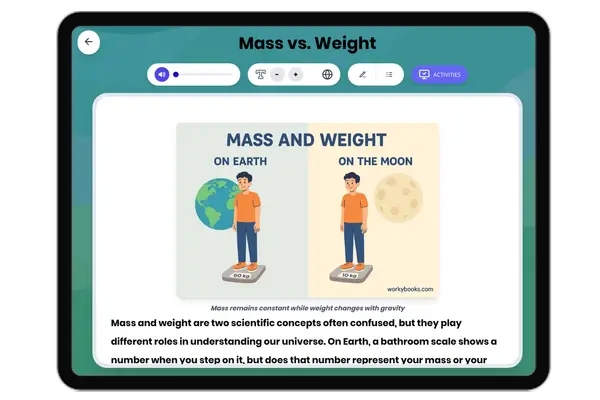
Mass remains constant while weight changes with gravity
Weight and mass are two scientific terms that are often confused, but they have distinct meanings and play different roles in science. In physics, understanding the difference between mass and weight is essential, especially when studying motion, gravity, or space exploration. Many students notice that astronauts float in space, or that objects seem lighter on the Moon. These observations raise important questions about how gravity affects matter and how scientists measure it.
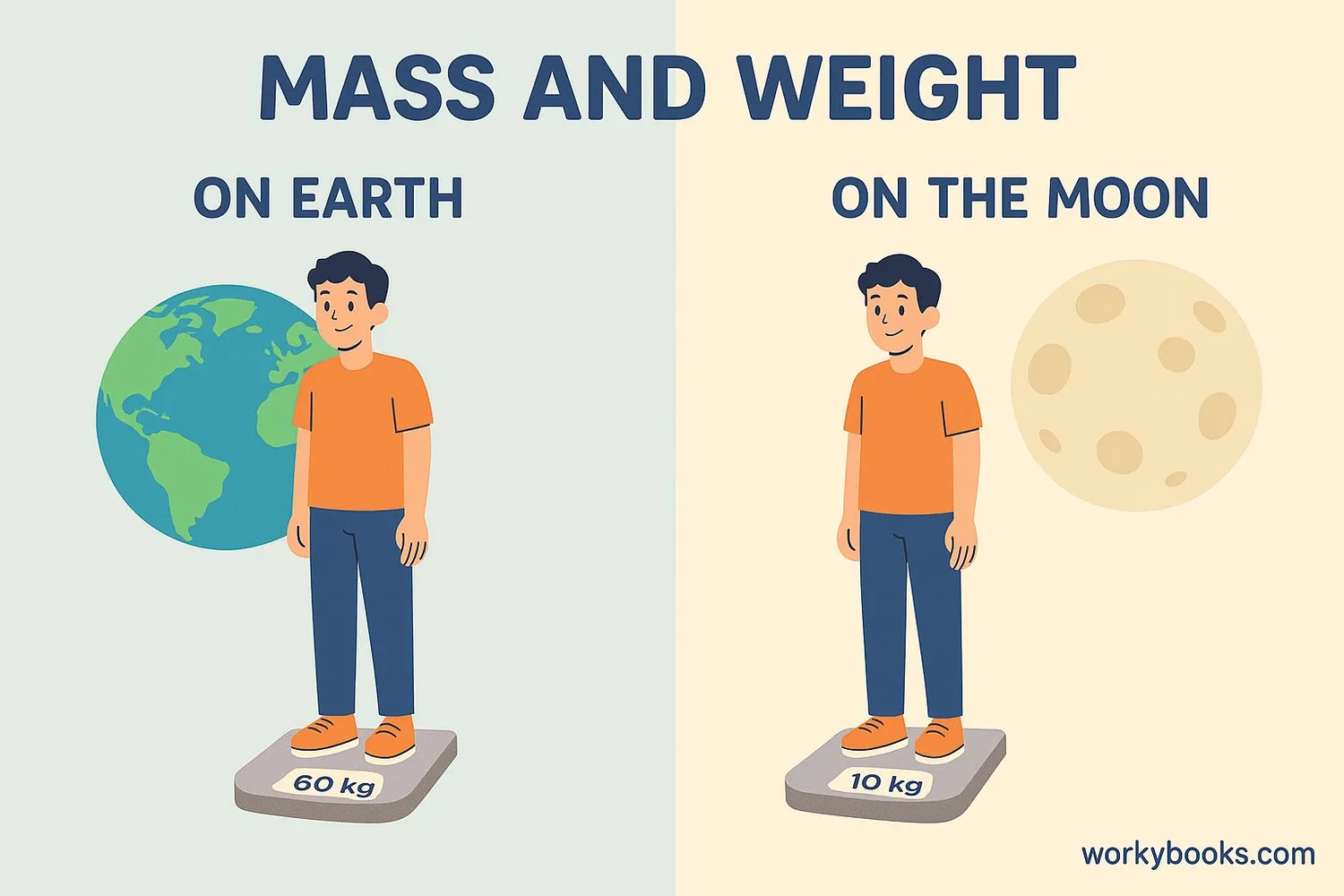
Mass: The Intrinsic Property Mass is the amount of matter in an object. It is measured in kilograms (kg) and does not change, no matter where the object is in the universe. Mass is an intrinsic property, meaning it is a fundamental characteristic of the object itself. For example, if a person has a mass of 60 kg on Earth, their mass remains 60 kg on the Moon or even in deep space. Mass determines how much an object resists changes in motion, a property called inertia. Scientists use precise instruments, such as balances, to measure mass, ensuring accuracy regardless of local gravity.
Weight: The Force of Gravity Weight, on the other hand, is the force with which gravity pulls on an object's mass. Weight is measured in Newtons (N), named after Isaac Newton. The weight of an object depends on two factors: its mass and the gravitational acceleration at its location. The formula for weight is: Weight = Mass × Gravitational Acceleration. On Earth, gravitational acceleration is about 9.8 meters per second squared (9.8 m/s²). For a 60 kg person, their weight on Earth is 60 kg × 9.8 m/s² = 588 N. On the Moon, where gravity is about one-sixth as strong (1.6 m/s²), the same person weighs only 96 N. In deep space, far from planets, gravity is so weak that the person is nearly weightless, even though their mass is unchanged.
Why the Difference Matters The difference between weight and mass is important in both science and everyday life. For instance, bathroom scales actually measure force (weight), but often display numbers in kilograms or pounds, leading to confusion. In space, astronauts are weightless because there is much less gravitational pull, but their mass, and therefore their inertia, remain the same. This means they still need to exert force to move themselves or objects. Understanding the difference is also vital for designing spacecraft and equipment, as engineers must calculate both the mass (for inertia and energy needs) and weight (for launch and landing considerations). The distinction is a key concept in physics and helps explain phenomena from falling objects to planetary motion.
Connecting to Larger Principles Knowing how mass and weight interact with gravity deepens our understanding of the universe. These concepts are part of the broader study of forces and motion, which are central to physical science and engineering. Recognizing the difference helps scientists make accurate measurements and predictions, whether testing new materials or sending astronauts to Mars. Grasping the distinction between mass and weight can also help students avoid common mistakes in science and appreciate the complexity of the world around them.
Interesting Fact: On Jupiter, gravity is about 2.5 times stronger than on Earth, so a person would weigh much more there, even though their mass stays the same!
What is the main difference between mass and weight?
Mass is the amount of matter in an object; weight is the force of gravity on that object.Mass changes with gravity; weight stays the same everywhere.Mass is measured in Newtons; weight is measured in kilograms.Weight is only important on Earth; mass is only important in space.
Which unit is used to measure mass?
Newton (N)Pound (lb)Kilogram (kg)Meter (m)
What property determines how much an object resists changes in motion?
GravityInertiaWeightForce
Which sentence best explains why a person weighs less on the Moon than on Earth?
The person's mass decreases on the Moon.Gravity is weaker on the Moon, so the force pulling on the person's mass is less.The Moon has no gravity at all.The person is farther from the Sun when on the Moon.
What does 'intrinsic property' mean in the passage?
A property that changes with gravity.A basic property that does not change based on location.A property only found in living things.A property that depends on temperature.
Which is an example of weight changing while mass stays the same?
A 60 kg person weighing 588 N on Earth and 96 N on the Moon.A rock breaking into smaller pieces.Water freezing into ice.A book being pushed across a table.
If the gravitational acceleration on a planet is higher than Earth, what happens to your weight?
It decreases.It stays the same.It increases.It becomes zero.
True or False: Mass changes when you travel from Earth to the Moon.
TrueFalse
True or False: Astronauts are weightless in orbit but still have the same mass as on Earth.
TrueFalse
What tool do scientists use to measure mass accurately?
Meter stickBalanceSpring scaleThermometer
Perfect For:
👩🏫 Teachers
• Reading comprehension practice
• Auto-graded assessments
• Literacy skill development
👨👩👧👦 Parents
• Reading practice at home
• Comprehension improvement
• Educational reading time
🏠 Homeschoolers
• Reading curriculum support
• Independent reading practice
• Progress monitoring
Reading Features:
📖
Reading Passage
Engaging fiction or nonfiction text
❓
Comprehension Quiz
Auto-graded questions
📊
Instant Feedback
Immediate results and scoring
📄
Printable Version
Download for offline reading
🔊
Read Aloud
Voice-over with word highlighting
Reviews & Ratings
No reviews yet. Be the first to share your experience!
Related Content
Gravity
This comprehensive science passage introduces middle school students to the concept of gravity, the invisible force that...
MS-PS2-4
Scientific Laws
This comprehensive middle school science passage introduces students to scientific laws, focusing on how they describe c...
MS-PS2-4MS-PS1-5MS-ETS1-4
Mass vs Weight
This grade 6-8 science passage explores the fundamental difference between mass and weight, aligned with NGSS standard M...
MS-PS2-4
What Is Gravity?
This comprehensive middle school science reading passage explores the concept of gravity, aligning with NGSS standards M...
MS-ESS1-2MS-PS2-4
Escape Velocity and Space Travel
This middle school science passage introduces students to the concept of escape velocity—the minimum speed required to b...
MS-ESS1-2MS-PS2-4
Weightlessness and Microgravity
This science reading passage for middle school students explores the phenomenon of weightlessness and microgravity. Alig...
MS-PS2-4MS-ESS1-2
Orbits and Orbital Motion
This middle school science passage, aligned with NGSS MS-ESS1-2 and MS-PS2-4, explores the science of orbits and orbital...