This learning resource is available in interactive and printable formats. The interactive worksheet can be played online and assigned to students. The Printable PDF version can be downloaded and printed for completion by hand.
"This comprehensive middle school science passage defines radioactive decay as the process by which unstable atomic nuclei become stable by releasing particles and energy. It details the three main types of decay—alpha, beta, and gamma—explaining the specific changes that occur in the nucleus for each. The passage introduces the concept of half-life as a key measure of decay rate and connects the topic to real-world applications like radiometric dating and medical procedures. This resource is designed to help students understand core concepts in physical science, aligning with NGSS standards related to matter, its structure, and its interactions. It provides a foundational understanding of nuclear processes and their significance."
CONTENT PREVIEW
Expand content preview
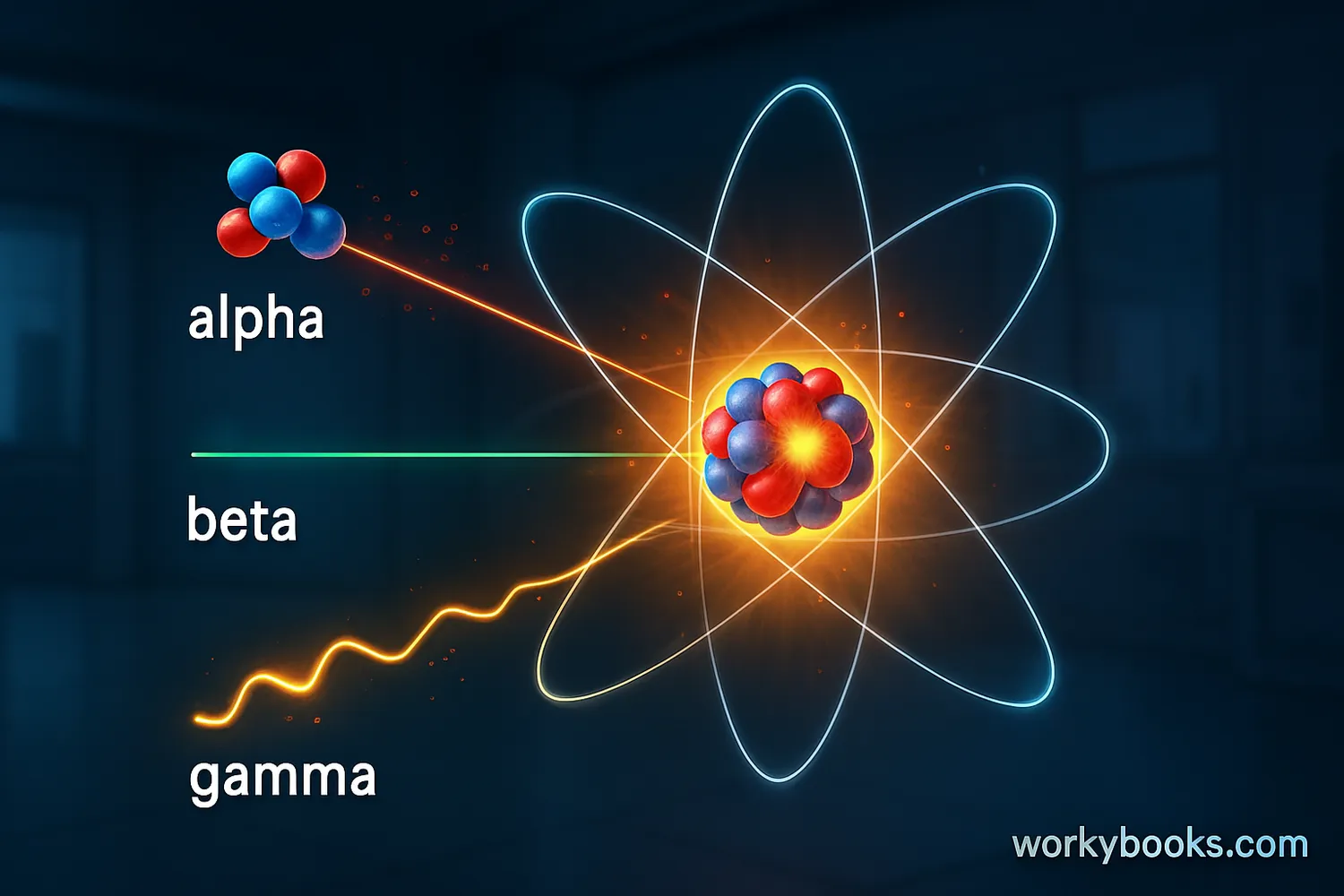
Radioactive decay, showing an unstable nucleus releasing alpha, beta, and gamma radiation to achieve stability.
At the heart of every atom lies a nucleus, a dense center containing protons and neutrons. While most atoms have a stable nucleus that remains unchanged, some have an unstable, or radioactive, nucleus. Radioactive decay is the process by which these unstable nuclei lose energy by emitting particles and radiation to become more stable. This fundamental process is a natural part of the universe, transforming one element into another over time. The rate at which this decay occurs is unique to each radioactive isotope and is measured by its half-life.
There are three primary types of radioactive decay, each distinguished by the particles or energy released. In alpha decay, an unstable nucleus ejects an alpha particle, which is essentially the nucleus of a helium atom (two protons and two neutrons). This results in the original atom transforming into a new element with a lower atomic number. In beta decay, a neutron inside the nucleus converts into a proton and an electron. The electron is then ejected from the nucleus as a beta particle, causing the atom's atomic number to increase by one, and again, creating a different element. Finally, gamma decay involves an unstable nucleus releasing excess energy in the form of high-energy electromagnetic waves called gamma rays. Unlike alpha and beta decay, gamma decay does not change the number of protons or neutrons, so the atom remains the same element.
Radioactive decay has many important real-world applications. For example, the predictable rate of decay, or half-life, of certain isotopes like Carbon-14 is used in radiometric dating to determine the age of ancient artifacts and fossils. This process helps scientists understand Earth's history and the history of life. In medicine, controlled amounts of radioactive isotopes are used for medical imaging, such as PET scans, and for treating cancer. The ability to harness this natural process allows for advancements in science, technology, and healthcare.
Fun Fact: The banana is naturally radioactive due to the presence of a small amount of the isotope potassium-40. This tiny amount is harmless and contributes to the background radiation we are all exposed to every day.
What is the main purpose of radioactive decay for an unstable nucleus?
To gain more neutronsTo become more stableTo increase its sizeTo change its mass
An alpha particle is composed of which two subatomic particles?
Protons and electronsNeutrons and electronsProtons and neutronsElectrons only
What happens to an atom's atomic number during beta decay?
It decreases by oneIt increases by oneIt stays the sameIt doubles
Which type of decay involves the nucleus releasing only energy, without changing its elemental identity?
Alpha decayBeta decayGamma decayBoth alpha and beta decay
If an isotope has a half-life of 10 years, how much of a 100-gram sample will remain after 20 years?
50 grams25 grams10 grams0 grams
According to the passage, what is a key application of radioactive decay's predictable rate?
Powering a nuclear reactorCreating new elementsMedical imagingRadiometric dating
What is the central idea of the passage?
Explaining the dangers of radiation.Describing the components of an atom.Defining and explaining radioactive decay and its uses.Comparing stable and unstable elements.
Why is gamma decay different from alpha and beta decay?
It changes the atomic number.It emits a particle instead of energy.It does not change the atom's element.It has a longer half-life.
Perfect For:
👩🏫 Teachers
• Reading comprehension practice
• Auto-graded assessments
• Literacy skill development
👨👩👧👦 Parents
• Reading practice at home
• Comprehension improvement
• Educational reading time
🏠 Homeschoolers
• Reading curriculum support
• Independent reading practice
• Progress monitoring
Reading Features:
📖
Reading Passage
Engaging fiction or nonfiction text
❓
Comprehension Quiz
Auto-graded questions
📊
Instant Feedback
Immediate results and scoring
📄
Printable Version
Download for offline reading
🔊
Read Aloud
Voice-over with word highlighting
Reviews & Ratings
No reviews yet. Be the first to share your experience!
Related Content
Physical Properties of Matter
This comprehensive reading passage introduces grades 6-8 students to the concept of physical properties of matter, perfe...
MS-PS1-1
Changes in Matter
This engaging science passage introduces Grade 4-5 students to the concept of how matter can change, meeting NGSS standa...
What Are Physical Changes?
This engaging Grade 4-5 science passage introduces students to the concept of physical changes in matter, aligning with ...
Kinetic Theory of Matter
This middle school science reading passage introduces students to the kinetic theory of matter, aligning with NGSS MS-PS...
MS-PS1-4
The Nature of Science
This passage explores the nature of science for middle school students, aligning with NGSS standards MS-ETS1-4, MS-PS1-1...
MS-ETS1-4MS-PS1-1MS-LS1-1
Particle Model of Matter
This comprehensive science reading passage for grades 6-8 explores the particle model of matter, aligning with NGSS stan...
MS-PS1-1MS-PS1-4
Evaporation as Physical Change
This middle school science passage examines the process of evaporation, a fundamental physical change where a liquid tur...
MS-PS1-4
Physical Changes: Deposition
This middle school science passage explores the concept of deposition, a type of physical change where matter transition...
MS-PS1-4
Sublimation as Physical Change
This educational passage for grades 6-8 explores the science of sublimation—a physical change where a solid transforms d...
MS-PS1-4
Physical Changes: Condensation
This middle school science passage explores the process of condensation, the physical change where a gas becomes a liqui...
MS-PS1-4
Is Evaporation a Physical Change
"This reading passage is designed for middle school students to explore the concept of evaporation and its classificatio...
Chemical Properties of Matter
This engaging middle school science passage explores the chemical properties of matter, focusing on how these properties...
MS-PS1-2
Science Vocabulary
This worksheet on domain-specific words will help students learn some science vocabulary. Students will be asked to matc...
L.3.6L.3.4.A
Simple Machines Science Report
This science writing task requires students to clearly explain how three simple machines work using precise domain-speci...
W.5.4
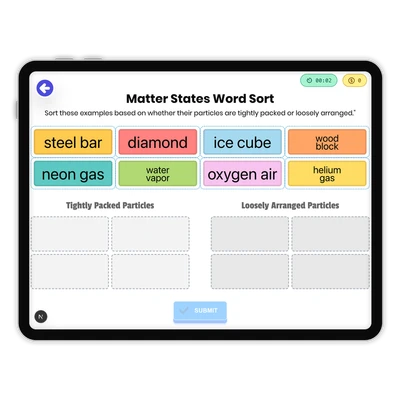
Matter States Word Sort
This interactive word sort focuses on helping students understand the different states of matter through real-world exam...
PS1.A
The Idea of the Atom
This informational science passage introduces middle school students (grades 6-8) to the concept that all matter is made...
MS-PS1-1
Matter States Word Sort
This classification activity helps students understand how particles are arranged in different states of matter. Student...
5-PS1-1
What Is Density?
This comprehensive science passage introduces middle school students (grades 6-8) to the concept of density, aligned wit...
MS-PS1-1
What Is Earth Science?
This engaging middle school science passage introduces students to the field of Earth science, aligning with NGSS standa...
MS-ESS1MS-ESS2MS-ESS3SEP
Citizen Science and Ecological Monitoring
This engaging passage for grades 6-8 introduces the concept of citizen science and its critical role in ecological monit...