Who Invented the Barometer — Reading Comprehension
Rate this|
1
Premium Resource
Present
Present in classroom. No work saved
Assign
Classroom with student accounts, Track progress
Quick Play
No student accounts, assign with a link
Grades
3
4
5
6
7
8
PRINT+DIGITAL RESOURCE
This learning resource is available in interactive and printable formats. The interactive worksheet can be played online and assigned to students. The Printable PDF version can be downloaded and printed for completion by hand.
"This middle school science learning module explores the invention of the barometer by Evangelista Torricelli. It is designed to align with NGSS standards, specifically MS-PS1-4, by examining how the physical properties of matter, like the weight of air, can be measured and used to predict phenomena. The reading passage details Torricelli’s groundbreaking experiment with mercury and the concept of a Torricellian vacuum. Students will learn how changes in atmospheric pressure are linked to weather patterns and altitude, and how this foundational discovery led to modern applications. The module includes multiple-choice questions to assess a student's understanding of key concepts, the historical context, and real-world applications of barometers. This resource is perfect for a unit on matter and its interactions, and for teaching students how scientific models and instruments are developed to explain the world around us."
CONTENT PREVIEW
Expand content preview
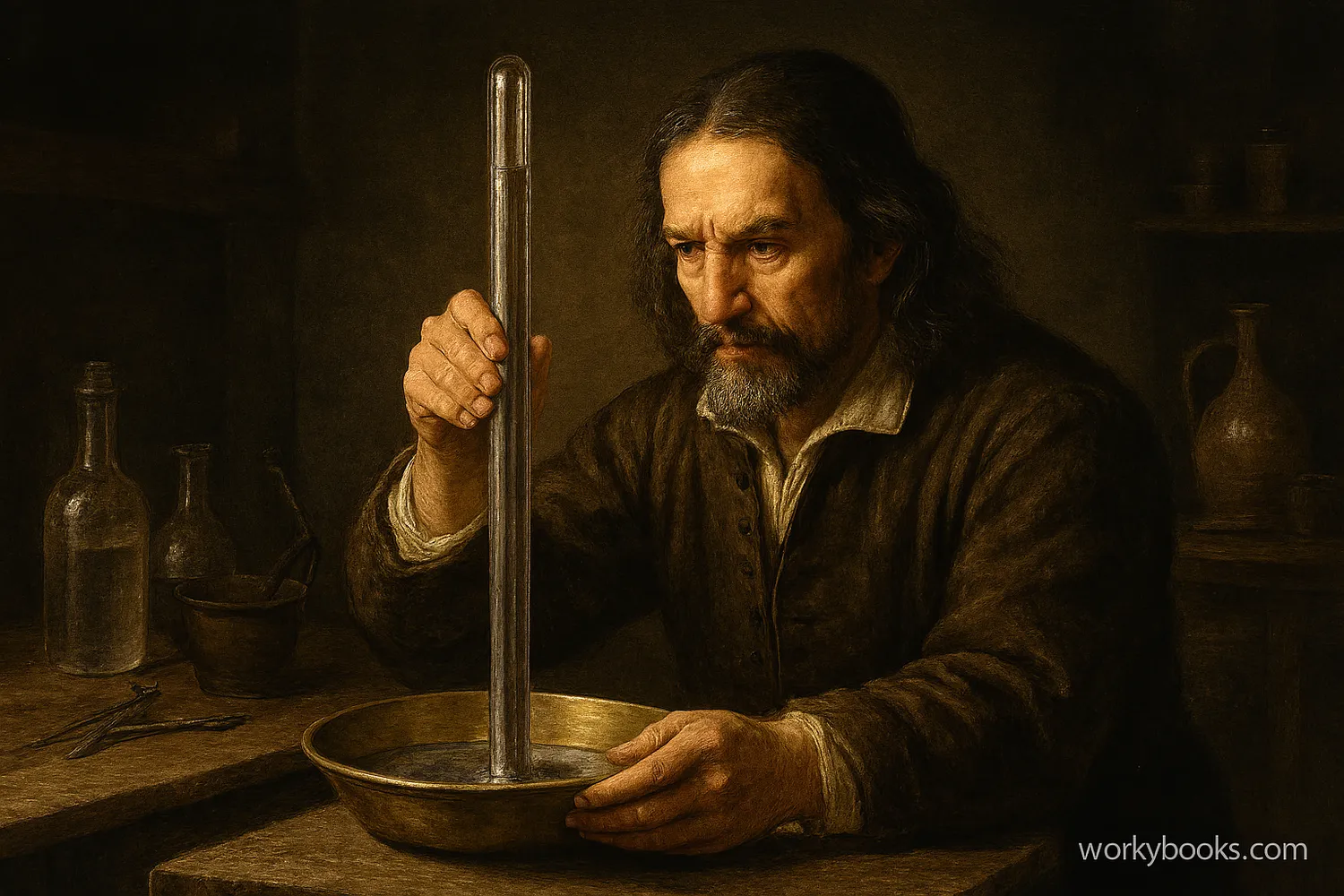
Evangelista Torricelli performing the experiment that led to the invention of the first barometer in 1643.
The concept of atmospheric pressure, the weight of the air that surrounds us, was not always understood. For centuries, people believed that a vacuum could not exist and that water pumps worked because "nature abhors a vacuum." This idea, however, could not explain why a pump could only raise water to a maximum height of about 10 meters. The answer to this puzzle was discovered by Evangelista Torricelli, a brilliant Italian physicist and mathematician who was a student of the famous Galileo Galilei. In 1643, Torricelli created the first-ever barometer, a device that could measure the pressure of the atmosphere.
Torricelli's invention was a simple but groundbreaking experiment. He took a long glass tube, sealed at one end, and filled it completely with mercury. He then inverted the tube and placed its open end into a basin of mercury. He observed that the column of mercury in the tube did not completely fall out. Instead, it settled at a specific height, leaving an empty space, or Torricellian vacuum, at the top of the tube. Torricelli correctly deduced that the pressure of the surrounding air pushing down on the mercury in the basin was what held the mercury column up inside the tube.
The height of the mercury column was a direct measure of the atmospheric pressure. A higher column meant greater pressure, while a lower column indicated less pressure. This groundbreaking discovery proved that air has weight and that atmospheric pressure is a quantifiable force. Torricelli’s mercury barometer became the standard for measuring air pressure for centuries. Today, we use various types of barometers, including more portable aneroid barometers, which use a sealed, flexible metal box instead of liquid mercury.
Barometers are essential tools in modern life, particularly in the field of meteorology. By tracking changes in air pressure, meteorologists can forecast weather patterns. A rapid drop in pressure often signals an approaching storm, while a steady rise suggests fair, clear weather. Pilots also rely on barometers to determine their altitude, as air pressure decreases at higher elevations. The invention of the barometer fundamentally changed our understanding of the atmosphere and paved the way for modern weather science.
Fun Fact: The unit of pressure "torr" is named in honor of Evangelista Torricelli. One torr is equal to about 1/760 of an atmosphere, a value derived from the average height of the mercury column in Torricelli's experiment.
Who is credited with inventing the first barometer?
A rapid drop in barometric pressure is often a sign of what weather condition?
A calm, clear dayAn approaching stormUnchanging fair weatherA decrease in temperature
Why did the mercury column in Torricelli's experiment not completely fall out of the tube?
The tube was too long.It was held up by atmospheric pressure.The mercury was too heavy.A seal was at the bottom.
Which of the following best describes the main idea of the passage?
Barometers are the most important invention in history.Torricelli's experiment was a lucky accident.The invention of the barometer proved air has weight.Modern barometers are more useful than old ones.
If a pilot is flying and their barometer shows a decreasing pressure reading, what is likely happening?
They are increasing in altitude.They are decreasing in altitude.The weather is improving.The plane is flying faster.
Perfect For:
👩🏫 Teachers
• Reading comprehension practice
• Auto-graded assessments
• Literacy skill development
👨👩👧👦 Parents
• Reading practice at home
• Comprehension improvement
• Educational reading time
🏠 Homeschoolers
• Reading curriculum support
• Independent reading practice
• Progress monitoring
Reading Features:
📖
Reading Passage
Engaging fiction or nonfiction text
❓
Comprehension Quiz
Auto-graded questions
📊
Instant Feedback
Immediate results and scoring
📄
Printable Version
Download for offline reading
🔊
Read Aloud
Voice-over with word highlighting
Reviews & Ratings
No reviews yet. Be the first to share your experience!
Related Content
Climate and weather activity
This worksheet is perfect for understanding the differences between climate and weather. Students will read the phrases ...
Climate and Weather — Distinguishing Characterstics
This worksheet highlights the differences between climate and weather. The chart format makes comparing and contrasting ...
Comparing Weather and Climate Texts
This reading comprehension worksheet has 5th graders read two informational texts about Weather and Climate. Students th...
RI.5.9
Tools and Technology in Earth Science
This middle school science reading passage explores the wide range of tools and technologies used in Earth science, from...
MS-ESS2-2MS-ESS3-2MS-ETS1-1MS-PS4-3
What Is Space Weather and How Does It Affect the Earth?
This NGSS-aligned science passage for middle school explains what space weather is and how it affects Earth. Students le...
MS-ESS2-2
What Is Earth Science?
This engaging middle school science passage introduces students to the field of Earth science, aligning with NGSS standa...
MS-ESS1MS-ESS2MS-ESS3SEP
Extreme Weather and Climate Change
This Grade 6-8 science passage, aligned to NGSS standards, explores the impact of climate change on extreme weather even...
What Is The Difference Between Climate Model And Weather Model?
This reading passage delves into the fundamental differences between weather models and climate models, explaining their...
Scientific Inquiry in Earth Science
This passage explores scientific inquiry in Earth science for grades 6-8, aligned with NGSS standards MS-ESS1-4, MS-ESS2...
MS-ESS1-4MS-ESS2-1MS-ESS3-5SEP
Earth's Major Climate Zones Explained
This engaging science passage for grades 6-8 explains Earth's major climate zones, including tropical, temperate, and po...
Climate Through Earth's History
This engaging passage for grades 6-8 explores how Earth's climate has naturally changed over millions of years, highligh...
MS-ESS1-4MS-ESS2-6
Earth: Our Home in Space
This engaging Grade 4-5 science passage, aligned to NGSS, introduces students to Earth's special place in the solar syst...
Weather vs. Climate
This comprehensive passage for grades 6-8 explores the difference between weather and climate, aligning with NGSS standa...
MS-ESS2-6
How is Climate Different from Weather?
This passage distinguishes climate from weather for young readers. It defines climate as the usual weather patterns over...
RI.3.1RI.4.14.ESS2.D
Air Masses and Weather
This audio-integrated passage, "Air Masses and Weather," is designed for 6th-grade students to understand how the moveme...
Antarctica Climate
This engaging science passage for grades 6-8 explores Antarctica, the coldest climate zone on Earth. Students will learn...
Climate Zones Word Sort
This word sort activity helps students understand different climate zones through real-world locations. Students classif...
How Climate Change Affects Weather
This middle school science passage explores how and why weather patterns are changing globally. Students will learn abou...
MS-ESS3-5
Escape Velocity and Space Travel
This middle school science passage introduces students to the concept of escape velocity—the minimum speed required to b...
MS-ESS1-2MS-PS2-4
Polar Bears and Climate
This informational text on polar bears is a great way to practice reading comprehension. Students will read the passage ...