The Role of Ocean Currents in Climate Patterns — Reading Comprehension
Rate this
Premium Resource
Present
Present in classroom. No work saved
Assign
Classroom with student accounts, Track progress
Quick Play
No student accounts, assign with a link
Grades
5
6
7
8
PRINT+DIGITAL RESOURCE
This learning resource is available in interactive and printable formats. The interactive worksheet can be played online and assigned to students. The Printable PDF version can be downloaded and printed for completion by hand.
This engaging NGSS-aligned reading passage explores the critical role of ocean currents in shaping our planet’s climate patterns. Designed for grades 6-8, the passage explains essential scientific concepts such as surface and deep ocean currents, their causes, and their effects on weather and climate. Key vocabulary words like 'salinity,' 'gyre,' and 'thermohaline circulation' are highlighted and defined to build scientific literacy. Real-world examples, including the Gulf Stream and El Niño, help students connect the science to daily life. Comprehension is reinforced through a set of multiple-choice questions and writing prompts that encourage deeper analysis of cause and effect in nature. Spanish translation and audio integration support diverse learners, making the material accessible to all. This resource is perfect for classrooms, homework, or science centers, and gives students a strong foundation for understanding how the ocean’s invisible highways affect everything from rain patterns to ecosystems worldwide.
CONTENT PREVIEW
Expand content preview
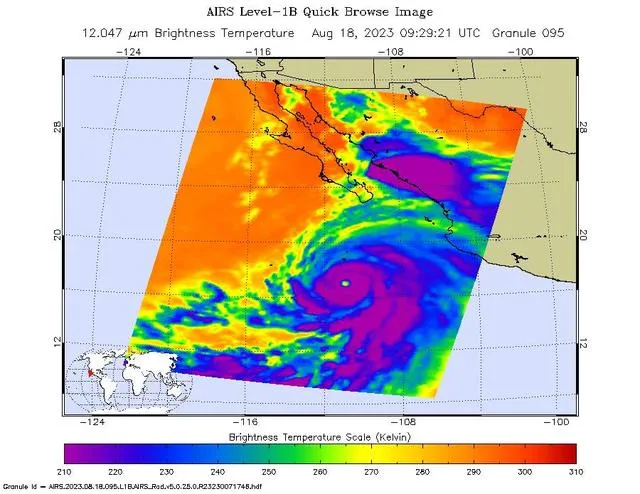
"Hurricane Hilary Captured by NASA's AIRS" / NASA (Public domain).
Ocean currents are large streams of moving water that flow through the world’s oceans. These currents can be warm or cold, and they travel across thousands of miles. Ocean currents play a vital role in shaping the climate of coastal regions and even places far from the sea.
The two main types of ocean currents are surface currents and deep currents. Surface currents flow in the top 400 meters of the ocean and are mainly driven by wind. Deep currents move slowly deep below the surface and are caused by differences in water temperature and salinity (how salty the water is).
One of the most famous surface currents is the Gulf Stream. The Gulf Stream carries warm water from the Gulf of Mexico along the east coast of the United States and across the Atlantic Ocean to Europe. This current helps keep parts of Europe warmer than other places at the same latitude. For example, London is much warmer in winter compared to other places as far north because of the Gulf Stream.
Ocean currents affect the climate by moving heat around the planet. Warm currents make nearby air warmer and can bring more rain. Cold currents cool the air and can make coastal regions drier. In some places, changes in ocean currents can cause major weather events. For instance, El Niño is a change in the Pacific Ocean current that can cause floods, droughts, and storms in different parts of the world.
Currents are also important for marine life. They carry nutrients that feed tiny plants and animals called plankton. These nutrients support the entire ocean food chain, including fish, whales, and seabirds.
Scientists study ocean currents using satellites, ships, and underwater robots. Understanding currents helps us predict weather, protect sea animals, and plan safe shipping routes. As the climate changes, ocean currents may also change, which could affect weather and life on Earth.
Interesting Fact: The world’s largest current, the Antarctic Circumpolar Current, circles Antarctica and is the only current to flow all the way around the globe!
What drives surface currents?
WindEarthquakesSunlightVolcanoes
Which current keeps Europe warmer?
Gulf StreamAntarctic CircumpolarEl NiñoIndian Current
What is plankton?
Small ocean plants and animalsLarge ocean fishRocks in the oceanClouds over the sea
Why are ocean currents important for weather?
They move heat around EarthThey make oceans deeperThey cause earthquakesThey make water salty
How can changes in currents affect regions?
Cause floods or droughtsCreate mountainsMelt glaciersMake deserts wetter
What would happen if warm currents stopped?
Coastal regions may get colderMore plankton would growRain would increase everywhereOceans would dry up
Ocean currents never change direction. True or false?
TrueFalse
What does 'salinity' mean?
How salty the water isHow deep the water isHow fast water flowsHow warm the water is
Perfect For:
👩🏫 Teachers
• Reading comprehension practice
• Auto-graded assessments
• Literacy skill development
👨👩👧👦 Parents
• Reading practice at home
• Comprehension improvement
• Educational reading time
🏠 Homeschoolers
• Reading curriculum support
• Independent reading practice
• Progress monitoring
Reading Features:
📖
Reading Passage
Engaging fiction or nonfiction text
❓
Comprehension Quiz
Auto-graded questions
📊
Instant Feedback
Immediate results and scoring
📄
Printable Version
Download for offline reading
🔊
Read Aloud
Voice-over with word highlighting
Reviews & Ratings
No reviews yet. Be the first to share your experience!
Related Content
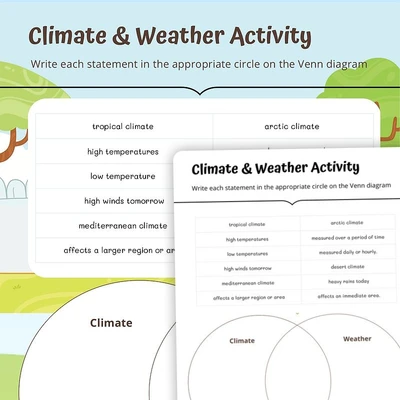
Climate and weather activity
This worksheet is perfect for understanding the differences between climate and weather. Students will read the phrases ...
Climate and Weather — Distinguishing Characterstics
This worksheet highlights the differences between climate and weather. The chart format makes comparing and contrasting ...
Comparing Weather and Climate Texts
This reading comprehension worksheet has 5th graders read two informational texts about Weather and Climate. Students th...
RI.5.9
Tools and Technology in Earth Science
This middle school science reading passage explores the wide range of tools and technologies used in Earth science, from...
MS-ESS2-2MS-ESS3-2MS-ETS1-1MS-PS4-3
What Is Space Weather and How Does It Affect the Earth?
This NGSS-aligned science passage for middle school explains what space weather is and how it affects Earth. Students le...
MS-ESS2-2
What Is Earth Science?
This engaging middle school science passage introduces students to the field of Earth science, aligning with NGSS standa...
MS-ESS1MS-ESS2MS-ESS3SEP
Extreme Weather and Climate Change
This Grade 6-8 science passage, aligned to NGSS standards, explores the impact of climate change on extreme weather even...
Scientific Inquiry in Earth Science
This passage explores scientific inquiry in Earth science for grades 6-8, aligned with NGSS standards MS-ESS1-4, MS-ESS2...
MS-ESS1-4MS-ESS2-1MS-ESS3-5SEP
What Is The Difference Between Climate Model And Weather Model?
This reading passage delves into the fundamental differences between weather models and climate models, explaining their...
Earth: Our Home in Space
This engaging Grade 4-5 science passage, aligned to NGSS, introduces students to Earth's special place in the solar syst...
Earth's Major Climate Zones Explained
This engaging science passage for grades 6-8 explains Earth's major climate zones, including tropical, temperate, and po...
Climate Through Earth's History
This engaging passage for grades 6-8 explores how Earth's climate has naturally changed over millions of years, highligh...
MS-ESS1-4MS-ESS2-6
Weather vs. Climate
This comprehensive passage for grades 6-8 explores the difference between weather and climate, aligning with NGSS standa...
MS-ESS2-6
Air Masses and Weather
This audio-integrated passage, "Air Masses and Weather," is designed for 6th-grade students to understand how the moveme...
How is Climate Different from Weather?
This passage distinguishes climate from weather for young readers. It defines climate as the usual weather patterns over...
RI.3.1RI.4.14.ESS2.D
Antarctica Climate
This engaging science passage for grades 6-8 explores Antarctica, the coldest climate zone on Earth. Students will learn...
Escape Velocity and Space Travel
This middle school science passage introduces students to the concept of escape velocity—the minimum speed required to b...
MS-ESS1-2MS-PS2-4
How Climate Change Affects Weather
This middle school science passage explores how and why weather patterns are changing globally. Students will learn abou...
MS-ESS3-5
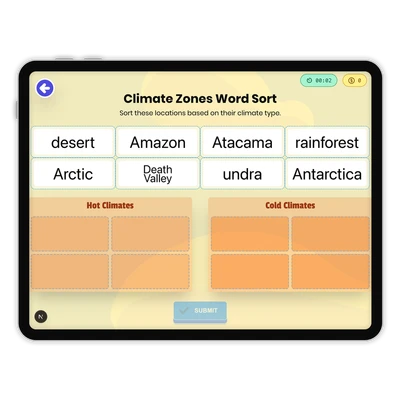
Climate Zones Word Sort
This word sort activity helps students understand different climate zones through real-world locations. Students classif...
Polar Bears and Climate
This informational text on polar bears is a great way to practice reading comprehension. Students will read the passage ...