Why Do Helmets Protect Your Head — Reading Comprehension
Rate this
Premium Resource
Present
Present in classroom. No work saved
Assign
Classroom with student accounts, Track progress
Quick Play
No student accounts, assign with a link
Grades
3
4
5
Standards
NGSS 4-PS3-3
PRINT+DIGITAL RESOURCE
This learning resource is available in interactive and printable formats. The interactive worksheet can be played online and assigned to students. The Printable PDF version can be downloaded and printed for completion by hand.
This 250-word reading passage explores how helmets protect your head during collisions, aligned with NGSS 4-PS3-3 and physical science standards for grade 4. Students discover how kinetic energy must be absorbed when your head hits something, and how helmets manage this energy transfer through smart design. The passage explains that without a helmet, your skull absorbs all the energy in a sudden impact, but helmets spread force over a larger area and use foam lining that crushes slowly during impact. This extends the collision time, reducing the force your head feels. The content connects to Disciplinary Core Ideas PS3.A (energy and motion), PS3.B (energy transfer), and PS3.C (energy in collisions). Audio-integrated features support diverse learners. Activities include comprehension questions testing recall and application, writing prompts requiring students to explain concepts and make real-world connections, and graphic organizers helping students analyze cause-effect relationships and structure-function connections. The passage uses age-appropriate language, concrete analogies, and familiar examples to build foundational understanding of energy transfer during collisions and how engineering design can manage energy absorption for safety.
CONTENT PREVIEW
Expand content preview
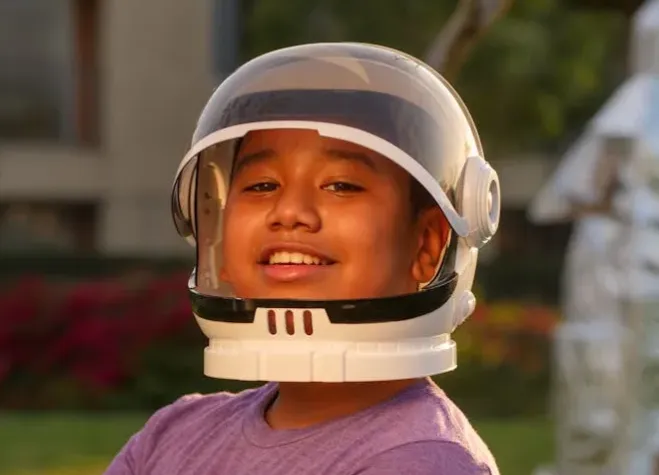
"A smiling boy wearing a space helmet outdoors, embodying childhood imagination." by Kindel Media / Pexels.
A helmet is a hard shell with soft padding inside that protects your head during a fall or crash. When your head hits something hard, it has kinetic energy—the energy of motion. This energy must go somewhere, and without a helmet, your skull absorbs all of it in a sudden impact, which is when two objects hit each other with force.
A helmet protects you in three important ways. First, the hard outer shell spreads the force—a push or pull on an object—over a larger area instead of one small spot on your head. Think of it like pressing your hand on a table versus poking it with a pencil point. The table spreads the pressure, so it doesn't hurt. Second, the foam padding inside the helmet absorbs energy, which means it takes in the energy and keeps it from reaching your head. The foam crushes slowly during the collision, like a sponge squishing when you squeeze it.
Third, and most importantly, the helmet extends the time of the collision. When the foam crushes slowly instead of your head stopping suddenly, the impact takes a tiny bit longer. This reduces the force your head feels. Scientists call this energy transfer—the movement of energy from one object to another. Good helmet design manages how energy transfers during a collision, protecting your brain from injury. That's why wearing a helmet while biking, skating, or playing sports is so important.
What is kinetic energy?
Energy from the sunEnergy of motionEnergy from foodEnergy from batteries
What absorbs energy inside a helmet?
The hard outer shellThe foam paddingThe chin strapThe air holes
How does a helmet spread force?
Over a small spotOver a larger areaInto the airInto your neck
Why does extending collision time help?
It makes the helmet prettierIt reduces the force feltIt makes you go fasterIt keeps you warmer
What happens during energy transfer?
Energy disappears completelyEnergy moves from one object to anotherEnergy stays in one placeEnergy creates new objects
How is foam crushing like squeezing?
Both happen very fastBoth absorb energy slowlyBoth make loud soundsBoth create heat
Helmets only protect during bike rides.
TrueFalse
What does impact mean in the passage?
When objects hit each other with forceWhen objects float in waterWhen objects make noiseWhen objects change color
Perfect For:
👩🏫 Teachers
• Reading comprehension practice
• Auto-graded assessments
• Literacy skill development
👨👩👧👦 Parents
• Reading practice at home
• Comprehension improvement
• Educational reading time
🏠 Homeschoolers
• Reading curriculum support
• Independent reading practice
• Progress monitoring
Reading Features:
📖
Reading Passage
Engaging fiction or nonfiction text
❓
Comprehension Quiz
Auto-graded questions
📊
Instant Feedback
Immediate results and scoring
📄
Printable Version
Download for offline reading
🔊
Read Aloud
Voice-over with word highlighting
Reviews & Ratings
No reviews yet. Be the first to share your experience!
Related Content
Motion After Collisions
This engaging 250-word science passage helps Grade 4-5 students understand Motion After Collisions, aligned with NGSS st...
NGSS 4-PS3-3
Sound from Collisions
This 250-word reading passage introduces fourth-grade students to the concept of sound production through collisions, al...
NGSS 4-PS3-3
Heat from Collisions
This comprehensive Grade 4 physical science reading passage explores how heat is produced through collisions and frictio...
NGSS 4-PS3-3
Predicting Collisions
This engaging 250-word science passage helps Grade 4-5 students understand how scientists predict collision outcomes by ...
NGSS 4-PS3-3
What Is a Collision
This engaging science passage introduces Grade 4-5 students to the concept of collisions and energy transfer, aligned wi...
NGSS 4-PS3-3
Modeling Collisions
This engaging 250-word science passage teaches Grade 4-5 students about modeling collisions and how scientists use model...
NGSS 4-PS3-3
Why Do Roller Coasters Go So Fast
This engaging 250-word reading passage helps Grade 4 students understand energy transformation through the familiar cont...
NGSS 4-PS3-3
What Happens When Cars Collide
This 250-word reading passage introduces fourth-grade students to the concept of energy transfer and transformation duri...