The Decline of Ancient Egypt
Interactive passage with audio narration, comprehension questions, and printable PDF.
What's included
The Decline of Ancient Egypt preview and details
About this printable The Decline of Ancient Egypt reading passage (Grades 5-8)
Sample passage and quiz from The Decline of Ancient Egypt
Reading passage and comprehension quiz preview
The Decline of Ancient Egypt
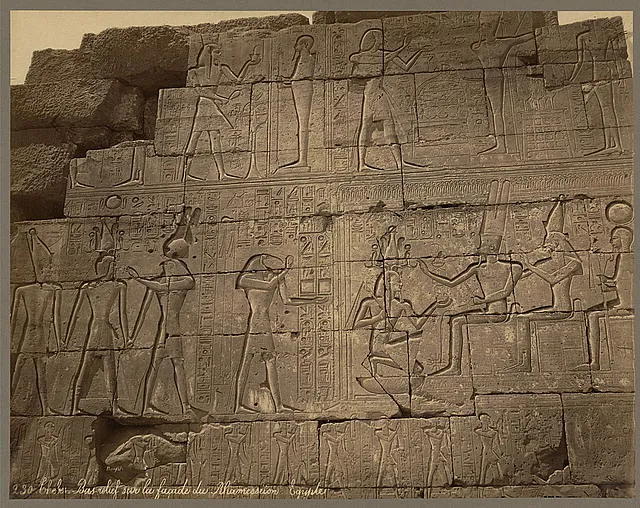
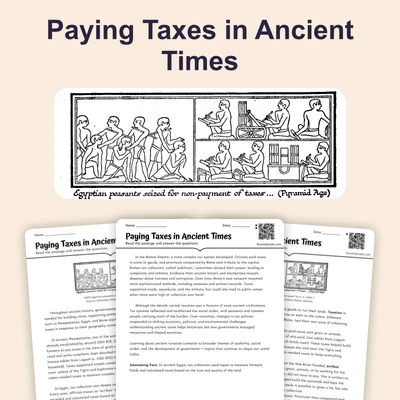
Source: Library of Congress - Maison Bonfils (Beirut, Lebanon)
The decline of Ancient Egypt began after centuries of remarkable achievement and stability along the Nile River. Once a powerful civilization led by strong pharaohs, Egypt eventually faced many internal and external challenges that weakened its control. By the end of the New Kingdom around 1070 BCE, Egypt’s political unity and prosperity had begun to unravel.
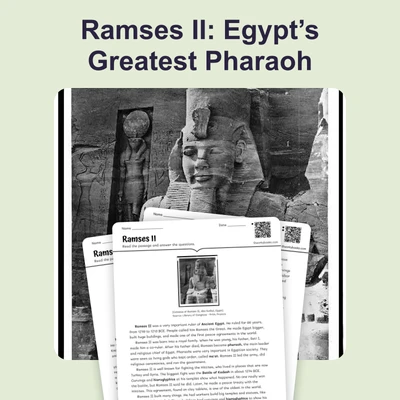
Several major causes contributed to Egypt’s decline. Internal conflict and weak leadership became common as rival families competed for the throne. For example, after the reign of Ramses III (c. 1186–1155 BCE), records from the Harris Papyrus show that workers at Deir el-Medina staged the first known labor strike in history due to unpaid wages. This event reflected economic troubles and a breakdown of royal authority. Meanwhile, the power of local governors, or nomarchs, increased, leading to division and instability across the kingdom.
At the same time, Egypt faced threats from outside forces. The Sea Peoples, a group of mysterious invaders described in temple carvings at Medinet Habu, attacked Egypt repeatedly during the late 12th century BCE. Although Ramses III managed to defeat them, the wars exhausted Egypt’s resources. Later, the kingdom was invaded by foreign rulers such as the Libyans, Nubians, Assyrians, and Persians. These invasions further weakened Egypt’s defenses and disrupted daily life for ordinary Egyptians.
Economic decline also played a significant role. The Nile’s unpredictable flooding in some years led to poor harvests and famine. Trade with neighboring regions decreased, and Egypt could no longer afford large building projects or strong armies. Archaeological evidence from tombs and temples reveals that art and construction quality declined over time. Social classes became more rigid, and many people struggled to survive as the wealth gap widened.
Despite these challenges, some aspects of Egyptian culture and religion continued, showing continuity even during decline. However, by 332 BCE, Alexander the Great conquered Egypt, marking the end of Egyptian rule and the start of the Greco-Roman period. The story of Ancient Egypt’s fall helps us understand how geography, leadership, and outside forces can shape the rise and fall of civilizations.
This period connects to larger themes of world history, such as the impact of leadership, the consequences of environmental changes, and the influence of geography on the fate of societies.
Interesting Fact: The workers’ strike at Deir el-Medina around 1155 BCE is the earliest recorded labor protest in history.
Comprehension quiz (8 questions)
1. Who was Ramses III?
2. What was Deir el-Medina?
3. When did Alexander the Great conquer Egypt?
4. Why did the first labor strike happen?
5. How did weak leadership affect Egypt?
6. What effect did invasions have?
7. Egyptian culture completely disappeared. True or false?
8. What is a "famine"?
Perfect for the way you teach
- Build comprehension skills
- Auto-graded quiz
- Differentiated reading
- Read together at home
- Improve fluency
- Quiet reading time
- Reading curriculum support
- Independent practice
- Track Lexile growth