Ramses the Great of Egypt
Interactive passage with audio narration, comprehension questions, and printable PDF.
What's included
Ramses the Great of Egypt preview and details
About this printable Ramses the Great of Egypt reading passage (Grades 5-8)
Sample passage and quiz from Ramses the Great of Egypt
Reading passage and comprehension quiz preview
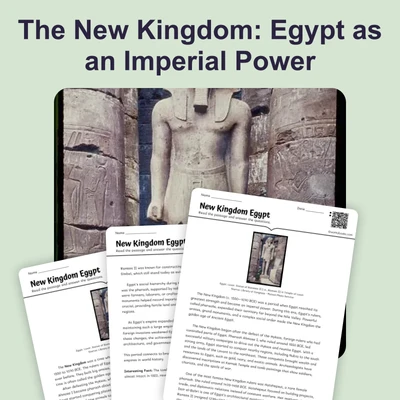
Ramses the Great of Egypt
![[Colossus of Ramses II, Abū Sunbul, Egypt]](https://assets.workybooks.com/INTERACTIVE/media/pd--Colossus-of-Ramses-II--Ab--Sunbul--Egypt--1762524671123-211544745.webp)
Source: Library of Congress - Frith, Francis
Ramses II was one of the most powerful and influential rulers of Ancient Egypt. He reigned for 66 years, from 1279 to 1213 BCE, during the New Kingdom period. Known as Ramses the Great, he expanded Egypt’s territory, built grand monuments, and signed one of the world’s first known peace treaties.
Born into a royal family, Ramses II was named co-ruler with his father, Seti I, at a young age. After his father’s death, Ramses became pharaoh, the supreme ruler and religious leader of Egypt. The role of the pharaoh was crucial in Egyptian society. As a pharaoh, Ramses was considered a living god who maintained order and harmony, known as ma'at. His responsibilities included leading the army, overseeing religious ceremonies, and managing the government.
One of Ramses II’s greatest achievements was his campaign against the Hittites, a powerful empire in modern-day Turkey and Syria. The most famous conflict was the Battle of Kadesh around 1274 BCE. Archaeological evidence, such as temple reliefs at Abu Simbel and hieroglyphic inscriptions, reveal vivid details of this battle. Although neither side won a clear victory, Ramses II claimed success and later negotiated a historic peace treaty with the Hittites. This treaty, inscribed on clay tablets, is considered one of the earliest surviving diplomatic agreements.
Ramses II was also a master builder. He ordered the construction of enormous temples, statues, and cities. The temples at Abu Simbel and the Ramesseum are among his most famous projects. These structures, decorated with detailed carvings and hieroglyphics, demonstrated both his power and devotion to the gods. The labor for these monuments came from skilled workers, laborers, and sometimes enslaved people, reflecting Egypt’s strict social hierarchy.
During his reign, Egypt enjoyed relative stability and prosperity. Ramses II’s policies promoted trade along the Nile River and with neighboring regions, bringing wealth and new ideas. His legacy lasted for centuries, inspiring later rulers and leaving a lasting imprint on Egyptian art and culture. Even thousands of years after his death, statues and temples built by Ramses II continue to awe visitors and historians alike.
Ramses II’s life and accomplishments illustrate the importance of leadership, diplomacy, and cultural achievements in shaping a civilization. His reign helps us understand how geography, power, and belief systems influenced Ancient Egypt’s place in world history.
Interesting Fact: Ramses II had over 100 children and may have been the inspiration for the biblical Pharaoh in the story of Exodus.
Comprehension quiz (8 questions)
1. When did Ramses II become pharaoh?
2. Which empire did Ramses II fight?
3. What is Abu Simbel?
4. Why was the Battle of Kadesh important?
5. How did Ramses II show his power?
6. What does 'pharaoh' mean in Egypt?
7. Ramses II ruled for 66 years. True or false?
8. What are hieroglyphics?
Perfect for the way you teach
- Build comprehension skills
- Auto-graded quiz
- Differentiated reading
- Read together at home
- Improve fluency
- Quiet reading time
- Reading curriculum support
- Independent practice
- Track Lexile growth