Chinese Inventions
Interactive passage with audio narration, comprehension questions, and printable PDF.
What's included
Chinese Inventions preview and details
About this printable Chinese Inventions reading passage (Grades 5-8)
Sample passage and quiz from Chinese Inventions
Reading passage and comprehension quiz preview
Chinese Inventions That Changed the World
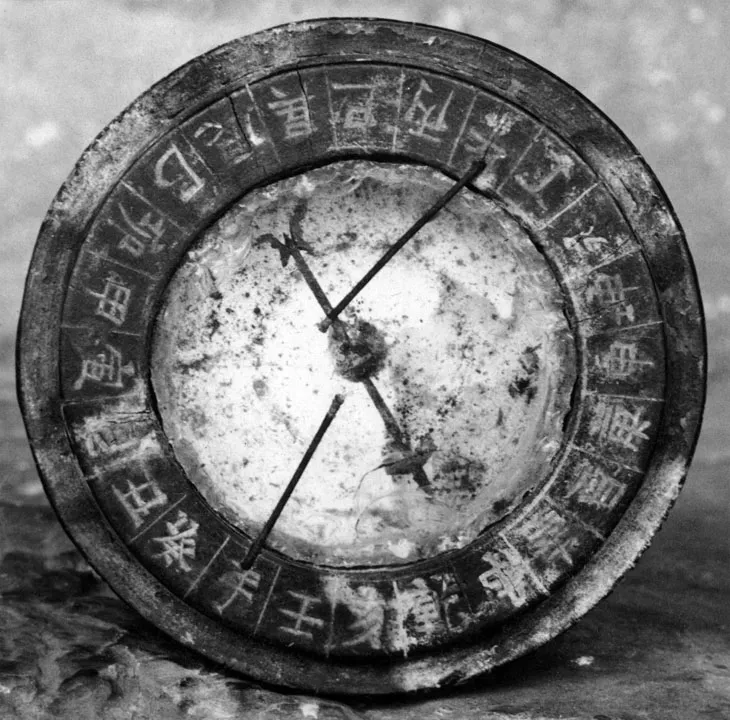
"Queensland State Archives 1884 Chinese compass held at the Museum c1938" by Agriculture And Stock Department, Publicity Branch / Wikimedia Commons
Ancient China is recognized for its remarkable innovations that transformed societies both within and beyond its borders. Three of the most influential inventions—paper, gunpowder, and the compass—emerged during different Chinese dynasties and had a lasting global impact. Understanding these inventions reveals the ways in which technology, geography, and daily life in China shaped world history.
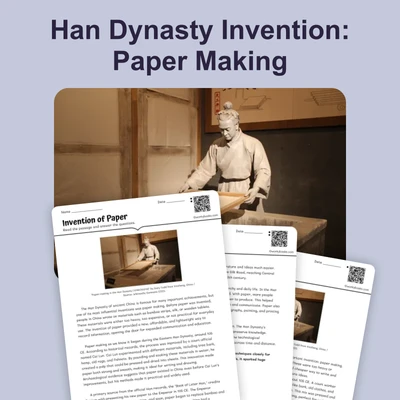
The invention of paper during the Han dynasty (206 BCE–220 CE) revolutionized communication and record keeping. According to historical records, Cai Lun, a court official, developed a method for making paper from mulberry bark, hemp, and rags in 105 CE. Before paper, people wrote on bamboo slips or silk, which were expensive and difficult to use. Archaeological discoveries, such as ancient documents found in the Dunhuang caves, prove that paper made writing more accessible to scholars, government officials, and ordinary people. Over time, papermaking spread along the Silk Road, reaching the Middle East and Europe by the 12th century, changing how knowledge was shared worldwide.
The compass, another Chinese invention, played a crucial role in navigation and exploration. The earliest compasses, called "south-pointing spoons," were made of lodestone and date back to the Han dynasty. By the Song dynasty (960–1279 CE), Chinese inventors improved the compass by using a magnetized needle floating in water or mounted on a pivot. This device helped sailors and traders navigate the seas, leading to increased trade between China, India, and Arabia. European explorers later adopted the magnetic compass, which enabled the Age of Exploration. Primary sources from ship logs and maps show how navigation and maritime connections expanded because of this technology.
The development of gunpowder in the 9th century CE marked a major turning point in military history. Chinese alchemists searching for an elixir of immortality accidentally discovered a mixture of saltpeter, charcoal, and sulfur. Gunpowder was first used in fireworks and then in weapons such as bombs, rockets, and early guns. Tang dynasty texts and archaeological remains of ancient weapons provide evidence of gunpowder’s use in Chinese warfare. Eventually, gunpowder technology traveled along trade routes to the Middle East and Europe, profoundly affecting how wars were fought and how empires expanded.
These inventions were connected to China’s geography and society. The need for easier communication, safer travel, and improved defense led to creative solutions. The exchange of inventions along the Silk Road shows how cultural contact can spread new ideas. Despite differences in social hierarchy, these technologies reached many levels of society, from scholars to merchants to soldiers.
In summary, Chinese inventions such as paper, the compass, and gunpowder changed the course of world history by making communication, exploration, and warfare more effective. Their influence can still be seen in modern life, demonstrating the lasting contributions of ancient China. Studying these inventions helps us understand how societies solve problems and how technology connects people across time and place.
Interesting Fact: The oldest known printed book, the Diamond Sutra, was produced in China in 868 CE using woodblock printing on paper.
Comprehension quiz (8 questions)
1. Who invented paper in China?
2. When was gunpowder invented?
3. What was the compass first made from?
4. Why was paper important?
5. How did the compass help trade?
6. What effect did gunpowder have?
7. Gunpowder was first used in fireworks.
8. What does 'dynasty' mean?
Perfect for the way you teach
- Build comprehension skills
- Auto-graded quiz
- Differentiated reading
- Read together at home
- Improve fluency
- Quiet reading time
- Reading curriculum support
- Independent practice
- Track Lexile growth