Food Chains
Interactive passage with audio narration, comprehension questions, and printable PDF.
What's included
Food Chains preview and details
About this printable Food Chains science reading passage, NGSS-aligned (Grades 5-8)
Sample passage and quiz from Food Chains
Reading passage and comprehension quiz preview
Food Chains
Energy is constantly moving through ecosystems, allowing living things to grow, move, and survive. In nature, one way to trace this movement is through a food chain. A food chain is a single pathway that shows how energy passes from one organism to another. Understanding food chains is essential because they reveal how each living thing in an ecosystem depends on others for survival and how disruptions can affect the whole system.
How Food Chains Work: Energy Transfer and Trophic Levels
Food chains always start with producers, like plants or algae, which use sunlight to make their own food through photosynthesis. These producers form the first trophic level, or feeding level. When a primary consumer, such as a rabbit, eats the producer, energy moves up to the second trophic level. Next, a secondary consumer, like a fox, eats the rabbit, transferring even less energy to the third trophic level. Sometimes a tertiary consumer, or top carnivore, eats the secondary consumer, forming a fourth level. Each step up the chain, only about 10% of the energy is passed on; the rest is lost as heat or used for life processes. At the end, decomposers like bacteria and fungi break down dead organisms, recycling nutrients back into the soil.
Examples and Limitations: Food Chains in Different Ecosystems
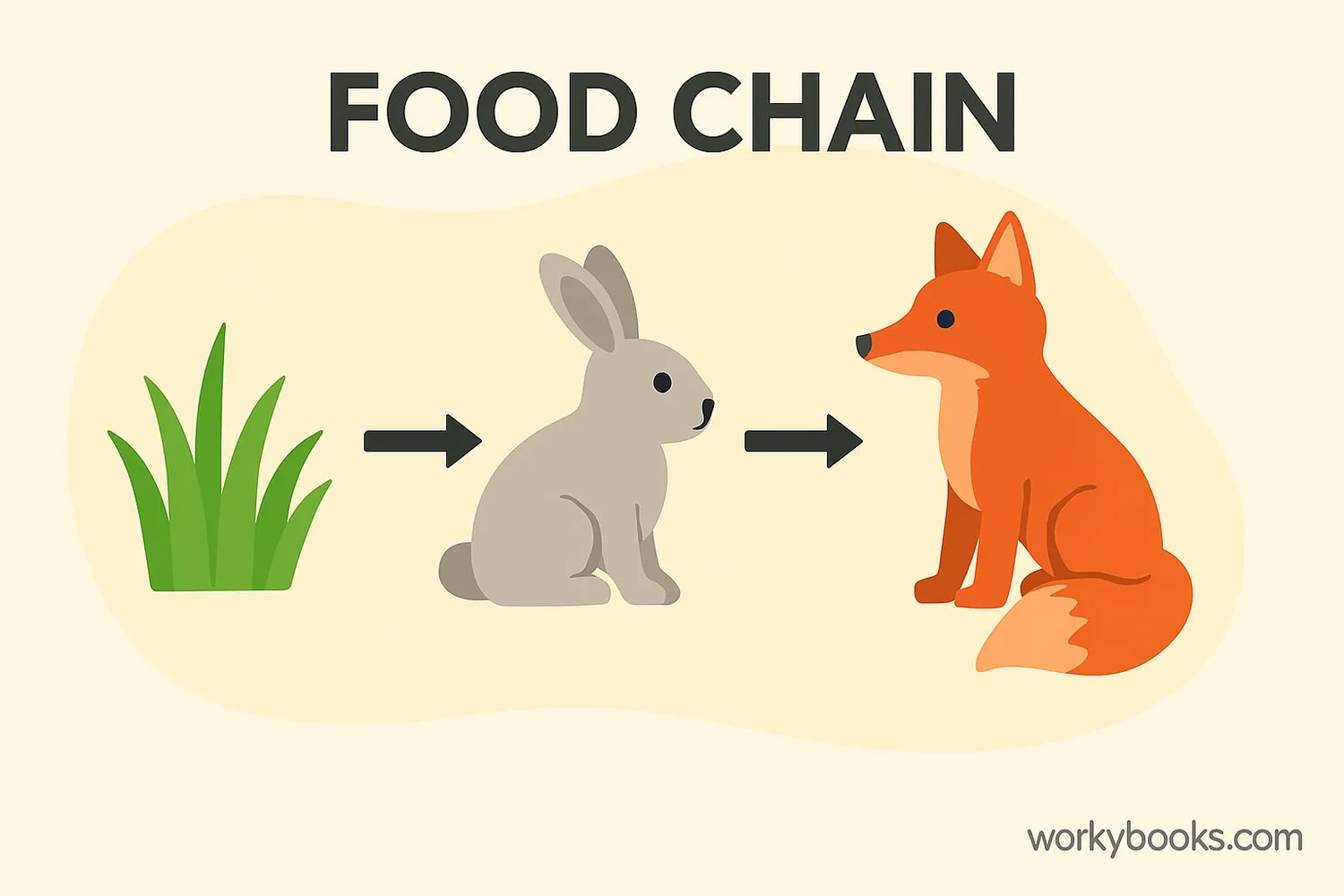
Consider this land food chain: grass → rabbit → fox → decomposers. Here, grass is the producer, the rabbit is the primary consumer, the fox is the secondary consumer, and decomposers finish the cycle. In aquatic systems, a food chain might look like this: phytoplankton → zooplankton → small fish → large fish. The arrows in a food chain always point in the direction of energy flow, from the eaten to the eater. However, food chains are simplified models. In real ecosystems, most animals eat and are eaten by more than one kind of organism. This creates a food web, a network of interconnected food chains that better represents the complex feeding relationships in nature.
Importance and Broader Implications
Food chains help scientists understand how disruptions—like removing a top predator or introducing a new species—can affect entire ecosystems. For example, if a disease wipes out rabbits in a grassland, foxes (who depend on rabbits) may decline, and grass may grow unchecked. These changes ripple through the ecosystem, showing the importance of every link. Food chains also connect to broader scientific ideas about systems and energy flow, reminding us that even small changes can have large impacts in nature. Knowing about food chains can help humans make better decisions about protecting environments and managing resources.
Interesting Fact:
Less than 10% of the energy at each trophic level is passed to the next, which is why food chains rarely have more than four or five levels!
Comprehension quiz (10 questions)
1. What is the main function of a food chain?
2. Which organism always starts a food chain?
3. What is the role of a decomposer in a food chain?
4. What does the word 'trophic level' mean as used in the passage?
5. What does the word 'producer' mean in the context of the passage?
6. Based on the passage, what would happen if all the rabbits disappeared from a grassland food chain?
7. Why are food chains described as 'oversimplified' in the passage?
8. If a new predator is introduced at the top of a food chain, what could happen?
9. True or False: Arrows in a food chain show the direction of energy flow.
10. True or False: Only about 50% of the energy is passed to the next trophic level in a food chain.
Perfect for the way you teach
- Build comprehension skills
- Auto-graded quiz
- Differentiated reading
- Read together at home
- Improve fluency
- Quiet reading time
- Reading curriculum support
- Independent practice
- Track Lexile growth