This learning resource is available in interactive and printable formats. The interactive worksheet can be played online and assigned to students. The Printable PDF version can be downloaded and printed for completion by hand.
This engaging middle school science passage focuses on savanna herbivores and their role in maintaining the balance of grassland ecosystems. Designed for grades 6-8, the passage aligns to NGSS standards such as MS-LS2-1, MS-LS2-2, and MS-LS2-3, addressing ecosystem dynamics, energy flow, and species interactions. Students will learn how animals like elephants, zebras, and antelopes interact with plants, predators, and the environment to create complex food webs and influence biodiversity. The passage integrates scientific thinking, cause-and-effect analysis, and real-world environmental concerns, with activities such as quizzes, writing prompts, and graphic organizers to reinforce understanding. Glossary terms help build academic vocabulary, and the resource includes audio integration for accessibility. This comprehensive, standards-aligned lesson is ideal for developing scientific literacy and critical thinking about ecosystems and the importance of herbivores in the savanna.
CONTENT PREVIEW
Expand content preview
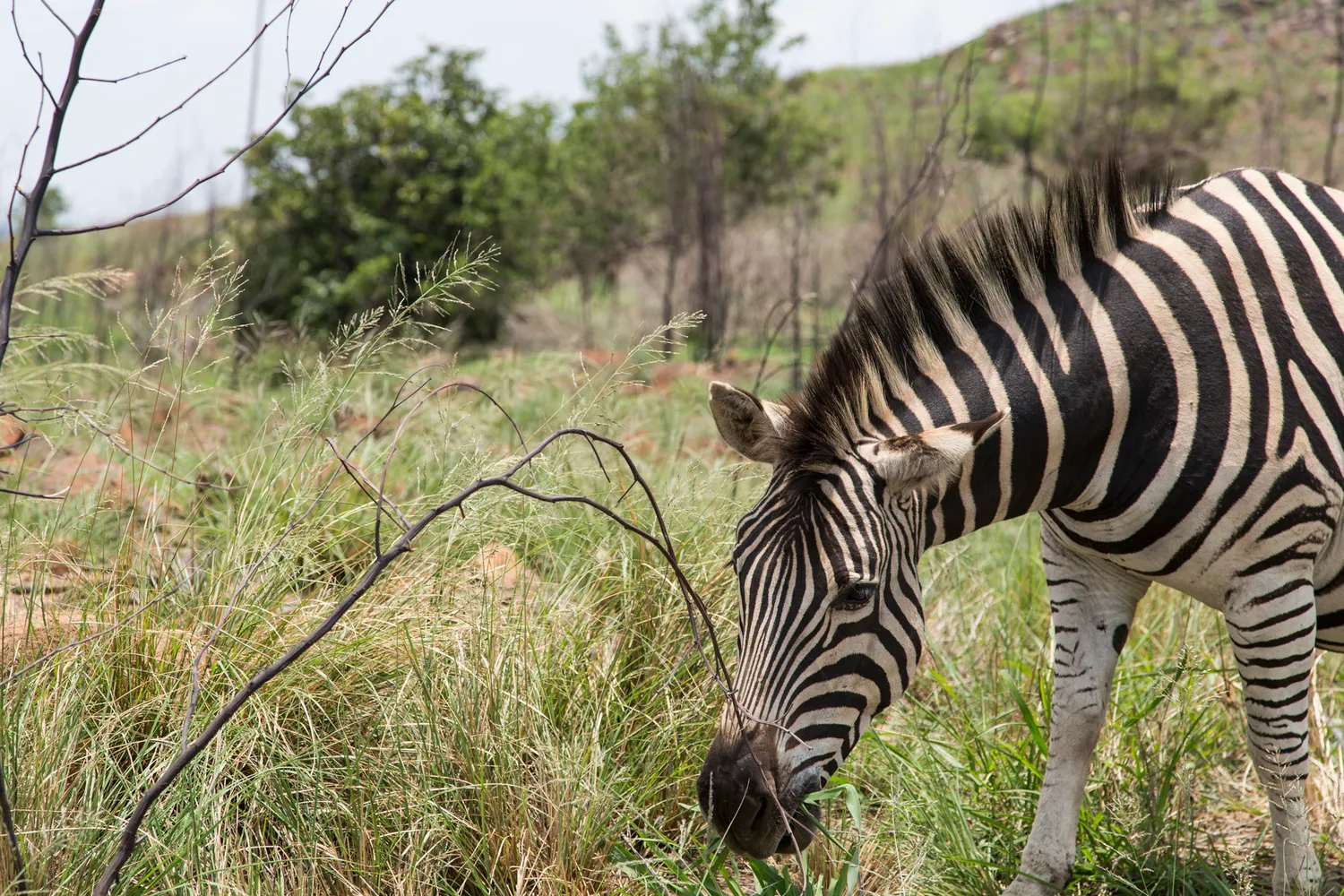
South Africa Zebra eating grass.Image by Peace Corps / Wikimedia Commons (Public domain).
Savannas are grassland ecosystems found in regions like Africa, South America, and Australia. These environments are defined by a mix of grasses and scattered trees, as well as seasonal rainfall. The presence and behavior of herbivores—animals that eat plants—are crucial for maintaining the delicate balance of the savanna ecosystem. Scientists study savanna herbivores to understand how their feeding shapes the landscape and affects the survival of many other species.
How Herbivores Shape the Savanna In the savanna, large herbivores like elephants, zebras, and antelopes perform essential ecological functions. By eating grass, leaves, and shrubs, these animals control plant growth, which prevents any single species from dominating. For example, elephants can knock down trees and strip bark, creating open areas and allowing more light to reach the ground. This helps grasses thrive and supports smaller herbivores. Zebras graze on tall grasses, while antelopes prefer shorter, fresh shoots. This division of food resources, called niche partitioning, reduces competition and allows many species to coexist.
Systems and Interactions The interactions between herbivores and plants set off a chain reaction in the ecosystem. When herbivores feed, they also disperse seeds in their droppings, helping plants spread across the savanna. Their movement and grazing patterns can influence the frequency of wildfires, since grazed areas have less dry material to burn. The populations of herbivores are regulated by predators like lions and hyenas, as well as by disease and availability of water. For instance, when rainfall is unusually low, plant growth slows down, leading to food shortages that reduce herbivore numbers. Researchers use data such as population counts and satellite images to track these changes and better understand ecosystem health.
Real-World Applications and Challenges Human activities, including farming and poaching, can disrupt savanna systems. Overgrazing by livestock may lead to soil erosion and loss of plant biodiversity. Conservationists work to maintain healthy populations of native herbivores to support ecosystem stability. By studying savanna herbivores, scientists learn how energy flows through food webs and how to manage ecosystems sustainably. These lessons are vital as climate change and human development continue to threaten these important landscapes.
In summary, savanna herbivores are more than just plant-eaters—they are ecosystem engineers. Their feeding strategies, movement, and interactions with other species help maintain the structure and function of the savanna. Understanding these relationships helps scientists protect biodiversity and develop better ways to conserve grassland habitats.
Interesting Fact: An adult elephant can eat up to 150 kilograms of plant material per day, shaping entire landscapes through its feeding!
What is the main role of herbivores in the savanna ecosystem?
They regulate plant growth and help maintain ecosystem balance.They serve as the only food source for predators.They increase the number of wildfires.They build nests in trees.
Which of the following animals is NOT mentioned as a major savanna herbivore in the passage?
ElephantGiraffeZebraAntelope
How does niche partitioning help different herbivores coexist in the savanna?
By allowing them to feed on different plants or plant parts.By reducing the overall number of herbivores.By forcing them to migrate every year.By making them all eat the same food.
What is one way herbivores indirectly help plants reproduce?
By dispersing seeds in their droppings.By keeping predators away.By causing more wildfires.By drinking water from rivers.
What does the term 'wildfire' mean as used in the passage?
A controlled fire started by people.A large, natural fire that spreads quickly through grasslands.A small campfire used for cooking.A flash of lightning during a storm.
Why might herbivore populations decrease after a period of low rainfall?
Because less rain means less plant growth and less food.Because more predators appear in the area.Because wildfires increase.Because there are too many trees.
How do scientists track changes in the savanna ecosystem?
By counting animal populations and using satellite images.By tasting the grass.By watching television.By listening to animal sounds only.
If people allow too many livestock to graze on the savanna, what is a possible effect?
Soil erosion and loss of plant biodiversity.An increase in wild predators.More rainfall.Growth of new forests.
Herbivores are always helpful to the savanna. (True/False)
TrueFalse
Niche partitioning allows many species to live together by reducing competition. (True/False)
TrueFalse
Perfect For:
👩🏫 Teachers
• Reading comprehension practice
• Auto-graded assessments
• Literacy skill development
👨👩👧👦 Parents
• Reading practice at home
• Comprehension improvement
• Educational reading time
🏠 Homeschoolers
• Reading curriculum support
• Independent reading practice
• Progress monitoring
Reading Features:
📖
Reading Passage
Engaging fiction or nonfiction text
❓
Comprehension Quiz
Auto-graded questions
📊
Instant Feedback
Immediate results and scoring
📄
Printable Version
Download for offline reading
🔊
Read Aloud
Voice-over with word highlighting
Reviews & Ratings
No reviews yet. Be the first to share your experience!
Related Content
The Narwhal: Arctic’s Unicorn of the Sea
This NGSS-aligned passage (MS-LS2-1) explores how narwhals survive in Arctic ecosystems. Students learn about specialize...
MS-LS2-1RI.6.3RI.7.3RI.8.8
The Blue-Ringed Octopus
This NGSS aligned passage explores how the tiny blue-ringed octopus impacts its ecosystem through predator-prey relation...
MS-LS2-1RI.6.3RI.7.3RI.8.8
Tardigrades: Microscopic Superheroes
Aligned to MS-LS1-1, this passage examines how tardigrade cell structures (TDP proteins, DNA-repair enzymes) allow survi...
MS-LS2-1RI.6.3RI.7.3RI.8.8
The Leafy Sea Dragon: Nature's Living Seaweed
This NGSS-aligned passage explores how leafy sea dragons (Phycodurus eques) demonstrate key life science concepts for mi...
MS-LS2-1RI.6.3RI.7.3RI.8.8
What Do Axolotls Eat?
This science reading passage, titled "What Do Axolotls Eat?", offers an engaging exploration into the feeding habits of ...
MS-LS2-1
Where Do Axolotls Live?
This science reading passage, titled "The Axolotl's Home," delves into the specific natural environment of the fascinati...
MS-LS4-DMS-LS2-1
The Blobfish
This science reading passage, titled "The Blobfish: A Deep-Sea Mystery," introduces students to one of Earth's most pecu...
MS-LS4-DMS-LS2-1
What Do Blobfish Eat?
This science reading passage, titled "What Do Blobfish Eat?", offers an engaging exploration into the feeding habits of ...
MS-LS2-1
Where Do Penguins Live?
This engaging science reading passage, titled "Where Do Penguins Live? A Cold and Coastal World," clarifies the diverse ...
MS-LS2-1
The Emperor Penguin
This science reading passage, titled "The Emperor Penguin: Antarctica's Royal Survivor," introduces students to one of t...
MS-LS2-1
The Adélie Penguin
This engaging science reading passage, titled "The Adélie Penguin: Antarctica's Little Explorer," introduces students to...
MS-LS2-1
How Does Global Warming Affect Adélie Penguins?
This comprehensive science passage, titled "How Does Global Warming Affect Adélie Penguins?", details the significant im...
MS-LS2-1
Desert Birds
This informational passage for grades 6-8 examines how desert birds survive and thrive in some of the harshest environme...
MS-LS2-1MS-LS2-2MS-LS1-4
Abiotic Factors in Ecosystems
This comprehensive informational reading passage is designed for middle school science students and aligns with NGSS sta...
MS-LS2-1
Biomes: Terrestrial Ecosystems
This NGSS-aligned science reading passage for grades 6-8 provides a comprehensive survey of Earth’s major terrestrial bi...
MS-LS2-1
Biomes: Aquatic Ecosystems
This middle school science passage, aligned with NGSS standard MS-LS2-1, introduces students to the key features and mec...
MS-LS2-1
Galápagos Islands
This engaging science passage explores the Galápagos Islands, a volcanic archipelago located off the coast of Ecuador in...
MS-LS2-1MS-LS4-4MS-ESS3-4
Florida Everglades
This comprehensive passage introduces middle school students to the Florida Everglades, a distinctive wetland ecosystem ...
MS-LS2-1MS-LS2-4MS-ESS3-3MS-ESS3-4
Great Barrier Reef
This passage introduces middle school students to the Great Barrier Reef, the world's largest coral reef system, located...
MS-LS2-1MS-LS2-4MS-ESS3-5
Wetland Biomes
This comprehensive science passage introduces middle school students to the concept of wetland biomes. Aligned with NGSS...