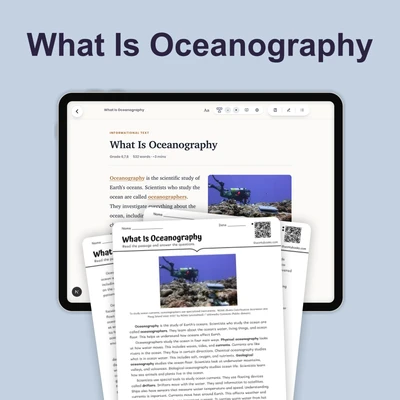
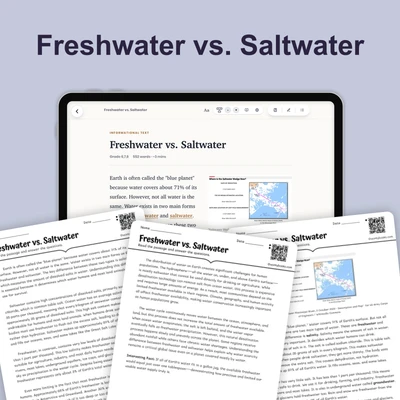
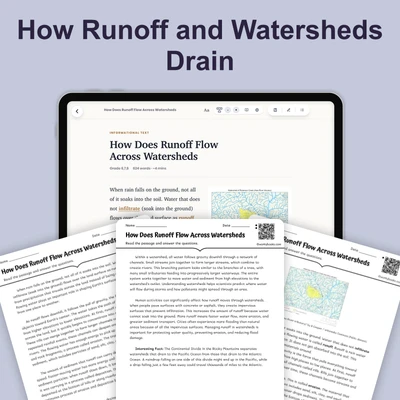
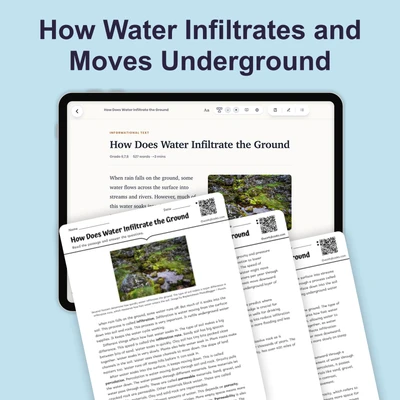
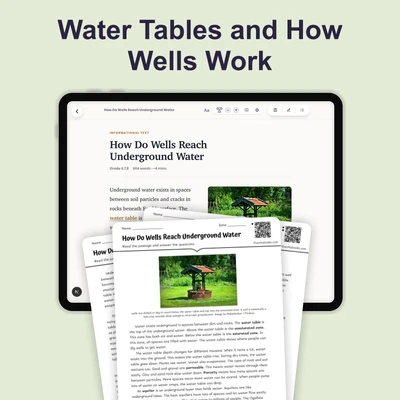
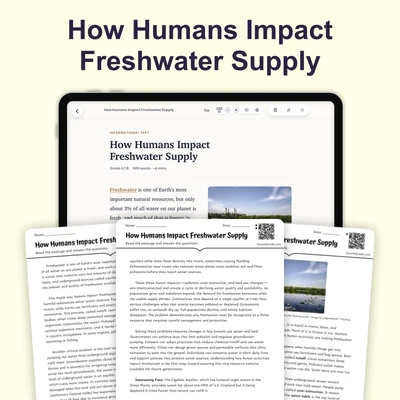
This learning resource is available in interactive and printable formats. The interactive worksheet can be played online and assigned to students. The Printable PDF version can be downloaded and printed for completion by hand.
This engaging passage for grades 6-8 explores the essential role of water in ecosystems, tracing its movement through various reservoirs and processes such as evaporation, transpiration, condensation, precipitation, runoff, infiltration, and groundwater flow. Students discover why water is vital for all organisms, how it acts as a universal solvent in biochemical reactions, and how human activities like dam construction, irrigation, pollution, and climate change affect water systems. The passage is meticulously aligned with NGSS standards MS-LS2-3 and MS-ESS2-4, helping students connect phenomena to scientific mechanisms and systems thinking. Interactive activities include a glossary, differentiated text, Spanish translations, multiple-choice and writing questions, and graphic organizers, all designed to reinforce learning. Audio integration supports accessible learning for diverse students. This comprehensive resource is ideal for classroom instruction and independent study.
CONTENT PREVIEW
Expand content preview
The Water Cycle
Water moves continuously through Earth's ecosystems, linking living organisms with the air, land, and oceans. The water cycle describes this constant movement, shaping the environment and supporting life. Understanding how water travels through different reservoirs and processes helps scientists predict weather, manage resources, and protect habitats. Water is not only essential for survival; it is the foundation for all biochemical reactions in living things.
The Mechanisms of the Water Cycle
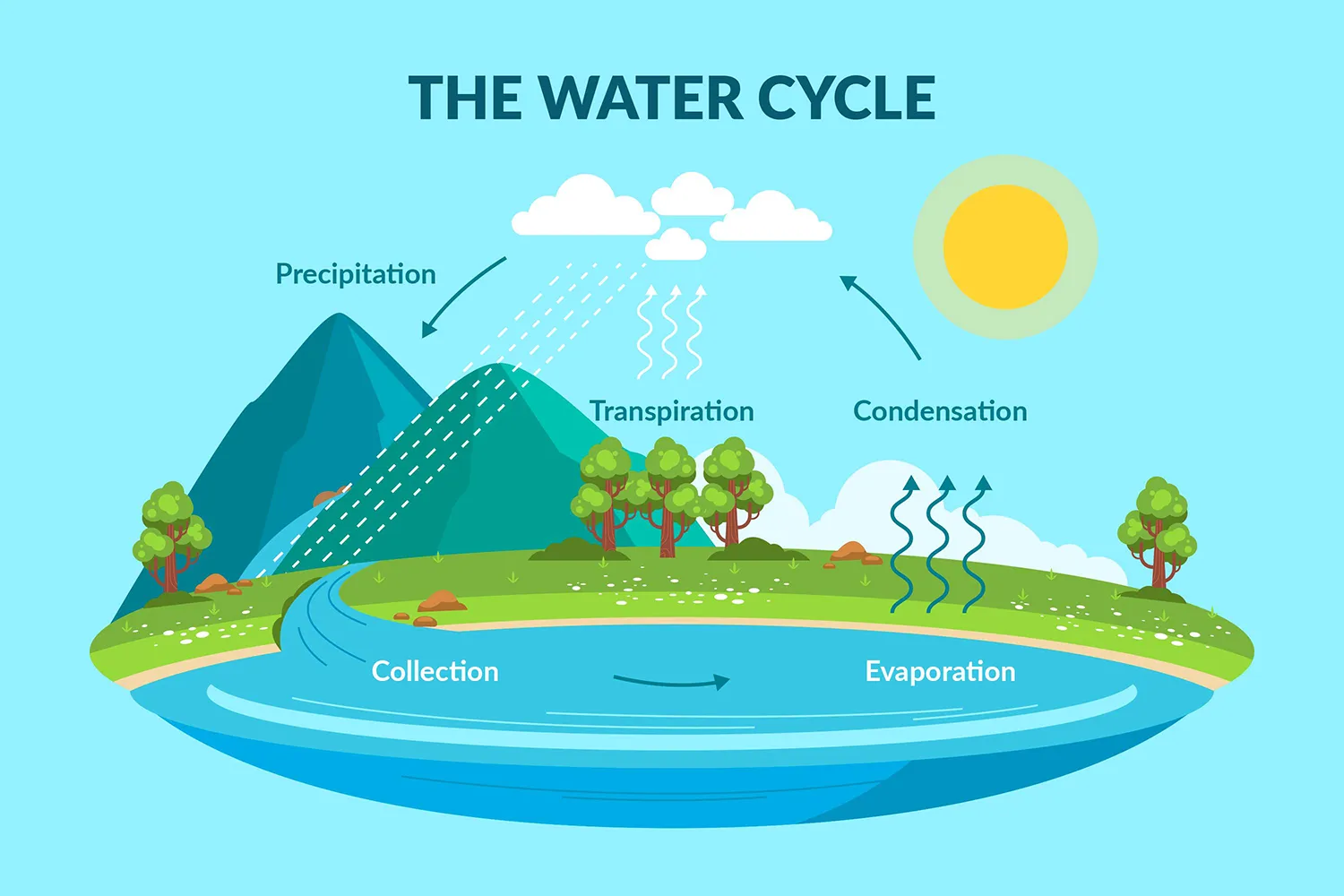
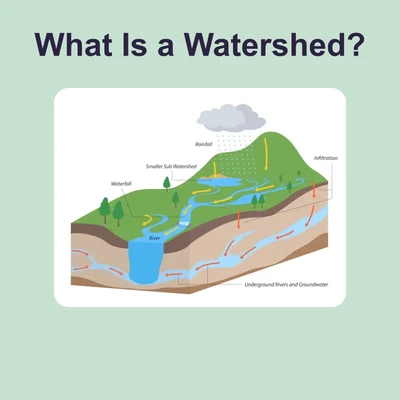
The water cycle is driven by energy from the sun, causing water to change states and move between locations. In evaporation, liquid water from oceans, lakes, and rivers changes into water vapor, a gas, as it absorbs heat. Plants also release water vapor through transpiration. Together, these processes contribute about 90% of the moisture in the atmosphere. As the air cools, water vapor turns back into liquid droplets in a process called condensation, forming clouds. When droplets combine and grow heavy, they fall to Earth as precipitation—rain, snow, sleet, or hail. Some water runs off the land into rivers and lakes, while some seeps into the ground through infiltration, replenishing groundwater supplies.
Reservoirs, Interactions, and Importance
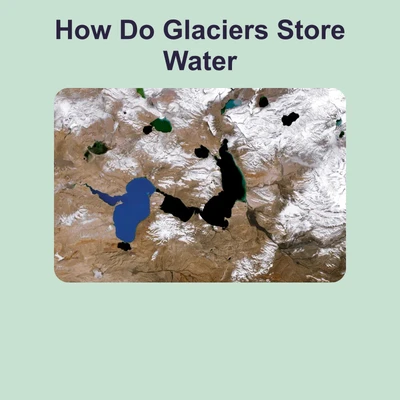
Most of Earth's water—about 97%—is stored in the oceans, the largest reservoir. Freshwater is found in ice caps and glaciers (about 2%), as well as in groundwater, lakes, rivers, and the atmosphere. Water moves between these reservoirs at different rates. For example, a water molecule may stay in the ocean for thousands of years but only spend days in the atmosphere. Water is a universal solvent, dissolving many substances and enabling essential chemical reactions in all living things. Every organism depends on water to transport nutrients, remove waste, and regulate temperature.
Human Impacts and Broader Implications
Humans have a significant influence on the water cycle. Dams and irrigation systems change the natural flow of rivers, affecting habitats and groundwater levels. Pollution can contaminate freshwater sources, making them unsafe for wildlife and people. Climate change is altering rainfall patterns and increasing evaporation rates, which can lead to droughts or floods in different regions. Scientists use data from satellites, weather stations, and field studies to monitor these changes and develop strategies for sustainable water management. Understanding the water cycle helps us protect resources and respond to environmental challenges.
Water's movement through ecosystems highlights the interconnectedness of Earth's systems. Recognizing how water supports life and how our actions affect its movement is vital for a sustainable future.
Interesting Fact: At any moment, only about 0.001% of Earth's water is found in the atmosphere as vapor, but this small amount is crucial for weather and climate!
What is the main purpose of the water cycle in ecosystems?
To move water through Earth's systems and support lifeTo make clouds grow largerTo increase ocean water levelsTo produce more ice caps
Which process describes water vapor turning back into liquid droplets in the atmosphere?
EvaporationCondensationTranspirationInfiltration
Where is most of Earth's water stored?
In the oceansIn lakes and riversIn the atmosphereIn groundwater
What is the primary source of energy that drives the water cycle?
The sunWindEarth's coreVolcanoes
What does infiltration mean in the context of the water cycle?
Water soaking into the groundWater evaporating from oceansWater forming cloudsWater running off land
Based on the passage, what is a solvent?
A place where water is storedA substance that dissolves other substancesA type of precipitationA process of water moving underground
Why is water important for all living organisms?
It enables chemical reactions and helps transport nutrientsIt makes the air colderIt forms rocks and mineralsIt increases the amount of sunlight
How can humans affect the natural water cycle? (Choose the BEST answer)
By building dams and polluting water sourcesBy increasing plant transpirationBy forming more cloudsBy making oceans larger
True or False: Only about 2% of Earth's water is found in ice caps and glaciers.
TrueFalse
True or False: Water in the atmosphere is not important for weather.
TrueFalse
Perfect For:
👩🏫 Teachers
• Reading comprehension practice
• Auto-graded assessments
• Literacy skill development
👨👩👧👦 Parents
• Reading practice at home
• Comprehension improvement
• Educational reading time
🏠 Homeschoolers
• Reading curriculum support
• Independent reading practice
• Progress monitoring
Reading Features:
📖
Reading Passage
Engaging fiction or nonfiction text
❓
Comprehension Quiz
Auto-graded questions
📊
Instant Feedback
Immediate results and scoring
📄
Printable Version
Download for offline reading
🔊
Read Aloud
Voice-over with word highlighting
Reviews & Ratings
No reviews yet. Be the first to share your experience!
Related Content
The Intertropical Convergence Zone (ITCZ): Earth's Weather Belt
This science passage explains the Intertropical Convergence Zone (ITCZ), a key equatorial weather system. Covering NGSS ...
MS-ESS2-5MS-ESS2-4RI.6.7
What Type of Cloud Is Associated with Hail?
This NGSS-aligned science reading passage for middle school explains that cumulonimbus clouds are the main cloud type re...
MS-ESS2-4
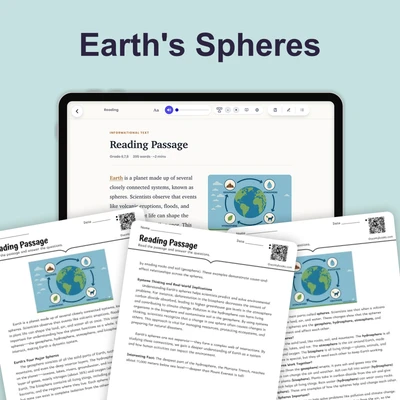
Earth's Spheres
This middle school science passage introduces students to Earth's four major spheres: the geosphere, hydrosphere, atmosp...
MS-ESS2-4MS-ESS2-6
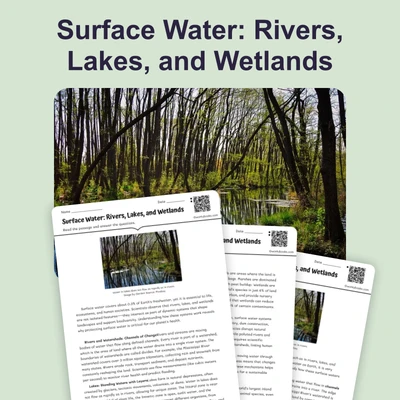
Surface Water: Rivers, Lakes, and Wetlands
This engaging middle school science passage explores the dynamic world of surface water, focusing on the complex systems...
MS-ESS2-4
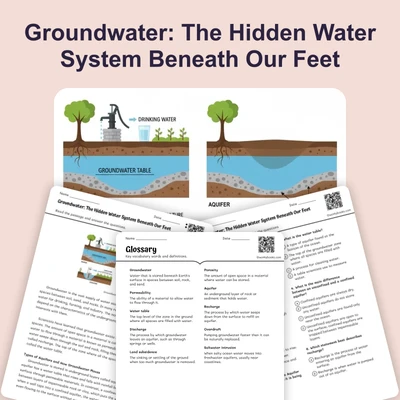
Groundwater
This middle school science passage explores the essential topic of groundwater, aligned to NGSS standards MS-ESS2-4 and ...
MS-ESS2-4MS-ESS3-1
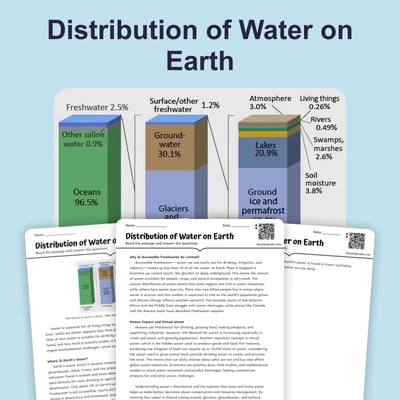
Distribution of Water on Earth
This middle school science reading passage explores the distribution of water on Earth, aligned with NGSS standards MS-E...
MS-ESS2-4MS-ESS3-1
The Ozone Layer
This engaging NGSS-aligned passage explores the science and importance of the ozone layer for middle school students (gr...
MS-ESS2-4MS-ESS3-3
Layers of the Atmosphere
This middle school science reading passage, aligned to NGSS standard MS-ESS2-4, guides students through the structure an...
MS-ESS2-4
What Is the Main Source of Carbon in an Ecosystem?
This NGSS-aligned science reading passage helps middle school students explore the main source of carbon in ecosystems: ...
MS-LS2-3
Consumers and Decomposers
This middle school science passage, aligned with NGSS standard MS-LS2-3, examines the essential roles of consumers and d...
MS-LS2-3
Nitrogen Cycle
This comprehensive passage explains the nitrogen cycle for grades 6-8, aligned with NGSS standard MS-LS2-3. Students wil...
MS-LS2-3
Food Chains
This comprehensive science passage for grades 6-8 explores the concept of food chains, aligning with NGSS standard MS-LS...
MS-LS2-3
Phosphorus Cycle
This comprehensive science reading passage introduces middle school students to the phosphorus cycle, a critical process...
MS-LS2-3
Herbivores of Savanna
This engaging middle school science passage focuses on savanna herbivores and their role in maintaining the balance of g...
MS-LS2-1MS-LS2-2MS-LS2-3
Producers: The Foundation of Ecosystems
This comprehensive science passage explains the critical role of producers, or autotrophs, in all ecosystems. Covering b...
MS-LS2-3MS-LS1-6
Photosynthesis in Ecosystems
This comprehensive passage for grades 6-8 explores the fundamental role of photosynthesis in ecosystems, aligning with N...
MS-LS1-6MS-LS2-3
Food Webs and Trophic Levels
This comprehensive science passage introduces middle school students to the concept of food webs and trophic levels, ali...