Food Webs and Trophic Levels
Interactive passage with audio narration, comprehension questions, and printable PDF.
By completing this purchase you agree to our Terms of Use and Privacy Policy. Your subscription renews automatically until you cancel. You can cancel anytime from your account settings. All sales are final and non-refundable. Digital content is available for download in your account immediately upon purchase.
What's included
Food Webs and Trophic Levels preview and details
About this printable Food Webs and Trophic Levels science reading passage, NGSS-aligned (Grades 5-8)
Sample passage and quiz from Food Webs and Trophic Levels
Reading passage and comprehension quiz preview
Food Webs and Trophic Levels

In every ecosystem, energy flows from one organism to another through feeding relationships. A food web is a complex network of interconnected food chains that shows how energy and matter move through an ecosystem. Unlike a simple chain, a food web demonstrates that most organisms eat more than one kind of food and are eaten by more than one predator. Understanding food webs is essential for explaining the stability of ecosystems and predicting what may happen if a species is removed.
How Food Webs Work
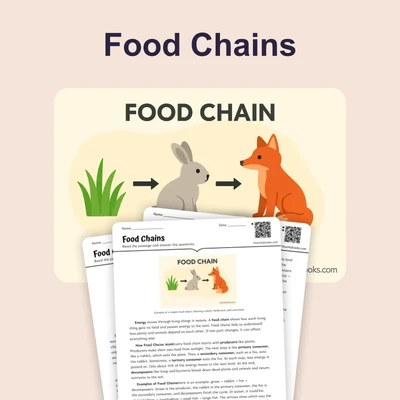
Food webs begin with producers, such as green plants, that capture sunlight and make their own food through photosynthesis. Consumers eat other organisms to get energy. These consumers are classified by their trophic level, or position in the food web. Primary consumers are herbivores that eat plants. Secondary consumers eat primary consumers, and tertiary consumers eat secondary consumers. Some organisms, like omnivores, can be both primary and secondary consumers, depending on what they eat. For example, a raccoon might eat fruit (acting as a primary consumer) and also eat small animals (acting as a secondary consumer). The arrows in a food web show the direction of energy flow, from food source to eater.
Interactions and Stability in Food Webs
Food webs reveal how interconnected life is within an ecosystem. Removing one species can have a ripple effect throughout the web. For instance, if a population of insects declines, the birds that eat them may also decrease. Meanwhile, the plants the insects once ate might increase due to less predation. Some species, called keystone species, have a disproportionate impact on the ecosystem. For example, sea otters are keystone species in kelp forests because they eat sea urchins, which would otherwise overgraze the kelp. Studies show that ecosystems with more connections between organisms are generally more stable because alternative food sources are available if one species declines.
Food Webs in the Real World
Scientists use field observations, experiments, and data analysis to construct and interpret food webs. By tracing what organisms eat and who eats them, researchers can map out these complex networks. In the Serengeti grasslands, for example, over 30 species of mammals and more than 60 species of birds are involved in food webs. Energy transfer between trophic levels is not 100% efficient—only about 10% of the energy from one trophic level is passed to the next. This means that food webs tend to have more producers and fewer top predators.
Understanding food webs helps scientists and conservationists predict the effects of environmental changes, such as habitat loss or species introduction. It also highlights the importance of biodiversity for the health and resilience of ecosystems.
Interesting Fact: The removal of just one keystone species, like the gray wolf in Yellowstone National Park, can lead to dramatic changes in the entire ecosystem—even changing the shape of rivers!
Comprehension quiz (10 questions)
1. What is a food web?
2. Which organism is a producer in a food web?
3. What does the term 'keystone species' mean in the passage?
4. How much energy is usually passed from one trophic level to the next?
5. What is the main role of arrows in a food web diagram?
6. In context, what does 'ripple effect' mean in a food web?
7. What might happen if a keystone species is removed?
8. Why are food webs more realistic than food chains?
9. True or False: All energy in a food web comes from consumers.
10. True or False: More connections in a food web usually make an ecosystem more stable.
Perfect for the way you teach
- Build comprehension skills
- Auto-graded quiz
- Differentiated reading
- Read together at home
- Improve fluency
- Quiet reading time
- Reading curriculum support
- Independent practice
- Track Lexile growth