Phosphorus Cycle
Interactive passage with audio narration, comprehension questions, and printable PDF.
What's included
Phosphorus Cycle preview and details
About this printable Phosphorus Cycle science reading passage, NGSS-aligned (Grades 5-8)
Sample passage and quiz from Phosphorus Cycle
Reading passage and comprehension quiz preview
Phosphorus Cycle
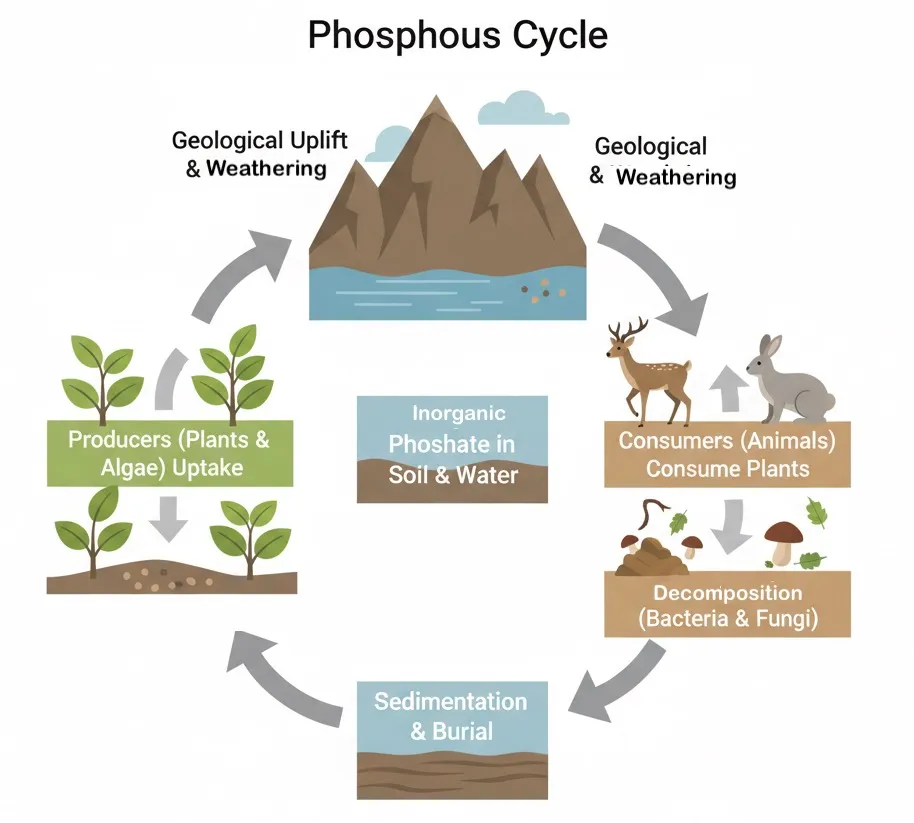
Phosphorus is an essential element that supports life on Earth, yet its movement through the environment follows a unique pattern. Unlike carbon or nitrogen, the phosphorus cycle does not include a gas phase in the atmosphere. Scientists have discovered that phosphorus mostly travels through rocks, soil, water, plants, and animals. This element is crucial for building DNA, cell membranes, and energy molecules like ATP. Without phosphorus, living things could not grow or reproduce efficiently.
Weathering and Soil Absorption
Phosphorus begins its journey locked inside rocks as phosphate minerals. Over time, weathering, or the slow breakdown of rocks by wind, rain, and temperature changes, releases phosphate into the soil. Plants absorb these phosphates through their roots, using them to develop tissues and store energy. In many ecosystems, phosphorus is a limiting nutrient, meaning its scarcity can restrict plant growth. For example, in some lakes and forests, less than 0.1% of the soil contains available phosphorus, so even a small increase can lead to rapid plant growth.
Movement Through Food Webs and Water
Animals obtain phosphorus by eating plants or other animals. When these organisms produce waste or die, decomposers like bacteria and fungi break down their remains, returning phosphorus to the soil. Some phosphorus dissolves in water and is carried by runoff into rivers, lakes, and oceans. In water bodies, phosphorus supports the growth of aquatic plants and algae. However, too much phosphorus—often from fertilizer runoff—can cause harmful algal blooms that deplete oxygen and damage aquatic life.
Sedimentation and Human Impact
Phosphorus that reaches oceans or lakes may eventually settle to the bottom as sediment. Over millions of years, these sediments can become new rock, restarting the cycle. Human activities, such as mining phosphate rock for fertilizers and detergents, have greatly accelerated phosphorus movement. Excess fertilizer use leads to more runoff, increasing pollution in water bodies. Scientists have measured that up to 50% of phosphorus applied as fertilizer can be lost from fields and end up in waterways.
Understanding the phosphorus cycle helps us see the connections within ecosystems and the impacts of our choices. Protecting this cycle is vital for maintaining healthy environments and ensuring sustainable food production for the future.
Interesting Fact:
Phosphorus is so important that, unlike many other nutrients, its shortage can limit the productivity of entire ecosystems—even if all other resources are abundant.
Comprehension quiz (10 questions)
1. Which element is the focus of the passage and is essential for DNA and cell energy?
2. What process releases phosphate from rocks into the soil?
3. Why is phosphorus often called a limiting nutrient?
4. Which vocabulary word from the passage means bacteria and fungi that return nutrients to the soil?
5. What effect does excess fertilizer runoff have on aquatic ecosystems?
6. Which term refers to the process in which phosphorus settles at the bottom of lakes or oceans?
7. Why is the phosphorus cycle different from the carbon and nitrogen cycles?
8. True or False: Human activities like mining and fertilizer use can speed up the movement of phosphorus in the environment.
9. True or False: The phosphorus cycle includes a stage where phosphorus is found in the atmosphere as a gas.
10. If phosphorus is added to a lake ecosystem, what is a likely result?
Perfect for the way you teach
- Build comprehension skills
- Auto-graded quiz
- Differentiated reading
- Read together at home
- Improve fluency
- Quiet reading time
- Reading curriculum support
- Independent practice
- Track Lexile growth