This science passage provides a clear explanation of how black holes are formed, a topic aligned with NGSS standards related to stellar evolution and gravitational forces. It details the process of stellar collapse, starting with a massive star's nuclear fusion and ending with the formation of a singularity. The passage defines key terms such as 'black hole,' 'event horizon,' and 'supernova' in an accessible way for a middle school audience. Students will learn about the balance between outward pressure and gravity in a star's life and how the loss of this balance leads to a catastrophic supernova. The content is structured to build from core concepts to real-world connections, offering a comprehensive and engaging learning experience.
Written by Workybooks TeamPublished by Workybooks
Preview
Sample passage and quiz content
CONTENT PREVIEW
Expand content preview
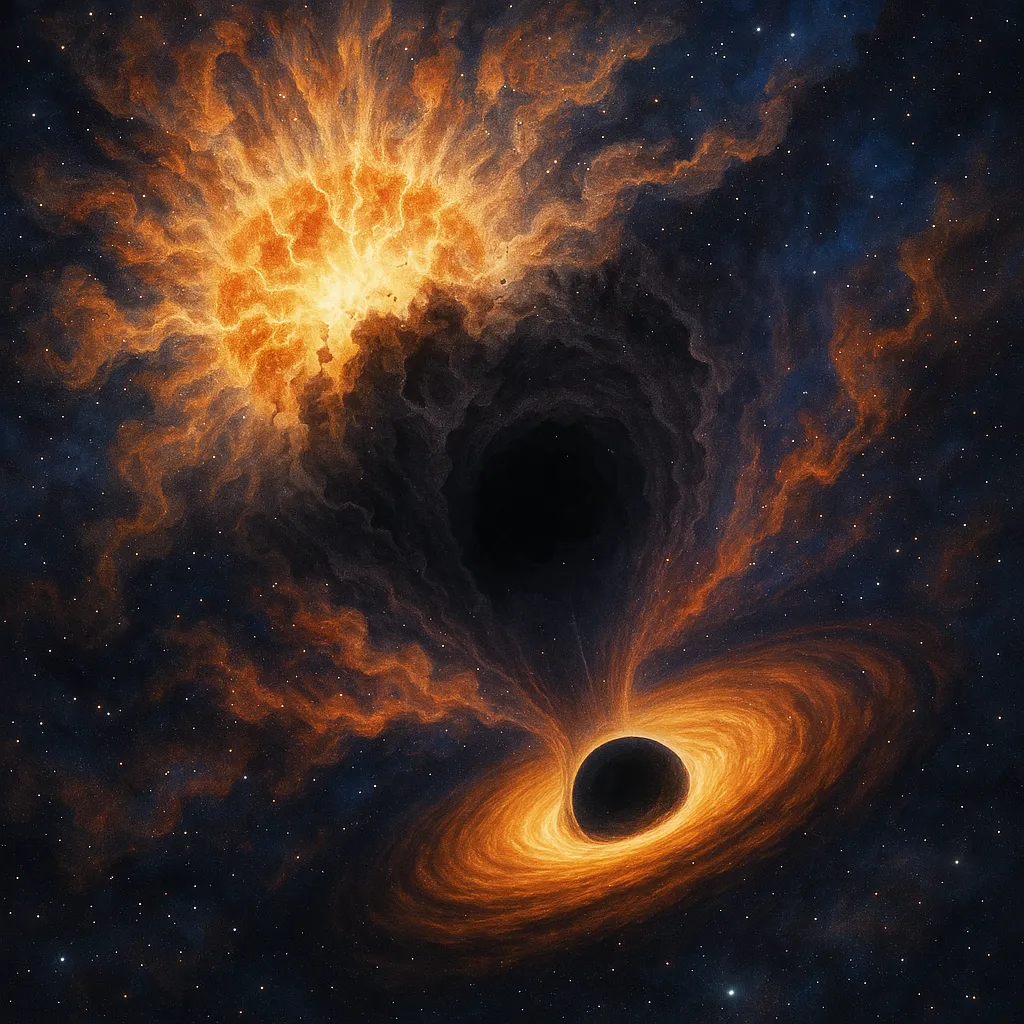
Supernova explosion, the final stage in the life of a massive star that collapses to form a black hole.
Black holes are one of the most mysterious and extreme objects in the universe. A black hole is not a literal hole, but rather a region in space where gravity is so incredibly strong that nothing, not even light, can escape. This intense gravitational pull is a result of a massive amount of matter being squeezed into an extremely small space. The boundary around a black hole beyond which escape is impossible is called the event horizon. While we cannot see a black hole directly because it absorbs all light, its presence is inferred by observing its powerful effects on surrounding stars and gas.
The most common way for a black hole to form is from the death of a very large star, a process known as stellar collapse. Throughout its life, a star generates energy through nuclear fusion, converting lighter elements like hydrogen into heavier ones. This fusion process creates an outward pressure that perfectly balances the inward pull of gravity. When a massive star, one that is at least ten times the mass of our Sun, runs out of fuel, the fusion process stops. The outward pressure disappears, and gravity takes over, causing the star's core to collapse in on itself at incredible speeds.
This rapid collapse triggers a cataclysmic explosion called a supernova, which blasts the star's outer layers into space. What remains is a super-dense core. If this leftover core is more than three times the mass of our Sun, gravity is so strong that it overcomes all other forces, continuing to compress the matter into an infinitesimally small point called a singularity. This singularity is the heart of the newly formed black hole. The size of the event horizon is directly proportional to the mass of the black hole. The more massive the black hole, the larger its event horizon.
The existence of black holes is supported by Albert Einstein’s theory of general relativity, which describes how mass warps space-time. A black hole’s immense gravity warps space-time so severely that it creates a one-way trip, pulling everything toward the singularity. After formation, black holes can continue to grow by absorbing gas, dust, and even other stars.
Fun Fact: If the Sun were to suddenly become a black hole, its gravity would be the same, and Earth would continue to orbit it just as it does now, though our planet would be plunged into total darkness.
What is the definition of a black hole?
A physical hole in spaceA region where gravity is extremely strongA star that has run out of fuelA type of planet with no light
What is the boundary around a black hole called?
The stellar collapseThe singularityThe event horizonThe supernova
What process provides the outward pressure that balances gravity in a star's life?
According to the passage, what type of star can become a black hole?
A star smaller than our SunA star at least ten times the mass of our SunA star with no nuclear fusionA star with an event horizon
What event occurs after a massive star's core collapses?
A supernova explosionThe star becomes a white dwarfThe star's gravity disappearsThe star's outer layers shrink
Why can we not see a black hole directly?
It is too far away.It is hidden behind stars.Its gravity prevents light from escaping.It is made of dark matter.
Which statement best summarizes the main idea of the passage?
Black holes are dangerous objects that destroy everything.Supernovas are the most important part of a star's life cycle.Black holes are formed from the gravitational collapse of massive stars.Albert Einstein discovered the existence of black holes.
If a star's core after a supernova is less than three times the mass of our Sun, what is a likely outcome, based on the passage?
It will become a black hole.It will explode again in a hypernova.It will form a different, very dense object.Its gravity will be too weak to form anything.
Who it's for
Perfect for the way you teach
Teachers
Build comprehension skills
Auto-graded quiz
Differentiated reading
Parents
Read together at home
Improve fluency
Quiet reading time
Homeschoolers
Reading curriculum support
Independent practice
Track Lexile growth
Topics
black holeblack hole formationstellar collapsesupernovaevent horizonsingularityNGSSmiddle school science
Reviews & Ratings
No reviews yet. Be the first to share your experience!
More reading you might love
20 more
Earth: Our Home in Space
This engaging Grade 4-5 science passage, aligned to NGSS, introduces students to Earth's special place in the solar syst...
What Is Space Weather and How Does It Affect the Earth?
This NGSS-aligned science passage for middle school explains what space weather is and how it affects Earth. Students le...
MS-ESS2-2
Space Stations
This informational science reading passage for grades 6-8 explores the complex systems and technology behind space stati...
MS-ESS1-3MS-ETS1-1
Tools and Technology in Earth Science
This middle school science reading passage explores the wide range of tools and technologies used in Earth science, from...
MS-ESS2-2MS-ESS3-2MS-ETS1-1MS-PS4-3
Escape Velocity and Space Travel
This middle school science passage introduces students to the concept of escape velocity—the minimum speed required to b...
MS-ESS1-2MS-PS2-4
Exploring Space: Rockets and Spacecraft
Space exploration has been one of humanity's greatest achievements, made possible by rockets and spacecraft. Rockets act...
RI.4.4RI.4.2
International Space Station
Discover the wonders of the International Space Station with this informative coloring page showcasing the orbiting outpost where astronauts live and work in space. As children color the complex modul...
The Space Garden
This innovative passage combines plant science with space exploration, aligning with NGSS standards for life sciences an...
RL.3.1RL.2.1RL.4.9
The Space Needle
Students read a passage about the history and features of Seattle's Space Needle, then answer comprehension questions to...
RI.4.2
What Is Earth Science?
This engaging middle school science passage introduces students to the field of Earth science, aligning with NGSS standa...
MS-ESS1MS-ESS2MS-ESS3SEP
Scientific Inquiry in Earth Science
This passage explores scientific inquiry in Earth science for grades 6-8, aligned with NGSS standards MS-ESS1-4, MS-ESS2...
MS-ESS1-4MS-ESS2-1MS-ESS3-5SEP
How Satellites Help Scientists Study Earth From Space
This comprehensive 650-word reading passage aligned with NGSS standard MS-ESS2-1 explains how Earth-orbiting satellites ...
MS-ESS2-1
I Spy Outer Space
To reinforce their numeracy skills, the worksheet provides dedicated spaces where children can write the corresponding n...
K.CC.4K.CC.5K.CC.6
How Earth Science Fields Work Together
This engaging 650-word informational passage explores how the four branches of Earth science—geology, oceanography, mete...
MS-ESS2-1
How Earth Science Shapes Our World
This comprehensive 600-word reading passage introduces middle school students to Earth science and its practical applica...
MS-ESS3-1
What Is the Science of Astronomy
This comprehensive reading passage introduces middle school students to the field of astronomy and its importance in und...
MS-ESS1-1
Measuring Distances in Space
This middle school science passage explores how astronomers measure the vast distances in space, aligning with NGSS stan...
MS-ESS1-3
Life on the Space Station
This 450-word informational science passage for grades 6-8 explores how astronauts live aboard the International Space S...
MS-ESS1-1
The Space Food Lab
This engaging passage explores the fascinating world of space food technology, aligning with NGSS standards for engineer...
RL.3.1RL.2.1RL.4.7
How Earth Systems Show Repeating Patterns
This comprehensive 650-word reading passage introduces middle school students to the concept of patterns in Earth system...