Our Solar System - Introduction — Reading Comprehension
Rate this
Premium Resource
Present
Present in classroom. No work saved
Assign
Classroom with student accounts, Track progress
Quick Play
No student accounts, assign with a link
Grades
3
4
5
6
PRINT+DIGITAL RESOURCE
This learning resource is available in interactive and printable formats. The interactive worksheet can be played online and assigned to students. The Printable PDF version can be downloaded and printed for completion by hand.
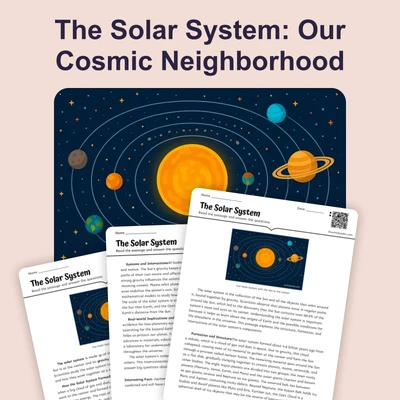
This engaging passage introduces Grade 4-5 students to our solar system, following NGSS science standards. Students will explore the sun, planets, and other objects in space, learning about key scientific concepts such as gravity, orbits, and the differences between planets. The passage highlights important vocabulary with clear definitions and includes real-world connections to how we study space. Activities include a multiple-choice comprehension quiz and writing prompts that encourage deeper thinking about the solar system, scientific processes, and real-life applications. An audio-integrated format ensures accessibility for all learners. This resource is ideal for classroom or home use, helping students build a strong foundation in general science and astronomy.
CONTENT PREVIEW
Expand content preview
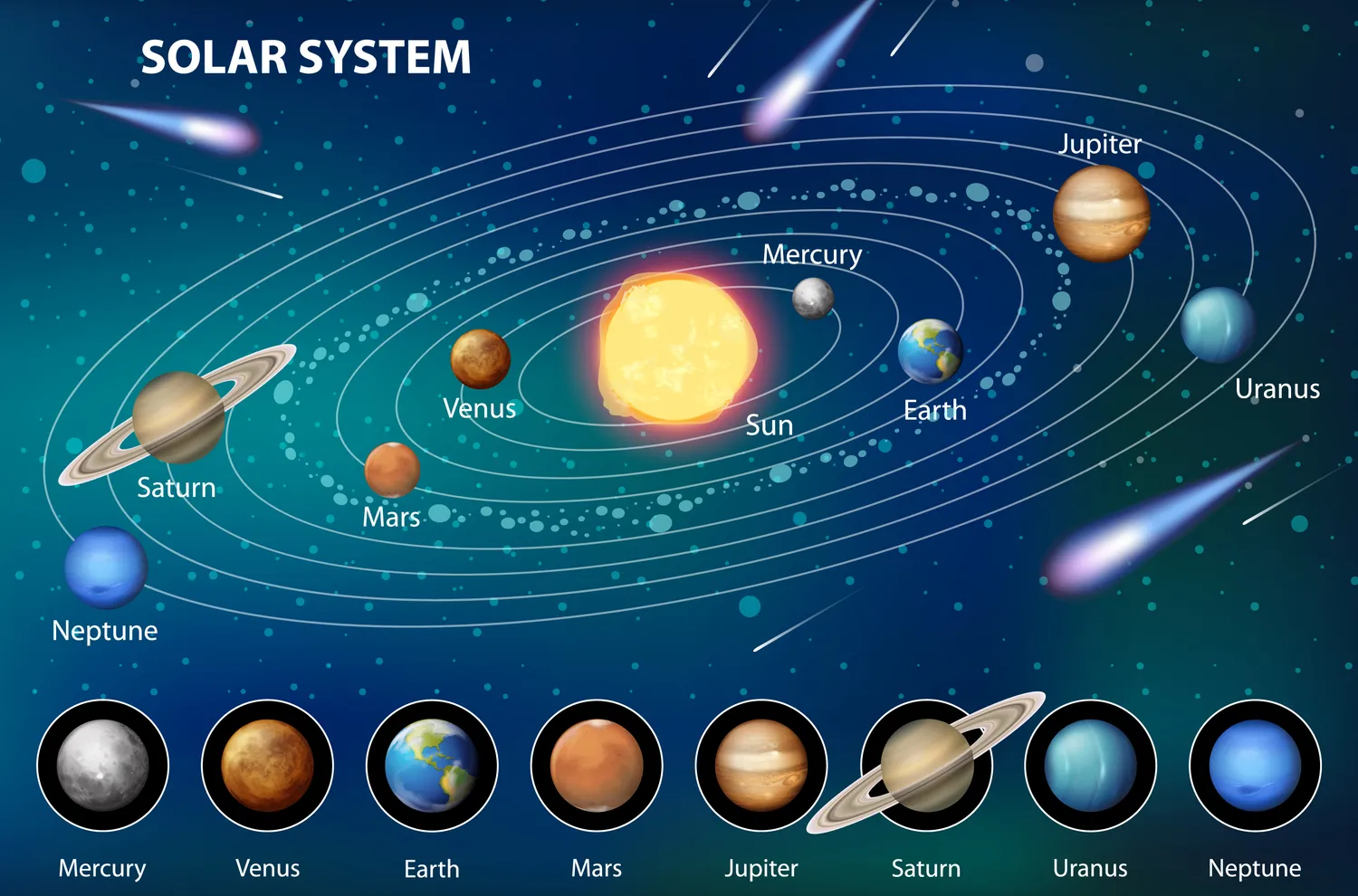
Each planet is different, but all travel in a path called an orbit around the sun.
The solar system is made up of the sun and everything that orbits, or moves around, it. Our solar system has eight main planets: Mercury, Venus, Earth, Mars, Jupiter, Saturn, Uranus, and Neptune. Each planet is different, but all travel in a path called an orbit around the sun.
The sun is a huge star at the center of our solar system. It gives us light and heat, which are very important for life on Earth. The sun's gravity keeps all the planets, moons, and other space objects, like asteroids and comets, moving in their orbits. Gravity is a force that pulls things toward each other. Without gravity, the planets would not stay close to the sun.
Some planets are made mostly of rock, like Earth, Mars, Mercury, and Venus. These are called rocky planets. Others, like Jupiter and Saturn, are much bigger and made mostly of gas. These are called gas giants. Each planet has its own special features. For example, Saturn has beautiful rings made of ice and rock.
Our planet Earth is the only place we know of where life exists. Scientists use special telescopes and space probes to learn more about the other planets and objects in our solar system. These tools help us discover new things and understand how our solar system works.
There are also smaller objects in the solar system, such as asteroids, moons, and comets. Asteroids are made of rock and metal. Moons are natural objects that orbit planets. Comets are icy objects that sometimes have bright tails when they get close to the sun.
Interesting Fact: A day on Jupiter is only about 10 hours long, much shorter than a day on Earth!
What is at the center of the solar system?
The sunEarthJupiterThe moon
How many main planets are there?
FourSixEightTen
What keeps planets in orbit?
WindSunlightGravityRain
What are gas giants mostly made of?
RockGasIceMetal
Which planet has beautiful rings?
MarsEarthSaturnMercury
Why do scientists use space probes?
To learn about planetsTo build rocketsTo make planets biggerTo heat planets
A day on Jupiter is 10 hours long.
TrueFalse
What does 'orbit' mean?
Spin in placeMove in a path around somethingGlow in the darkStay still
Perfect For:
👩🏫 Teachers
• Reading comprehension practice
• Auto-graded assessments
• Literacy skill development
👨👩👧👦 Parents
• Reading practice at home
• Comprehension improvement
• Educational reading time
🏠 Homeschoolers
• Reading curriculum support
• Independent reading practice
• Progress monitoring
Reading Features:
📖
Reading Passage
Engaging fiction or nonfiction text
❓
Comprehension Quiz
Auto-graded questions
📊
Instant Feedback
Immediate results and scoring
📄
Printable Version
Download for offline reading
🔊
Read Aloud
Voice-over with word highlighting
Reviews & Ratings
No reviews yet. Be the first to share your experience!
Related Content
Earth: Our Home in Space
This engaging Grade 4-5 science passage, aligned to NGSS, introduces students to Earth's special place in the solar syst...
Tools and Technology in Earth Science
This middle school science reading passage explores the wide range of tools and technologies used in Earth science, from...
MS-ESS2-2MS-ESS3-2MS-ETS1-1MS-PS4-3
Earth's Place in the Universe
This reading passage explains Earth's place in the universe, supporting NGSS 1-ESS1-1. It describes how Earth is one of ...
1-ESS1-1
Scientific Inquiry in Earth Science
This passage explores scientific inquiry in Earth science for grades 6-8, aligned with NGSS standards MS-ESS1-4, MS-ESS2...
MS-ESS1-4MS-ESS2-1MS-ESS3-5SEP
What Is Space Weather and How Does It Affect the Earth?
This NGSS-aligned science passage for middle school explains what space weather is and how it affects Earth. Students le...
MS-ESS2-2
Escape Velocity and Space Travel
This middle school science passage introduces students to the concept of escape velocity—the minimum speed required to b...
MS-ESS1-2MS-PS2-4
Space Stations
This informational science reading passage for grades 6-8 explores the complex systems and technology behind space stati...
MS-ESS1-3MS-ETS1-1
What Is Earth Science?
This engaging middle school science passage introduces students to the field of Earth science, aligning with NGSS standa...
MS-ESS1MS-ESS2MS-ESS3SEP
The Space Garden
This innovative passage combines plant science with space exploration, aligning with NGSS standards for life sciences an...
RL.3.1RL.2.1RL.4.9
Measuring Distances in Space
This middle school science passage explores how astronomers measure the vast distances in space, aligning with NGSS stan...
MS-ESS1-3
Earth: Our Home Planet
This comprehensive science passage for grades 6-8 explores Earth’s unique characteristics and the interconnected systems...
MS-ESS1-2
Meteorite Impacts on Earth
This engaging science reading passage for Grades 4-5 explores meteorite impacts on Earth, aligning with NGSS standards. ...
Exploring Space: Rockets and Spacecraft
Space exploration has been one of humanity's greatest achievements, made possible by rockets and spacecraft. Rockets act...
RI.4.4RI.4.2
Earth's Rotation
This middle school science passage, aligned with NGSS standard MS-ESS1-1, focuses on Earth's rotation—how Earth spins on...
MS-ESS1-1
Facts About Earth
This engaging science reading passage introduces Grade 4 and 5 students to Earth, our home planet. Aligned with NGSS sta...
International Space Station
Discover the wonders of the International Space Station with this informative coloring page showcasing the orbiting outpost where astronauts live and work in space. As children color the complex modul...
Earth's Moon Facts
This engaging science passage, 'The Moon: Earth's Companion,' is designed for Grade 4-5 students and aligns with NGSS ge...
The Space Needle
Students read a passage about the history and features of Seattle's Space Needle, then answer comprehension questions to...
RI.4.2
Earth's Seasons
This comprehensive reading passage for grades 6-8 explains why Earth has seasons, revealing the scientific mechanisms be...
MS-ESS1-1
Venus: Earth's Twin?
This comprehensive science passage for grades 6-8 examines Venus—often called Earth's twin—by exploring its similarities...