What Are Tipping Points in Climate Systems?
Interactive passage with audio narration, comprehension questions, and printable PDF.
By completing this purchase you agree to our Terms of Use and Privacy Policy. Your subscription renews automatically until you cancel. You can cancel anytime from your account settings. All sales are final and non-refundable. Digital content is available for download in your account immediately upon purchase.
What's included
What Are Tipping Points in Climate Systems? preview and details
About this printable What Are Tipping Points in Climate Systems? science reading passage, NGSS-aligned (Grades 6-8)
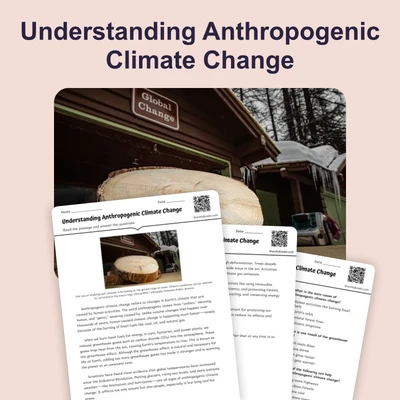
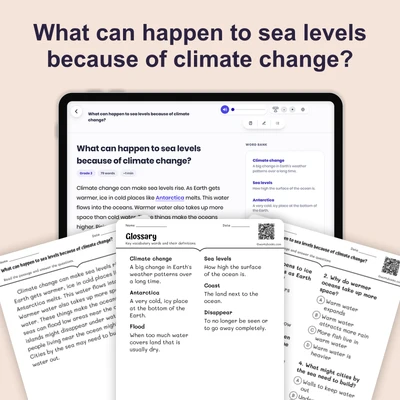
Sample passage and quiz from What Are Tipping Points in Climate Systems?
Reading passage and comprehension quiz preview
What Are Climate Tipping Points?
Climate tipping points are critical thresholds in Earth's climate system. When these thresholds are crossed, small changes can trigger large transformations that are difficult to reverse. Scientists compare tipping points to a chair tilting slowly backward. The chair stays balanced until it reaches a certain angle, then suddenly it falls. This simple comparison helps explain how climate systems can shift dramatically once they pass a specific point.
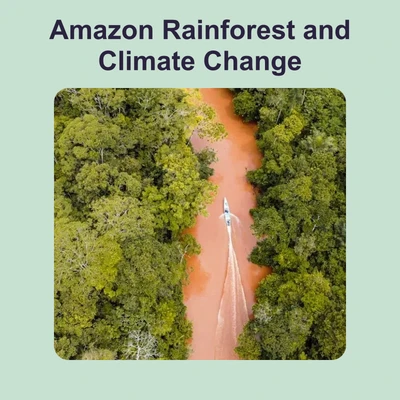
A tipping point occurs when part of Earth's climate crosses a threshold that leads to major change. Evidence shows that several parts of our climate system have these dangerous thresholds. Ice sheets in Greenland and Antarctica may reach a point where melting becomes unstoppable, even if temperatures stop rising. The Amazon rainforest could dry out and transform into grassland if deforestation and warming continue. Ocean currents that move heat around the planet may weaken or shut down entirely. Each of these changes would dramatically affect global climate patterns.
What makes tipping points especially concerning is the role of feedback loops. A feedback loop occurs when a change causes effects that speed up the original change. When ice melts, it exposes darker ocean water or land beneath. Dark surfaces absorb more heat than white ice, which causes more warming and more melting. This cycle can continue on its own, even without additional human activity. Scientists call this a positive feedback because it reinforces the change, though the results are negative for climate stability.
Scientists observe tipping points carefully because they may not be reversible. If we cool the planet later, a tipped system might not return to its original state. The West Antarctic Ice Sheet provides a real-world example. Research indicates this ice sheet sits on bedrock below sea level. Once enough ice melts, warm ocean water can flow underneath and accelerate melting from below. Scientists estimate this process may already be underway and could raise sea levels by several meters over centuries.
Understanding tipping points matters because they add urgency to climate action. Scientists cannot pinpoint exactly where these thresholds lie in every system. This uncertainty means we might cross a tipping point before recognizing the danger. By limiting warming now, we reduce the risk of triggering changes that could reshape Earth's climate for thousands of years. Evidence shows that preventing tipping points protects both natural ecosystems and human communities from rapid, difficult changes.
Interesting Fact: Scientists have identified at least nine major climate tipping points that could activate within the next few decades if warming continues. Some may trigger others, creating a domino effect of climate changes.
Comprehension quiz (10 questions)
1. What is a climate tipping point?
2. Which analogy do scientists use to explain tipping points?
3. What does the term 'feedback loop' mean in the context of climate?
4. According to the passage, what happens when ice melts and exposes darker surfaces?
5. Why is the West Antarctic Ice Sheet particularly vulnerable to tipping point collapse?
6. What makes tipping points especially worrying to scientists?
7. Which of the following is NOT mentioned as an example of a climate tipping point?
8. Why is it difficult for scientists to prevent tipping points?
9. True or False: If we cool the planet after crossing a tipping point, the climate system will always return to its original state.
10. True or False: Scientists have identified at least nine major climate tipping points that could activate in the coming decades.
Perfect for the way you teach
- Build comprehension skills
- Auto-graded quiz
- Differentiated reading
- Read together at home
- Improve fluency
- Quiet reading time
- Reading curriculum support
- Independent practice
- Track Lexile growth